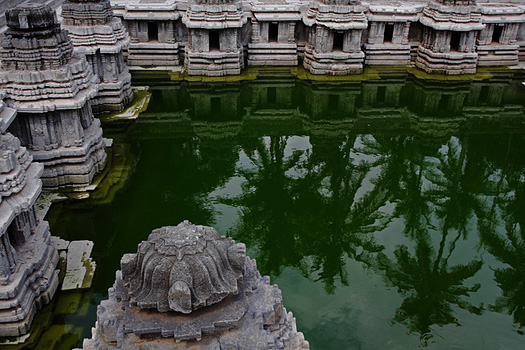
Badami – I
Who would think of the small town of Badami to be an ideal place to establish a kingdom and rule most of the peninsula? Chalukya Kings did, and they thought so more than 1,500 years ago. They constructed a large tank in a depression surrounded by sandstone cliffs in three sides, carved a few temples in those cliffs, built some more temples on the top and established the center of a dynasty that ruled for 600 years to control most of the land between Narmada and Kaveri.
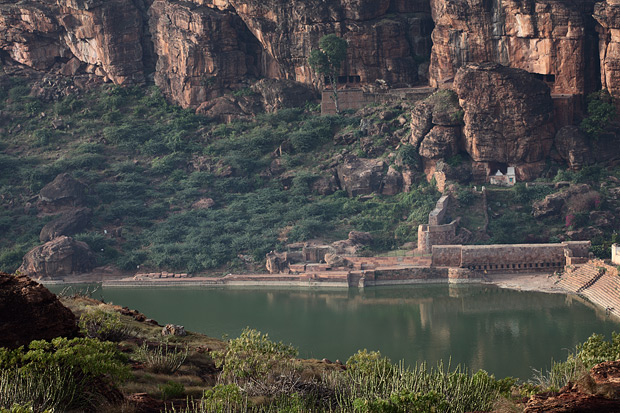
If recorded history of Badami is interesting, the associated legend is fascinating. On his journey south of Vindhyas, Sage Agastya was invited by demon Ilvala for a meal. Ilvala and his brother Vatapi called guests home and killed them in the most innovative possible way. Vatapi would turn into a ram while Ilvala would cook the ram’s meat and offer it to the guests. Once eaten, Vatapi would come out splitting the stomach of the guest, thus killing him.
But when it comes to legends, sages are always smarter than demons. Agastya knew the whole plan and digested Vatapi before he could come out, putting an end to the evils of the pair. The two cliffs around the lake in Badami are believed to be the two dead demons who were defeated by Sage Agastya.
The legend would have brought some aura to the town, but it is the remains of history that brings in bus loads of tourists today. My bus took me here on a relatively dry monsoon day, taking me through the vast plains of North Karnataka. Later half of my journey was largely sleepless, thanks to roadhumps that defied the logic of having a road at all. Beyond the stout hills past Hospet where river Tungabhadra overflowed and glittered in the moonlight, it was a perfectly flat terrain hosting groundnut fields, free of even slightest aberration anywhere in my field of vision. Arrival of Badami was marked by a change in landscape as the moonlight over the plains gave way to sun shining on vertical cliffs of red sandstone.
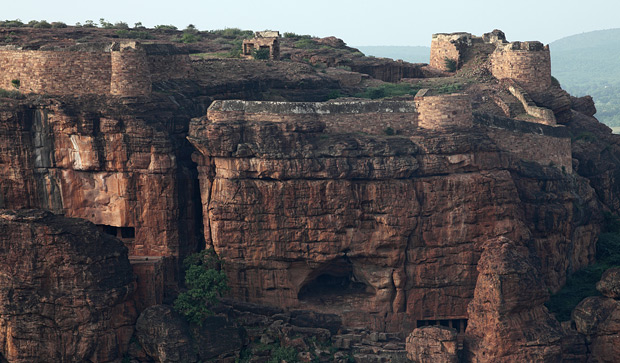
This was my second visit to Badami. I was here two years ago in a winter when the sky was blue and air was dry. But having seen tourist brochures of foaming water rushing down the red cliffs, I wanted to be here when it rained, when the vertical rock faces were wet and dripping. This time I had arrived in in the middle of the monsoon season and the sky stayed overcast through the four days I spent in the town. But rain gods remained unwilling to let down even a drop of water from those heavy clouds. Save for a gentle drizzle or two that gave me some hope, the weather remained dry and dusty. A few months after my visit, the clouds would descend with such a fury in and around the town that thousands of people were rendered homeless and that year’s effort in the groundnut fields were washed away by the raging floods.
How much ever I would have preferred to see it raining, it did not disappoint me to an extent that I would get out soon. I spent next four days walking around the tank, exploring the cliffs and the table land above them, visiting the villages nearby and a few curious rock structures near the town.