I was in Bhutan last month photographing its cultural heritage and the lives of its people. During the fourth day of my week-long trip, I had a chance to visit a small village surrounded by paddy fields in a wide mountain valley. Walking through the fields and enjoying the salubrious mountain weather, I struck conversation with the women working in the fields with an intent to understand the work they were doing and also make photographs in the process.
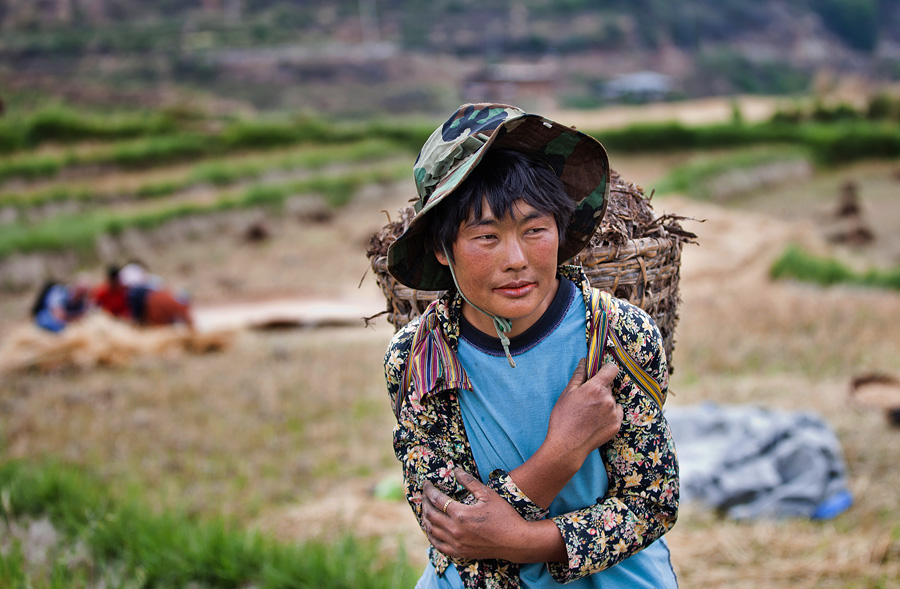
The month of May is a transition period between harvesting and sowing new crop. There were sections of the fields where a full-grown crop was waiting to be harvested, and at some places, they were already taking the winnowed crop home. The women I spoke to were a step further ahead preparing for the next season, spreading manure in the soil before the upcoming monsoons allowed them to plant fresh saplings. They were friendly, and were more than willing to be photographed, except that they posed a condition: I must give them prints of the photos that I made. I gladly agreed and we were on a roll.
If I have to think of brilliant view of a long line of Snow Peaks in the Himalayas, Dochula Pass in Bhutan quickly comes to mind.
Also see: my upcoming photography tour to Bhutan
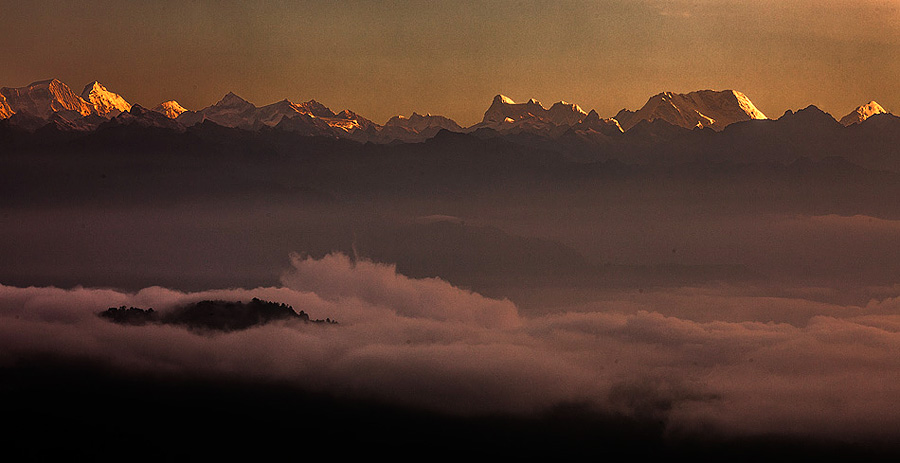
Sunrise from Dochula Pass, Bhutan
At ten thousand feet, DochuLa is not really high by Himalayan standards. But it is a good enough altitude to get clean air and a clear view of high mountains that are as far away as a hundred kilometers. On the horizon towards north-east from DochuLa is a long line of white summits on exhibit. The peaks include the who’s who of Bhutan’s mountain landscapes, Gangkar Puensum topping the altitude graph among them all. At 7,570 meters, Gangkar Puensum is also the world’s highest unclimbed peak today, primarily because sanctity of the peak makes it off-limits to mountaineers.
In October 2013, I fell down from a pagoda in Bagan, Myanmar, and dislocated a wrist bone in the right hand. The problem could not be diagnosed in Nyang U (Bagan) and I had to fly back home for a surgery. It took me a three-hop journey on three different airlines to get home. Subsequently, recuperating from a surgery and permitted by my doctor to travel, I took eight more flights in a span of two months when my hand was still in a sling or wrapped in a splint.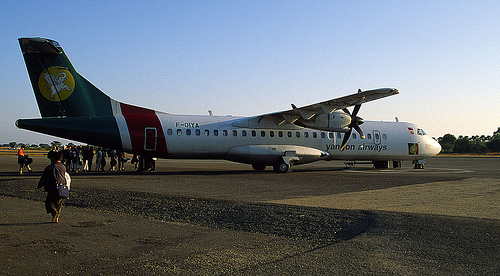
With a total of eleven hops using six different airlines, I had a chance to see how different airlines treat passengers with special needs. I was surprised at the sea difference in their treatment, sometimes even among the staff of same airline in different airports.
During all these journeys, I never requested for wheel chairs or special assistance, as my left hand was intact and I was able to handle my baggage, albeit with some difficulty. In some occasions, airline staff came forward to help me when they noticed my hand in a sling. Most airlines were neutral and in the only instance when I requested for some privilege, I was turned down.
Here is a compilation of my experiences taking eleven flights with six airlines.
The Best – Yangon Airways at Nyang U (Bagan) Airport
It is five months since I took a Yangon Airways flight from Nyang U (Bagan) to Mandalay and I still can’t forget how friendly the staff were. On arrival at airport, my cab driver waved at an airline staff at the gates and asked him to help me. One look at my injured hand (and many cuts on my face as well) and he understood I can do with some help. He sprung into the cab, lifted my bags out and placed them on a trolley. When I stretched my left hand (the uninjured hand) to push the trolley, he refused to hand it over and escorted me to the check-in counter.