I went to Alchi Monastery looking for the ancient paintings of a distinct style that sets it apart from other religious centers in Ladakh. Trees laden with apricots and the swift flowing Indus River were an added bonus.
My bus passed through lush green oasis of saspol village on its way to Alchi. After two hours on the road west of Leh along the Indus River, the bare mountainscape temporarily made way for a relatively flat terrain teeming with apricots and apples amidst barley fields. The apricots trees with numerous fruits looked more yellow than green. Apple trees were irresistibly red.
Just across the river, Alchi Village has one of the oldest standing structures anywhere in Ladakh. The Alchi choskor or the ‘religious enclave’ is dated approximately to eleventh century and has an architecture very unlike other monasteries in the region. It was abandoned as a place of worship and remained unknown to rest of the world, till historians unearthed the treasured paintings in the choskor only a few decades ago. On hindsight, its desertion seems to have worked well in its preservation. The monastery escaped destruction from Kashmiri invaders four centuries years ago as much as it escaped renovation and restoration from the Ladakhi monks.
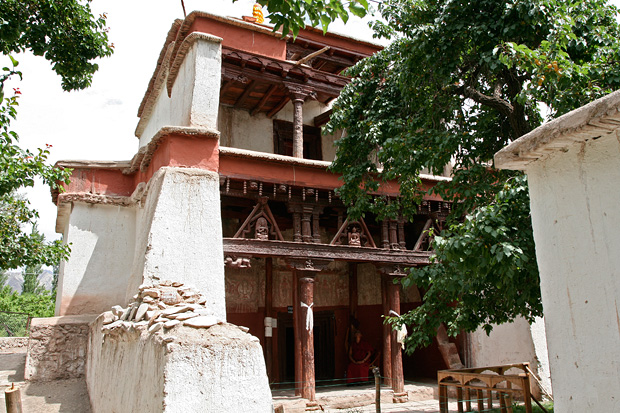
Sum Tsek at Alchi Monastery
Walking past the small village and along a narrow path on the banks of Indus, I entered the monastery that wore a deserted look. It did not have the usual buzz of playful kid-monks running along the corridor chasing each other or the smiling elderly lamas in ochre robes walking slowly as they chanted some mantra. Also missing were the randomly built living quarters that usually spread around the prayer hall, the quadrangle where the festivals are held and the colourful paintings on the front walls. The choskor looked more like a bunch of randomly built houses with a few apricot trees surrounding them.
The drab exteriors though, are a contrast to the colourful inner walls. Once inside, I see every inch of the wall covered with small paintings. The sum-tsek—the main temple in Alchi—is a three story building with colourful paintings in its inner walls. It takes some time to get used to the interiors kept dark to preserve the paintings. The colours start coming alive as the eyes slowly get accustomed to the darkness. The walls are covered from end to end with thousands of small colourful images of Buddha. At the center of three inner walls are three-story high statues of incarnations of Buddha—Avalokiteshwara, Maitreya and Manjushree. The upper half of the Buddha statues are not visible from below, as they stand above the first floor where the weakening structure doesn’t permit access.
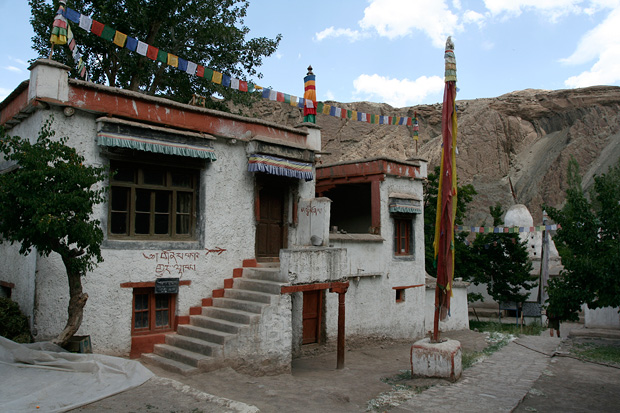
A section of the monastery
At the neighbouring prayer hall are equally colourful but a diverse variety of paintings that include a sailing ship, people wearing clothes that look Central Asian and other secular images that are evidently not Ladakhi. The paintings in Alchi vary considerably from other monasteries influenced by Tibetan culture and its animist origins. It doesn’t carry the extraordinary characters and stylization with demonic and unearthly features commonly seen on the walls of most other monasteries. On the contrary, they are said to bear resemblance to Buddhist paintings from the Indian plains, indicating that Alchi was perhaps built in a time when a wave of Buddhist preachings spread into Ladakh from Kashmir and North India. Historians often refer to this as ‘second spreading of Buddhism’ against the first arrival of the religion in Ladakh from Tibet. Among the Himalayan Buddhist centers, only other surviving monastery with paintings similar to Alchi are found in Tabo Village in Lahaul and Spiti. Both monasteries are now in the tentative list of UNESCO World Heritage sites.
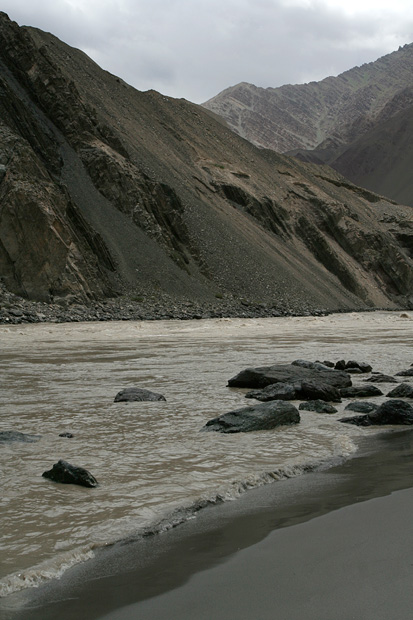
Just outside the monastery, Indus River flows swiftly in a depression carved by its currents. I walked down to the river bank and spent some time watching its fast flowing muddy current before making my way back to Leh in the evening.
Information
The Alchi choskor complex has five buildings. The sum-stek or the three story temple has three-story high statues of Avalokiteshwara, Maitreya and Manjushree, with its walls painted with thousands of small Buddhas. The dukhang or the main prayer hall is larger with two sections and has many secular and religious paintings. The Manjushri Lhakhang, Lotsawa Lhakhang and Lhakhang Soma are the smaller temples.
Alchi Monastery is known for the historical value and uniqueness of the paintings. It is no longer in use as a religious place, though it is maintained and managed by the monks of nearby Likir Monastery.
How to reach. Alchi is 65km from Leh downstream Indus. Most tourists hire a cab to get there, though Alchi is well connected by public transport from Leh (about 3 hours). If you are taking a bus from Leh, it is better to be informed about the timings beforehand. Ask your hosts in Leh or check at the bus-stand a day before.
Food and Accommodation. If you are on a day-trip from Leh, Alchi Village has a few restaurants just outside the monastery. In front of the the choskor is a place run by Likir Monastery, where food and accommodation is available. There are a few more guesthouses and hotels available in Alchi for those who would like to stay at the village.
Map and driving directions.
View Leh to Alchi in a larger map
This post turned out way longer than I expected! 🙂
Sometimes your impulse leads you to interesting things. Driving past Devarayanadurga about ten days ago, we saw a sign that read ‘Madhugiri’ and raced in that direction. In the next four hours, we went through some indecisive moments about climbing up steep slippery slopes, encountered surprises mid-way up the hill and eyed on beautiful landscapes from the top.
Looking up from the base of the hill, Madhugiri Fort looks like a maze of randomly built series of strong walls on the slopes. “30 to 45 minutes to go up,” we told ourselves as we looked at the last fort wall high on the peak. Adding another 20 minutes to get back and another 10 to gallivant on the top, we expected to be back in less than an hour and a quarter. It was 12.30pm, which means we could be back before 2pm and then look for a place in town to have lunch.
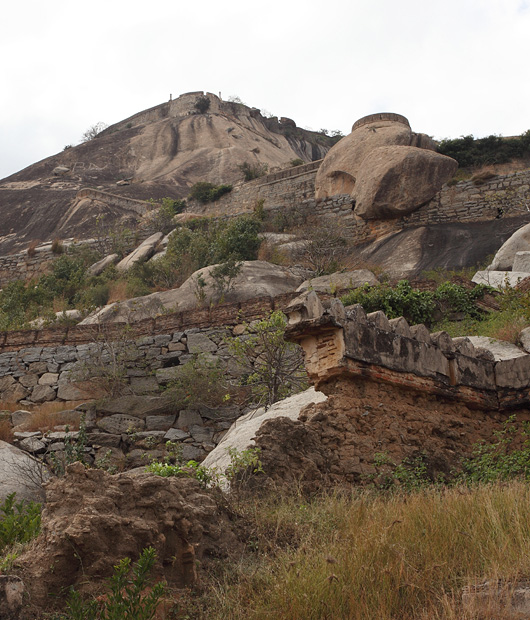
A section of Madhugiri Fort
We climbed slow and easy, pausing at a bastion that offered vista of the town, observing a waterway that filled up a tank in the fort and trying to make sense of some constructions that looked like store houses and dwelling for the soldiers. We went up through grassy slopes in the first five minutes and soon found us going up on steep rocky surface with nothing more than small etchings that served as supporting footsteps. The climb wasn’t exactly a skilled and adventurous activity, but we were occasionally forced to crawl up through slippery sections. My hesitant partners decided to stop just before the last visible wall, their unwillingness to go further amplified by a returning visitor who said ‘there is nothing up there.’
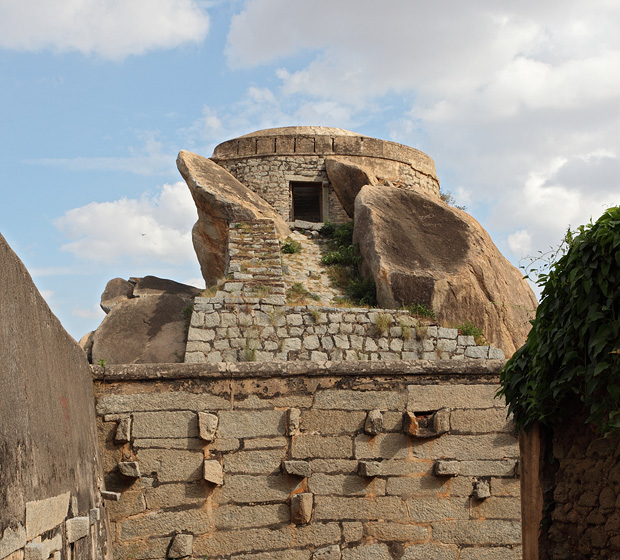
A fort bastion
I can never trust people who tend to see ‘nothing’. I have seen people traveling through some of the finest landscapes in the Indian plains and exclaiming that ‘there is nothing out there’. On a safari jeep deep in the heart of Corbett National Park where River Ramaganga meandered through thick sal forests, grasslands and beautiful foothills, I was appalled by a group of people who remarked with dissatisfaction that ‘all that this place has is forest, forest and more forest’. I have heard people being bored driving through mountains seeing ‘nothing’ but seeing ‘just mountains’. I have seen people unmoved by remarkable shows of nature and merely reducing it to ‘nothing’.
People tend to become blind to their surrounding when they do not see what they are anticipating. Perhaps this person was looking for a temple, an ordered construction, a spring, or if he is out of his mind – a shopping mall complete with glistening glass walls and the flashiest brands. As I was climbing up the slope, I was already becoming aware of the landscape around the fort, with hills dotting the surroundings and wide sprawl of lakes between them. Assisted by patches of clouds that blocked the sun, light and shadow alternated on the peaks, selectively highlighting some and subduing their neighbours.
I continued further up, past a steep section that required some careful climbing, arriving at the highest wall we saw so far. I anticipated a small plateau that would open up to the vistas of a range of hills on the other side, villages and lakes equally beautiful or perhaps even better. While our first surprise came in the form of the steep slopes that we encountered on the way up, the second one was something I was completely unprepared for. As I walked through the gates of the high wall, I saw the earlier invisible slopes that teased me and invited me to climb further. My already tired body looked up and groaned as I realized we had not even come half-way and were deceived by the walls that blocked our view to the highest point.
There I was, standing mid-way up the Madhugiri Fort, past lunchtime without a drop of water or an ounce of food, left to decide weather to go up or come down. It was a hot summer morning and there was every temptation to head down, but I was even more tempted by short glimpses of the tall hills that spread across the other side of the fort. My fellow travellers had already decided to head back and were waiting for me to return.
Lure of the mountains is always strong, however small the mountains are. It took me less than a minute to decide to continue up and another minute to motivate others. We were striding up soon, going up slopes that only seemed to get steeper and more troublesome. The fort is built in such a location that it would perhaps take even the strongest enemy all his energy and determination to push his way up the hill.
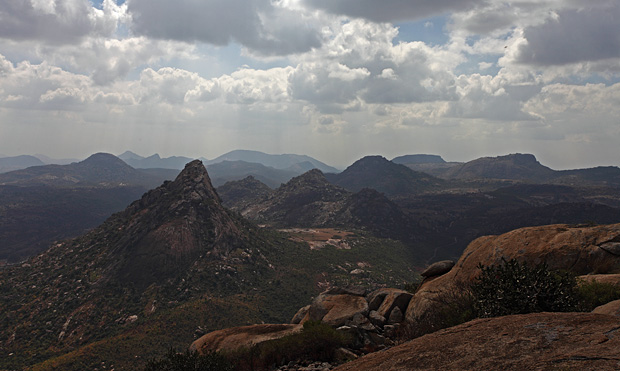
View from Madhugiri Fort
It must have taken us more than 2 hours to reach the top and go through the last of the fort wall—this time last one for real. Located on the top are shelter built of stone that could house a few hundred people, perhaps meant to house the soldiers who guarded the fort. Standing on the top of one of those shelters, I was blessed with the views that made up for the effort of the climb. A series of hills marked the western landscape, dominated by a narrow and rocky peak projecting nearly as high as my platform. A thin road bisected through the hills leading somewhere into their heart and beyond. The afternoon haze limited my views but the contour of the distant hills looked beautiful enough that I made a note to come back here again for an early morning visit.
Hunger and thirst drove us back and we descended down quickly in next 45 minutes, making our way for the nearest tender coconut vendor. It was about 4.30pm when we finally ordered our lunch that afternoon.
With the newly acquired respect for the fort, I came back home and looked up on the facts and history on Madhugiri (sources: wiki, business line, mouth shut). The hill is at an elevation of 3930 feet and is the second largest monolith in Asia. The first work on the fort dates back to Ganga Kings, while the walls remaining today are credited to a local chieftain named Heere Gowda, a feudal of the Vijayanagar Empire. Since the collapse of the empire, the fort was administered by Hyder Ali, Tipu Sultan and later by the Mysore Wodeyars. The fort is currently managed by Archaeological Survey of India.
Information.
Madhugiri Fort is approximately 110km from Bangalore. You can drive out to Tumkur on NH4, turn right and drive for another 40+ kilometers to reach Madhugiri (see map). Alternatively you can turn right at Dobbspet, about 20km after the toll gate at Nelamangala and take the road to Madhugiri. See the map below for precise driving directions.
It takes up to 2 hours to get to the top and an hour to get back. Sections of the climb are steep and can be difficult. Carry food and water, as there is nothing available on the way.
Below is the map of driving directions from Bangalore to Madhugiri.
View Bangalore to Madhugiri in a larger map
Here is another addition to the long list of weekend getaways from Bangalore.
We drove through some of the finest roads in the neighbourhood as the darkness made way for the first light of the dawn, on a not-so-chill winter morning last week. The obstacle-free NICE road and the toll highway to Tumkur let us clock the miles quickly and approach our destination earlier than expected.
The sun came out in his orange winter glow a little later than 6.30, when the air was still not warm and the body was still sleepy. I took shelter in the warmth of the car cabin and refused to join my fellow travellers—Srinidhi, Ravi and Santosh—in the rush to photographing the sun before his hues disappeared.
Further ahead, in Uradigere village just before the turn to our destination Devarayanadurga, a restaurateur had just started work on his grinding machine and could offer us nothing more than a cup of coffee. The road climbed up soon after, taking us through a forest surprisingly thick and beautiful for this terrain. The road meandered past a large rocky slope and a lake with its calm surface before arriving at Durgadahalli Village, above which was our destination.
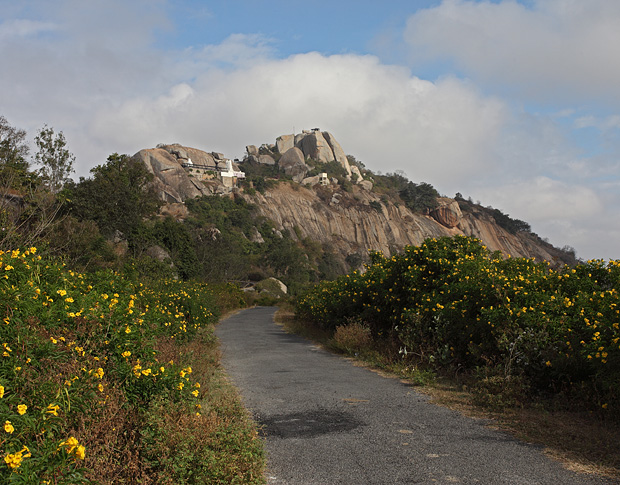
The approach to Devarayanadurga
Standing on the top of Devarayanadurga, nothing blocked my views all the way to the horizon as I looked at the villages on the plains to the east. The northern side of my view had a range of hills that tapered away gently into the plains. Lakes of various sizes glittered in the early morning sun all along the plains, standing out amidst the thin winter fog that hid the details of the landscapes. To the south, a sharp rocky peak jutted out in the hazy weather as the sun rays filtered through the fog and selectively brightened its half-dome-like peak, which attracted my eye with its unusually sharp summit pointing towards the sky.
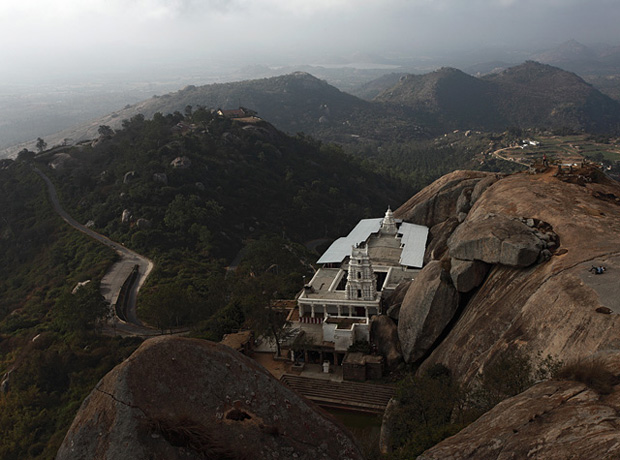
Lakshmi Narasimha Swamy Temple at Devarayanadurga
As one would expect to see anywhere on a high post all along the religious India, a temple stood below the peak of Devarayanadurga too, built on a narrow space just wide enough to accommodate its building. Wikipedia mentions of a history to the region that dates back to the Hoysala Kings and later to Vijayanagar empire, though the temple in its current form is attributed to the Wodeyars of Mysore. The sign at the temple indicated that the they open at 10am, but in the month preceding Sankranti, activity begins as early as 6am.
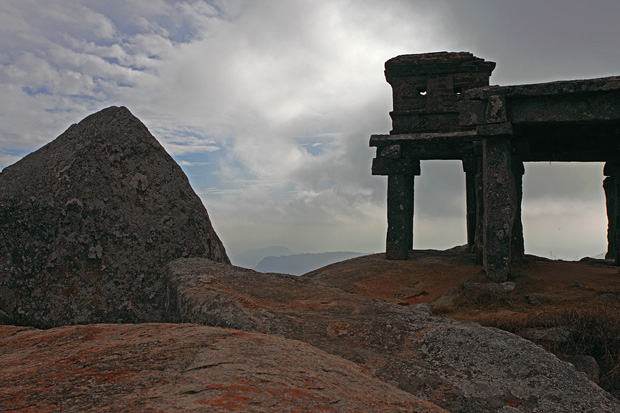
I sat on the rocky peak and let the strong breeze flow into me as I watched the world below appearing and disappearing with the drifting fog. As the day progressed and the sun gained strength, our stomach grumbled and complained of the missed breakfast, prompting us to head back to Uradigere.
Refulling with Thatte Idli served with a spicy chutney, we moved further to Namada Chilume, a sanctuary for deer in a vegetation surprisingly rich in this otherwise open terrain. Namada Chilume gets its name from a small perennial spring that trickles from a rock. The story goes that the spring was formed when Lord Rama in need of water shot an arrow into the rock. He needed drops of water to smear a nāma on his forehead, and hence the name Namada Chilume. In the adjacent sanctuary is a small fenced area that houses a group of spotted deer. A rocky aberration nearby hosts an ancient looking mantapa on a series of pillars, surrounded by thick vegetation that has begun shedding leaves for the winter. The surrounding hills and the nearby trees have a range of colours varying from green to yellow to a dark red, making up the best display of fall colours that you can see in the tropics.
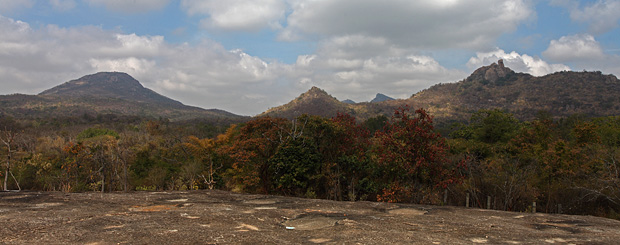
The vista from a rock near Namada Chilume
We proceeded further from Namada Chilume, circumventing Devarayanadurga whose tall peak stayed in our vision for most of our way. We had impulsively decided on our next destination as Madhugiri Fort, which had some surprises to offer us. More about Madhugiri Fort in another post.
Information
Devarayanadurga is a hill located approximately 90km from Bangalore. It can be easily done as a day-trip combined with a some of the other places nearby like Namada Chilume and Madhugiri Fort. The Lakshmi Narasimha Temple on the hill seems to be a popular place.
There are no restaurants at Devarayanadurga. If you are likely to be there at lunch time or planning to spend a lot of time, it is best to carry some food. A shop near the temple sells tender coconut, water bottles and some packaged foods like biscuits. About 15-minutes drive from Devarayanadurga is Uradigere village where you can get some basic food in small restaurants. There is no accommodation at the hill except for a forest department rest house. They might rent out the rooms, but it is recommended to check before you go.
There are two ways to get to Devarayanadurga. Head out on NH4 (Tumkur Road) from the city. After you drive for approximately 20km from the toll gate at Nelamangala, you will see a flyover at a place called Dobbspet. Go under the flyover and turn right and take the road leading to Devarayanadurga. There are no obvious signs indicating the arrival of Dobbspet or to provide directions to Devarayanadurga, so your best bet is to lookout for the flyover. After about 15km of driving, you will come to a junction in a village called Uradigere. Continue past Uradigere for about 250m where you see a left turn. Turn here and drive for another 15 minutes to reach Devarayanadurga.
Alternately, continue on NH4 till you exit through the toll gate near Tumkur. You need to turn right a little ahead (see map) and drive for another 20 minutes to reach Devarayanadurga. This road takes you through Namada Chilume.
Namada Chilume is a 10-minute drive from Devarayanadurga.
Below is the map and driving direction from Bangalore to Devarayanadurga
View Bangalore to Devarayanadurga in a larger map
View Bangalore to Devarayanadurga in a larger map