India Travel Blog reader Bala sent me an email and asked me a question about travelling with expensive equipment.
Love your work, regular reader of your Travel & Photography blog.Have a request, since you are prolific traveler and photographer would love to see a blog post on traveling with expensive camera gear in India. Kinda tips, suggestions & experiences.
I usually do carry expensive photography equipment with me during my journeys. My digital SLR costs a lot of money and so do my lenses. Since I spend a lot of time taking pictures of a variety of subjects from monuments to landscapes to birds, I tend to carry at least 2 lenses, sometimes more. If I am likely to stay at one place for a long time, I also pack my laptop, which allows me to work on the move. Together, they are expensive enough that I can’t afford not to be paranoid about loosing them. Yet, with photography being one of my greatest passions and my livelihood partially depending on it, I can’t imagine leaving home without them. Naturally I always keep an eye at my equipment and ensure that it never leaves my hand during the journey. Here is how I care for my camera gear when I travel.
By Bus. I often make overnight bus journeys if I am going somewhere within 8-12 hours distance from Bangalore. I can’t sleep in a bus, so I don’t really require maximum comfort. Instead of keeping my camera bag on the luggage rack above the seat or in the luggage box, I keep it on my lap through the journey. If I get down when the bus stops for a break, I necessarily carry the bag with me. At times when I have a lot of luggage, I split them into two bags and keep all the valuables in one bag which remains on my lap. My legs used to pain a bit after a few hours of keeping the (often heavy) bag on my lap, but now I am so used to it, I feel I am missing something without a bag on the lap.
By Train. Usually my train journeys last longer than a day. Although I have never experienced it myself, I presume theft in long distance trains is fairly common. Like in the bus journeys, I ensure that all my expensive equipment are in one bag and keep it with me all the time. Another risk in train comes during the night. When I drift into sleep at night, someone may flick the bag even if it is right next to me. If possible, I try to stuff the bottom of my bag with some cushioning material (a jacket, shawl or anything possible) and use it as a pillow. If not, I put my arm around a strap and let the bag lie next to me. Let me admit, I am very very paranoid about my luggage during train journeys.
By Air. There is not to much to worry about safety of equipment as long as it is not checked in. No one can steal your bag, open the doors and runaway with the booty! But it is important to take all the equipment in a carry-in baggage, so that they are not mishandled or stolen.
Safety in unknown places. Sometimes it may be a bad idea to walk alone in the middle of the night with a big and obviously expensive looking camera. It pays to ask for advice with your hotel owner, your guide or anyone you know and trust before you head out in an unknown location. I have probably not gone out alone in the night, but many times I find myself in deserted places early in the morning. But such places are usually remote, like a village in the middle of Himalayas, somewhere in a forest where we have camped or some such places where safety is not an issue. But I would be more careful if I were to plan shooting the streets of a city in the middle of the night. It may be a good idea if there are 2-3 people together in such occasions.
Get an Insurance. If your equipment is worth a lakh (Rs.100,000) or two, it would be prudent to spend another thousand rupees to get it insured. While my equipment are insured and I have known a few photographer friends who have done the same, I do not know of any one who has made a claim. If you know of anyone who has claimed insurance for theft or damages to photography equipment, do share the details in the comments. It doesn’t cost much to have them insured. I paid just Rs.800 per lakh for insuring my equipment.
Experiences. Personally I have never lost any equipment due to theft or robbery. But I do know of a friend, a professional photographer, who had all his equipment – a camera and a few lenses – stolen. Obviously it was very painful. He had saved money to buy a car, most of which had to be diverted to buy new equipment. How was it stolen? He had given the bag to a friend to keep it during the bus journey. This friend had kept the bag somewhere in the luggage rack. The bag was missing when they reached the destination.
While I haven’t lost any equipment, I have occasionally seen my equipment getting damaged because of carelessness. I once mounted my camera on a tripod on a rocky shore and turned out to see someone calling. The tripod was not standing firm. Before I knew I heard a thud. The tripod was on the ground and my camera’s LCD was broken. Thankfully it did not fall with lens facing down, which would have left me a lot more poorer. But I still came home poorer by about Rs.7,000. The camera was insured, but the disorganized person I am, I still need to claim the money.
If you have any tips about safety and caring for your equipment when travelling, do let us know by leaving a comment.
If you have any questions for me on travel photography, you can write to me here.
Although I travel a lot and enjoy it to the core, I do understand that there are many downsides to it. Two things that bother me most are the environmental and cultural impacts. I came across this post by Nomadic Post which summarizes a few bad things about travel. It is something every traveller must be aware of.
Travel hurts the environment– Traveling is not the most eco-friendly of activities. Flying, cruising, eating out, driving around all have an negative impact on the environment. Most people when they travel constantly use towels in hotel rooms, leave the air conditioner going, or forget to turn off the lights. Jetsetting around the world in airplanes or driving around in an RV all contribute to global warming. Between waste, development, and pollution, we are doing exactly what The Beach said we would do- destroy the very paradise we seek.
Read Why travel is bad for the world by Nomadic Matt
On a related topic, also read my earlier post on travel and environment.
See glossary for meaning of terms marked in bold below.
How can a photographer assume rights to treat a human being like an inanimate exhibit? It is hard for me to conceive stepping right into someone’s personal space with a big mean digital SLR and shoot a few hundred images using a long lens poking up to the nose of the person being photographed. As if that is not bad enough, the photographer never spoke a word. No smile, not even a hello. Instead, he went on clicking as though he was shooting a sheep, or even worse, a museum piece. He took his time to take pictures from various angles and went satisfied only after every inch of his subject was photographed.
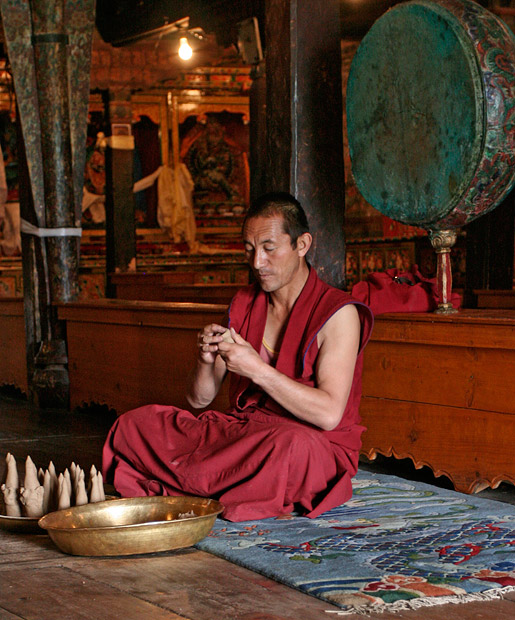
Yet, lama Sherap did not seem annoyed. He did not even blink at the photographer or showed the slightest discomfort. He simply continued at his work and once in a while looked up and smiled. He wasn’t perturbed even when the smile did not result in a reciprocation. After the mean photographer left without saying a ‘thank you,’ he looked at me and smiled as if telling me not to bother. I was sitting there talking with lama Sherap for a while and was very annoyed by the photographer’s behaviour. But the lama himself seemed to live up to what they learn – he was perfectly composed and simply resumed his work as though nothing happened.
Lama Sherap was taking care of the du-khang that day. He was alone in the prayer hall as his companions had gone to the village to perform some rituals. He was friendly, approachable and smiled gently every time he spoke. Sitting on the floor close to the entrance of the hall, he busied himself kneading chunks of tsampa (barley flour) and preparing torma. He explained me what torma is and helpfully added that it is for some special prayers being performed tomorrow.
As I sat and talked to with him, a Ladakhi woman walked in, greeted the lama with a smile and a ‘julley’, prostrated repeatedly towards the altar and and left as quickly as she came. Tourists kept coming in packs, took pictures and left within minutes, having ticked Thiksey off their list. After the nosy photographer completed his work, lama Sherap asked me how a digital camera works.
‘Today’s cameras don’t have film rolls and you can see the pictures at the back of them,’ he said, ‘where do the photos get recorded?’ I took out the CF card from my camera and showed him in answer. His next questions came immediately.
“How may photos get stored on them? They could get 36 in a roll of film. In which country do they make these things?”
After satisfying his curiosity, it was my turn to ask questions. Lama Sherap showed me a statue of Tson-ka-pa, helpfully identified it for me and explained that the monastery belongs to Gelugpa order. ‘There are about a hundred lamas,’ he said, ‘some are young lads and some are more than forty years old.’
As long as I was with him, he never saw his smile go away. When tourists misbehaved, sitting on the carpets that were meant only for lamas, he would wait to see if they would rise soon and then offer them another seat. There was not the slightest hint of irritation or anger despite repeated violation of regulations by visitors. Later at chon-kor, the room with a large idol of Buddha Maitreya, I saw a visitor stumble and drop a lamp on the floor and guiltily look at the monk taking care of the room, only to see him smiling. What could be an embarrassing moment was instantly dissolved in those smiles.
The chon-kor has an impressive 2-storey high statue of Buddha Maitreya. The tall Maitreya sits in padamasana (lotus position) and has a calm unblemished face. His lotus-like crown is embellished with images of reincarnations of Buddha. His large ornate ear rings complement the crown and stand out against the turquoise outfit.
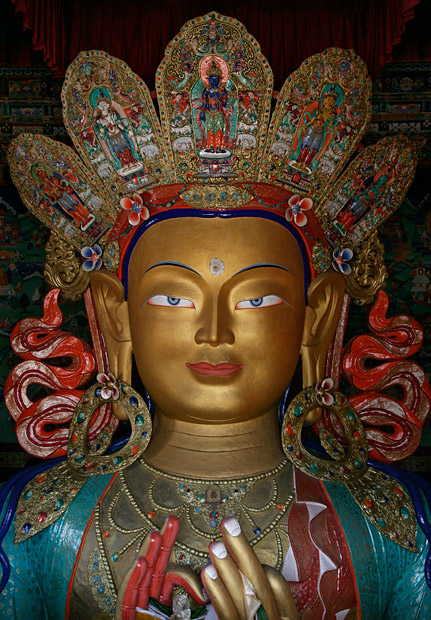
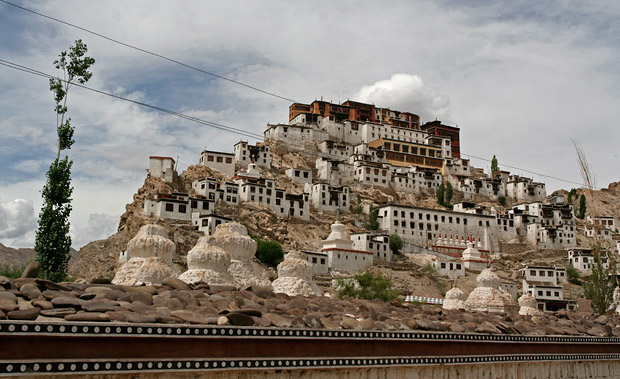
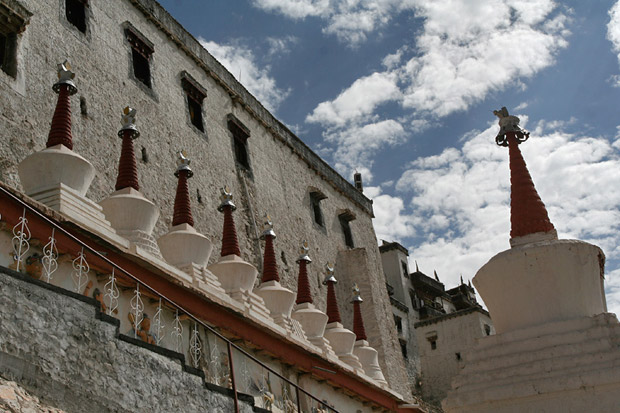
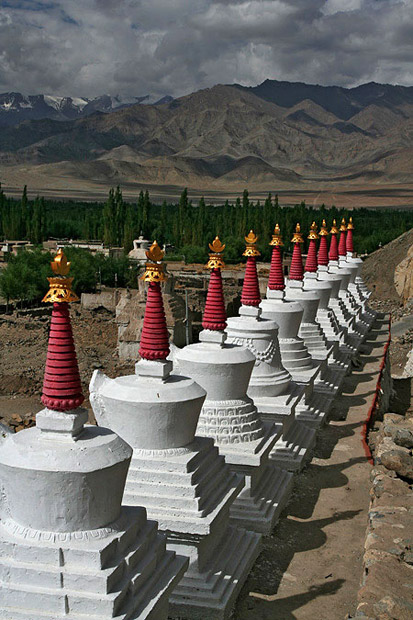
The Maitreya statue is relatively new, inaugurated in 1980 by Dalai Lama. The monastery itself was founded in early 15th century. Walking up the crag where a group of haphazardly built buildings of the monastery are located, it is evident that the institution has grown and expanded over the years. I climb up the steps leading to the monastery past a latest addition – a newly built row of chortens.
Inside, the du-khang seems to be old enough to be one of the first buildings built. To each side of its entrance are the colourful murals of the deities of the four directions, while inside walls are painted with various forms of Buddha and Yab Yum. At the rear side of du-khang is a small chapel with metallic statues of Tson-ka-pa and Manjushri.
The paintings on the outer walls have a curious diversion from tradition. The samsara-chakra has figures wielding guns and wearing clothes more suited for British and Indian men of the plains a few hundred years ago.
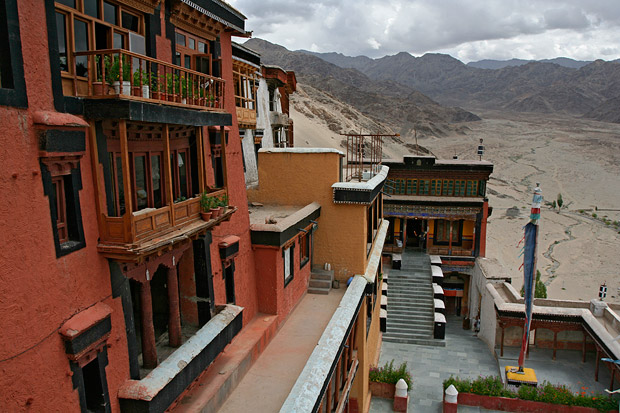
The stairs next to the du-khang lead to the terrace from where I can see the barley fields spread along the valley, the river coiling through the fields and the mountains beyond. In the corner of the terrace is a small room – a library filled with ancient Tibetan scriptures. As I descend from the stairs and head out to the valley, it is the smiles of Lama Sherap and the calm face of Maitreya that stay in my memory, etched stronger than the photographs I clicked in the monastery.