This article appeared in February issue of Terrascape, a travel magazine for which I am an editorial consultant and also write a column on photography. Read all the earlier earlier travel photography articles on India Travel Blog.
There is a good chance that you would have seen many brilliant sunrises and sunsets overlooking a beautiful landscape and yearned to freeze the moment with your camera. If you have tried it, you might have also noticed that your images might have turned out very dark, has shake or is not very clear. You might have also experienced similar problems when photographing something indoors where the light is low – it could be just a casual click in your house, a dazzling stage-performance or a party with friends. This month’s photo-tips is about avoiding such problems and taking better images in low-light.
Equipment. Basic cameras normally do not perform well in low-light. Even if they appear to make decent-looking images when you see on LCD, it shows a lot of noise (grains and undesirable colour dots) when you see on a big screen. It helps to have good equipment that can handle low-light. Use a camera that lets you control the aperture and ISO, which play a key role in controlling the quality of your photos in low-light. Mount the camera on a tripod if you are shooting subjects that are not moving. Your ideal choice of equipment will be a digital SLR along with a lens that has a wide aperture to let in more light and also stabilizes hand vibrations. Use a good external flash for indoor use. If you are using an on-camera flash, know that it can light up only a few feet in front of you. It is not much use to use an on-camera flash in a large hall.
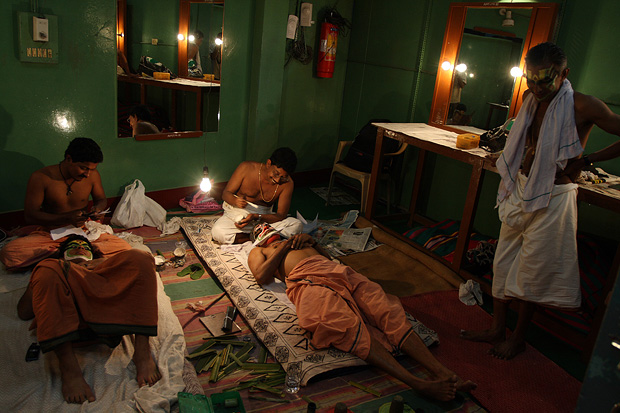
Technical aspects. Besides having good equipment, it is important to understand all the controls that you camera can offer. Know how shutter speeds, aperture and ISO work when you capture an image. Set the aperture wide open and ensure that your shutter speed is not very low. Find out the highest ISO at which your camera makes acceptable images and set it to that value. You are likely to get a shake-free image only if there is enough light to allow shutter speeds faster than 1/60sec. But a stable hand can help you take pictures in lesser speeds.
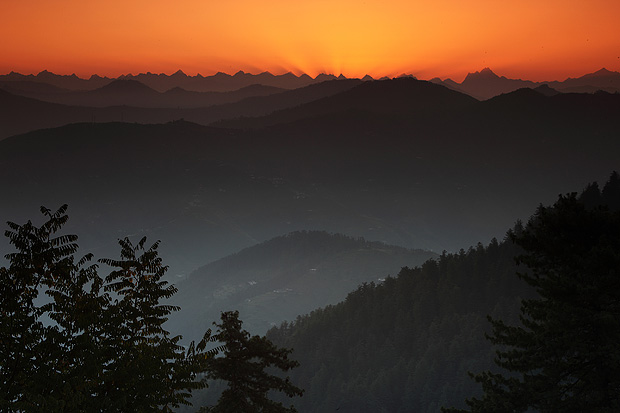
Hold the camera steady. If you are not shooting with a tripod, it is important to learn to hold your camera steady. Your hands shake less if they are close to your body, so use the viewfinder to compose instead of LCD. Breathe in before you shoot, hold your breath and release the shutter. Unless your camera has a very small lens, support the lens with your left hand and grip the camera body with right hand. If the camera supports shooting in burst more, fire a few shots together and pick the one that has least shake.
This article appeared in Spectrum, Deccan Herald’s Tuesday Supplement on January 18, 2011.
In the seemingly arid landscape along the National Highway 4 between Bangalore and Tumkur, there lies a stretch of thick forest and a series of hills that sometimes reminds one of the rich greenery and the slopes of Sahyadris. Moving off the highway near Tumkur towards the temple atop the hill at Devarayanadurga, I was surprised to see the boring and wide open highway make way to a leafy stretch of road with dense pack of trees on both sides. The winding road took me to a small perennial spring—Namada Chilime—in the heart of the forest.
The spring water trickles from a depression on a big rock and flows down to fill a pond just below. Legends attribute the spring’s origin to Lord Rama. Rama needed drops of water to smear ‘nama’ on his forehead and decided to extract it by shooting an arrow into the rock. A spring emerged from the rock and was called Namada Chilume.
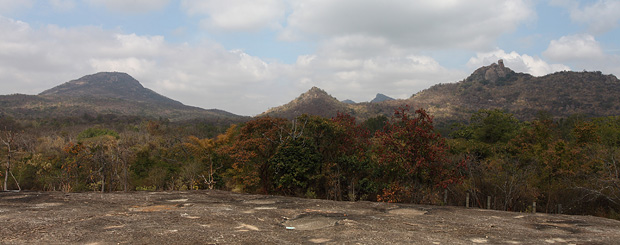
The hills surrounding Namada Chilume
The area around Namada Chilume is a leafy stretch with an enclosure that serves as a deer park. Across the park is a small rocky hillock with a mantapa, which offers views of the forest and the hills around the spring. In the view from mantapa are hills covered with shrub vegetation at their base and tall boulders higher up. In the early days of January when the trees are ready to shed leaves, the landscape occasionally sees a dazzle of yellow and red – as good that the fall colours can get in the tropics. To the east is Devarayanadurga, the tallest hill in the view with a 150-years old temple at the top.
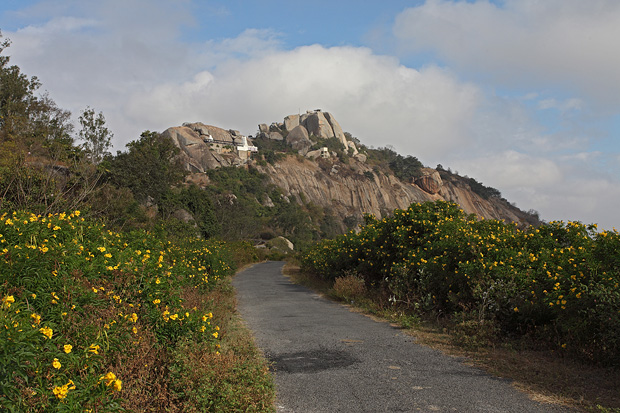
Lakshmi Narasimha Swamy Temple at Devarayanadurga
The foundation of Lakshmi Narasimha Swamy Temple at Devarayanadurga is credited to Hoysala Kings. Its current structure is attributed to the Wodeyar Kings of Mysore. Our road from Namada Chilume to Devarayanadurga meandered through a thick shrub forest as we drove through some steep climbs and switch backs before arriving at Durgadahalli Village just below the temple.
Climbing further to the peak and standing atop Devarayanadurga, nothing blocked my views all the way to the horizon as I looked at the villages on the plains to the east. The northern side of my view had a range of hills that tapered away gently into the plains. Lakes of various sizes glittered in the early morning sun all along the plains, standing out amidst the thin winter fog that hid the details of the landscapes. To the south, a sharp rocky ledge jutted out in the hazy weather as the sun rays filtered through the fog and selectively brightened its half-dome-like peak an an unusually sharp summit pointing towards the sky.
A series of hills decorate the landscape around Devarayanadurga. A thirty-minute drive further north took me to Madhugiri town dominated by a tall rocky hill, whose slopes are criss-crossed by several layers of fort walls.
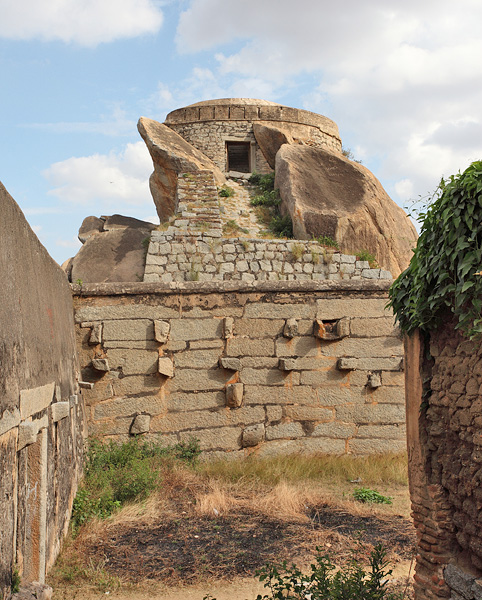
A section of Madhugiri Fort
Madhugiri hill is at an elevation of 3930 feet and is the second largest monolith in Asia. The first work on Madhugiri Fort dates back to Ganga Kings, while the walls remaining today are credited to a local chieftain named Heere Gowda, a feudal of the Vijayanagar Empire. Since the collapse of the empire, the fort was administered by Hyder Ali, Tipu Sultan and later by the Mysore Wodeyars. It is currently managed by Archaeological Survey of India.
Having made an impulsive decision to go up the hill, I climbed slow and easy. I pausing to look at a bastion that offered vista of the town, observed a waterway that filled up a tank in the fort, and stopped to take a good look at the fort walls and store-houses built along the way.
The initial climb is through grassy slopes that soon changes into steep rocky surface with nothing more than small etchings on the rock that served as supporting footsteps. Although the climb can not be called an activity that needed climbing skills, it was steep enough that I was occasionally forced to crawl up through slippery sections.
Standing at the bottom earlier, the climb to the peak appeared like an easy affair that may take no more than thirty minutes at most. But the deceptive fort walls built along the slopes hide the actual peak from the view, making it look like an easy climb. Several times I expected the peak to appear just across the next layer of fort wall, only to realize when I reached there, that it is a long way further.
As I was climbing up the slope, I was also becoming aware of the landscape around the fort, with hills dotting the surroundings and wide sprawl of lakes between them. Assisted by patches of clouds that blocked the sun, light and shadow alternated on the peaks, selectively highlighting some and subduing their neighbours.
It must have taken me more than 2 hours to reach the top and go through last of the fort wall. Located on the top are shelter built of stone that could house a few hundred people, perhaps meant to house the soldiers who guarded the fort. Standing on the top of one of those shelters, I was blessed with the views that made up for the effort of the climb. A series of hills marked the western landscape, dominated by a narrow and rocky peak projecting nearly as high as my platform. A thin road bisected through the hills leading somewhere into their heart and beyond.
The afternoon haze limited my views but the contour of the distant hills looked beautiful enough that I made a note to come back here again for an early morning visit. These hills along the Bangalore-Tumkur highway have many surprises, a lot of greenery and a rich history waiting to be explored.
Information
To reach Devarayanadurga, take NH4 out of Bangalore and drive till you exit through the toll gate near Tumkur. Turn right a little ahead of the toll gate the drive for another 20km to get to Devarayanadurga. This road takes you through Namada Chilume. Madhugiri Fort is another 30-minute drive from Devarayanadurga.
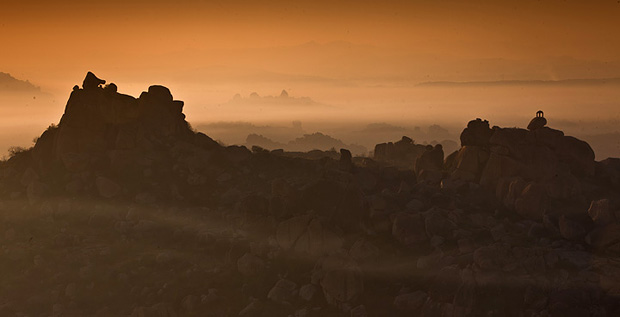
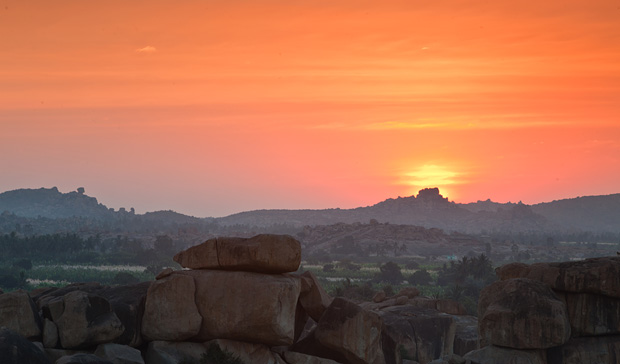
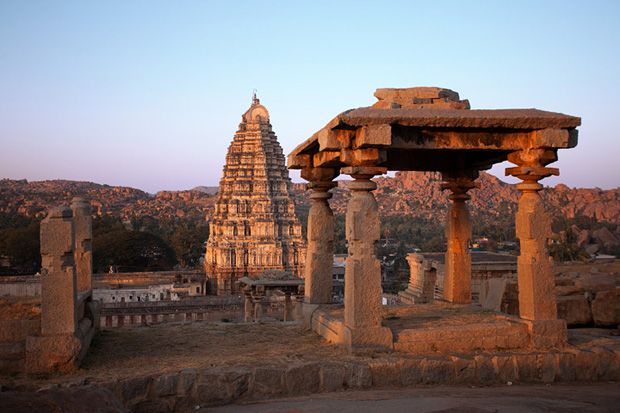
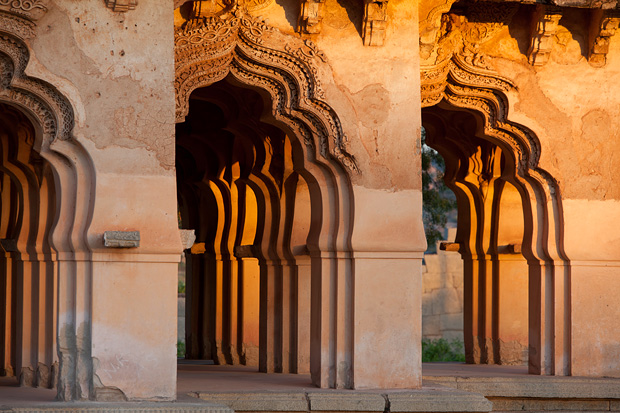
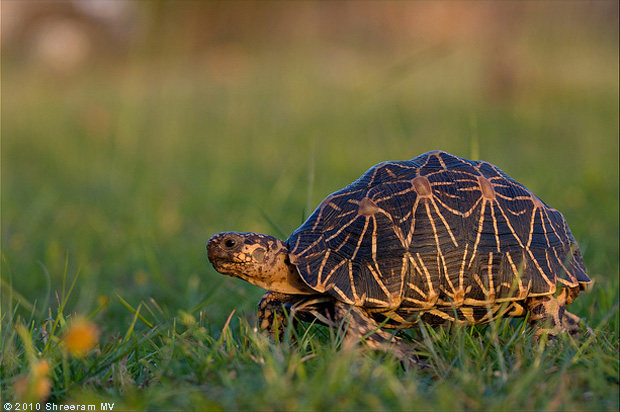
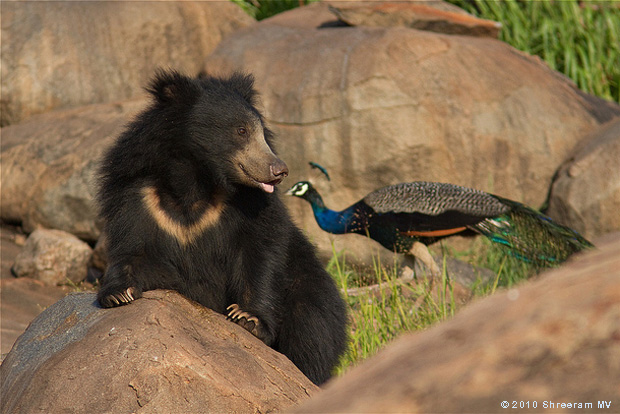
Our second edition of the photography tour of Hampi is scheduled for the weekend of February 19th. We call it ‘Many Worlds of Hampi,’ as the tour will see several faces of Hampi and not just the famed archeological riches. The places we go to photograph includes vantage points to photograph beautiful landscape that includes hills, boulders and the river in the view with colourful sunsets and sunrises. We will also see some wildlife, which primarily includes sloth bears, water birds and some rare ground birds. And of course we will see and capture a lot of the remains of the Vijayanagar Empire and the temple ruins strewn across Hampi. I will be with you in all these places, assisting you with compositions and photography techniques during all three days of the tour.
The tour also includes detailed sessions on basics of photography and in-depth sessions of travel, landscape and wildlife photography. The sessions are designed to benefit beginners as well as those getting serious with their cameras. While having a good camera is an advantage, even those owning a basic camera too can benefit from the tour. The tour will have a limited number of participants, helping us offer every participant a personal attention and do images reviews at the end of the day everyday.
See more details and register for the tour. Also join the facebook page of Darter Photography Tours to see some images shot by participants of the previous photography tour of Hampi and to stay updated on our upcoming tours.
Here are some images of the places that we will visit during the tour.
Landscapes
Architecture
Wildlife
Go here to see more details about the tour and to register. See some images shot by participants of the last tour on facebook page of Darter Photography Tours.