It has been a while since I have made a long journey. I have mostly stayed back home in the last three months, completing a lot of work and trying to give some impetus to my commercial photography work. I think all my travel plans get jinxed in the monsoon season. It is not that I prefer to sit at home and watch the rains; I would rather be out during the rainy days seeing and capturing the bounty of nature. In the last three years, I have always thought of making many trips to the western ghats once it starts raining. But that has never materialized. This monsoon season, I allowed some work to take priority over travel and hence gave a slip to some opportunities to travel. Some poor planning also kept me at home. In my mind was a visit to Sakaleshpur, one to Ooty, one to Kaas plateau and to a few more places. I also made some longer travel plans for October, which did not materialize. All that I could manage was a visit to Chikmagalur to see the monsoon at its best, besides a short visits to Mysore and Manchanabele. But it looks like I will have plenty of opportunities to be on the road in the next few months.
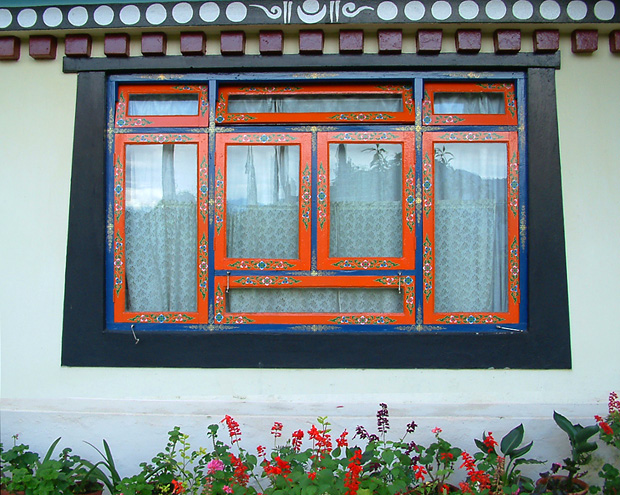
Beautiful window of a house in Gangtok, Sikkim
To begin with, I have an invitation to travel to Sikkim for a few days next week. It is a little more than a year since I have visited the Himalayas. I can’t wait any longer. Another invitation may see me going to Goa in the first week of November. Following that, I am looking forward to a visit to Bharatpur bird sanctuary in mid-November. While there are no concrete plans made for Decemeber, I might take up an invite to be in Kanha National Park early in December. The last weeks of December are the times when everyone will be on the road, when I feel better off staying home. January 2011 is the month I will be looking forward to. It is the time when I will finally get to go on Chadar Trek – something that I am organizing with a friend. I have been looking forward to doing this trek for almost three years now. Looks like what is in store is a quarter full of fun.
Now that the winter is here and there are many holidays lined up, I am sure most of you would be making some travel plans as well. Where are you heading this winter?
When the much publicized lighting come on at 7pm, the grandeur of Mysore Palace makes the most jaded traveler gasp for a moment and transports him into a fantasy land.
I had seen the palace lights a million times over in pictures and had set an expectation for the evening. I did look forward to seeing an elegant structure, tastefully illuminated. But in that moment when every other light in the vicinity was turned off and the decor lighting came on to built a palace outline formed just from tiny dots of light, I realized what is the feeling of being blown off from my feet like. It was like being in a fairy tale world and seeing something that only the best of the story tellers can imagine and narrate.
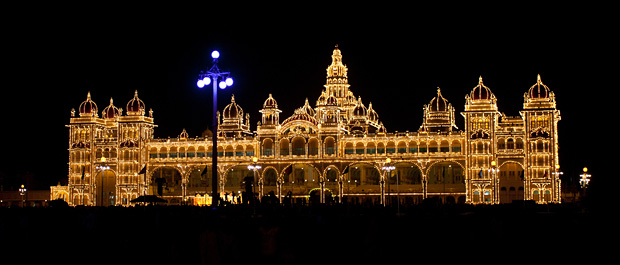
I made a short day-trip to Mysore to witness the Dasara celebrations. But at a time when the government was grappling with the problems of survival and had other imperative things to look after, the festival had become a low-key activity. There were information kisoks where people disseminated old tourist brochures but did not know the festival schedules. The famed mud-wrestling had now moved on with times and had shifted to a synthetic turf. The exhibition was not yet open and the cultural activities were limited to the evening hours. Our day at Mysore was limited to exploring the palace, and I am glad it turned out so.
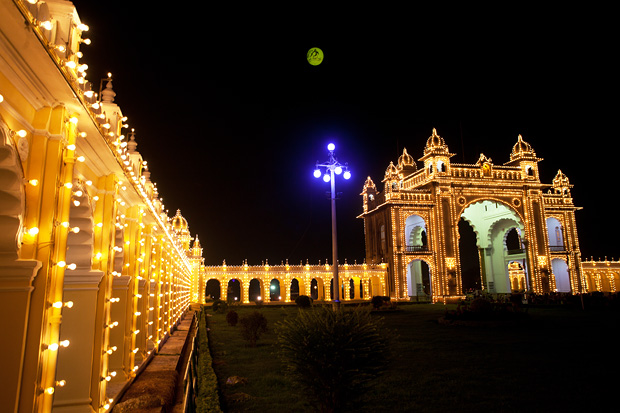
Most of my visits to Mysore in the past were on transit. I admired the quiet, wide lanes of the town as opposed to Bangalore’s congestion. I was jealous of its open spaces and the lakes teeming with birds. But it was just once that I stopped to see the sights, and even then, did not visit the palace. I made up for the loss on that day of Dasara. When the festival did not offer the expected excitement, it became a day dedicated to exploring the palace.
Even when it became obvious from outside that it is a grand edifice perhaps filled with luxury, the insides continued to impress me at every corner. The tall pillars painted in turquoise, the grand wedding hall three-stories high, the dolls of marble and wood on display, the golden throne, chairs of crystal and silver, an unbelievable work of tusks inlaid into wooden doors, gilded decorations in the private darbar hall, the grand pillars and marble floors of the public darbar, an array of canons in the courtyard, exquisite paintings of dasara procession make up only a small part of the impressive palace. The architects of the palace have not stopped until every corner of the palace is perfected and every room is decorated in the best possible way.
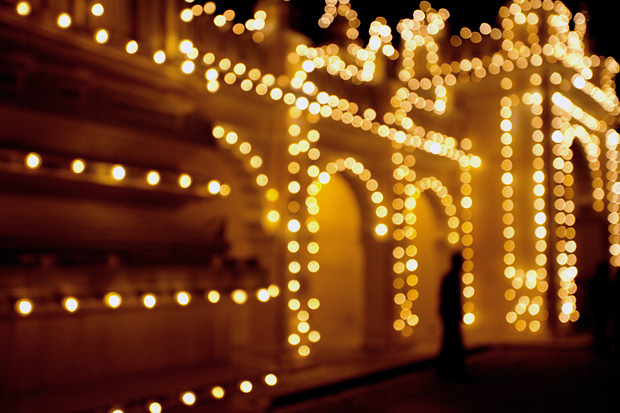
That evening when a cultural event was in progress in the palace premises, our eyes were focused on the edifice and its lighting. It looked like yet another beautiful structure in the evening hour as the floodlights focused on the walls. But the moment the decorative lights hugging every corner of the palace came alive, it was like a revelation of the maximum stretch of beauty. I admit, I haven’t seen anything else as grand and as beautiful yet.
A version of This article appeared in October issue of Terrascape, a travel magazine for which I am an editorial consultant and also write a column on photography. Read all the earlier earlier travel photography articles on India Travel Blog.
As the monsoons recede in October and make a way for winter, overcast skies are replaced by a clear blue expanse. The sky turns into deeper hues of red and orange during sunrise and sunset hours, adding a drama to the landscapes. Mild fog in the early morning hours hides the details of the landscape and highlights beautiful contours. This is the time of the year to see and photograph landscapes, especially mountain vistas.
Morning and Evening. The golden light of early morning is the best time to take pictures. The warm light makes the landscape look beautiful. Fog diffuses the light and adds a magical effect. A picture shot in the harsh afternoon sun can look dull and flat, but the same shot in the morning may look magical. If not in the morning, the next best time of the day is evening. Avoid the times when the sun is high.
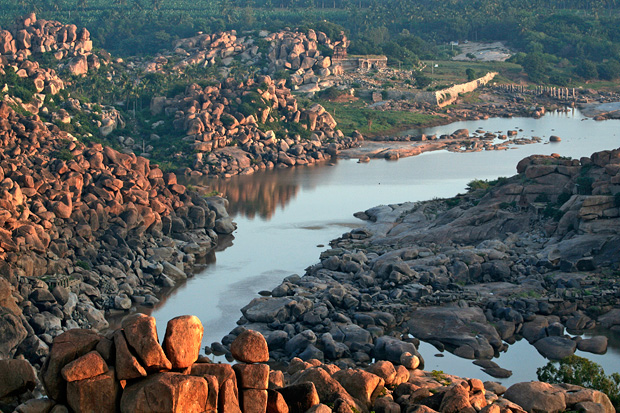
Include a foreground. Include a foreground element in your frame that offers a minor distraction from the main subject. For example, have some rocks in the foreground when you take picture of a lake. Include some flowers, plants or boulders in the foreground if the subject of the image is a mountain. The choice of foreground has to be made wisely and it must fill in just the amount frame not to distract the viewer from the main subject.
Remember the rule of thirds. For an image which has some sky and some earth, avoid composing with horizon in the center of the picture. If the sky has a lot of drama, allow it to take nearly two-thirds of the frame and let the earth take up a third of the space at the bottom. Do the reverse if the sky is uniform but there is a spectacular scenery on ground.
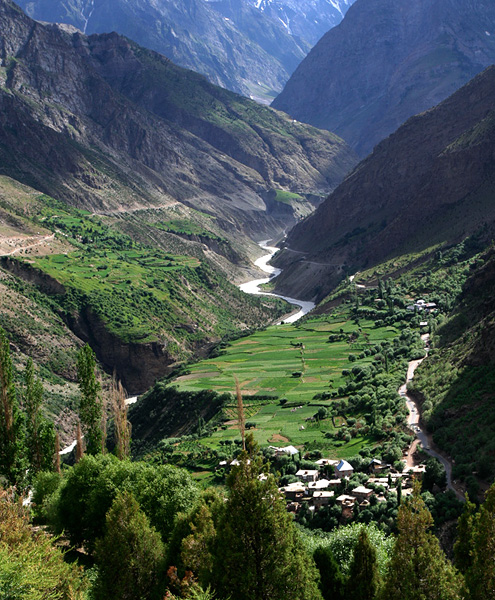
Find a vantage point. Standing on a plain surface often limits your views. Find a good vantage point that helps you see a wide vista. A higher position not only helps you get all the important elements of the landscape within the frame, it also gives you a completely different perspective than seeing things from below. Shooting hills and mountains from a height similar to your subject helps a great deal in emphasizing the scenery.
‘
Show the scale. Include some elements in the picture that depict scale. A picture of a hill will have an added drama with a man walking towards the top. A small boat somewhere in the picture can help in understand the expanse of a lake.
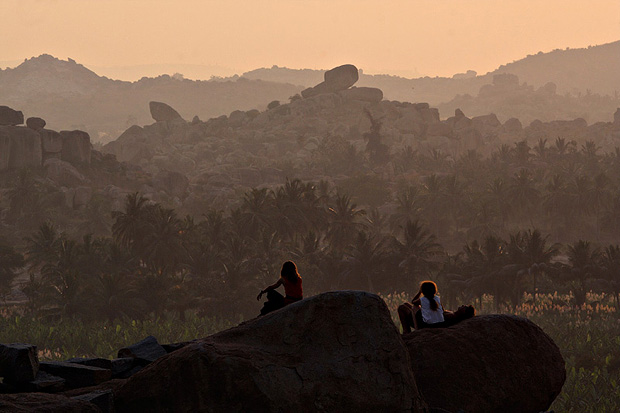
Technical aspects. This is for those of you who understand the basic camera controls that affect the image recorded. Use a small aperture to keep the whole frame in focus. An aperture f/11 or smaller is preferable. A sturdy tripod can make a lot of difference to the quality of the image.
Prints of all the images available. Request for prints.