I am often told that when you desire something strongly, the entire universe conspires to give it you. I do not know if the universe does so, but a group of unknown travelers certainly took care of something that was bothering me.
Despite having planned two months in Ladakh, we still could not fit Tso Kar anywhere in our itinerary. We had given up on it and consoled ourselves with a ‘there is always a next time.’ After spending four days in Tso Moriri and witnessing the celebrations at Korzok Gustor Festival, we were searching for transport back to Leh. We had hired a one-way transport to Tso Moriri and had left the return journey to chance. Now we were asking everyone in the village if there is a vehicle leaving for Leh tomorrow with two seats to spare.
Tso Moriri is a place far away from everywhere else. Not everyday can you expect to find a vehicle heading out of the village. The one bus that connects the lake with Leh operates once in every ten days, and that tenth day was still far away. Our hope was in connecting with tourists returning to Leh, who may have some additional space available in their cab. We inquired everyone whom we bumped into and left a message at the restaurant where we always ate. That’s how we stumbled into a group of four Israeli travellers who were planning to leave the next day. The good thing: they wanted to take the longer route to Leh and spend a night at Tso Kar on the way. We could not ask for more.
—
Journal entry on the brief visit to Tso Kar.
The road to Polo Kongka pass is a smooth ascent. It almost feels like driving on a plateaued land. Unlike the dry lands of Ladakh that we are so used to until now, there is a lot of grass and greenery all along the way. We occasionally stumble upon road workers and tents of changspa nomads. A steady descent from the pass takes us to Tso Kar lake in the middle of a wide, flat terrain.
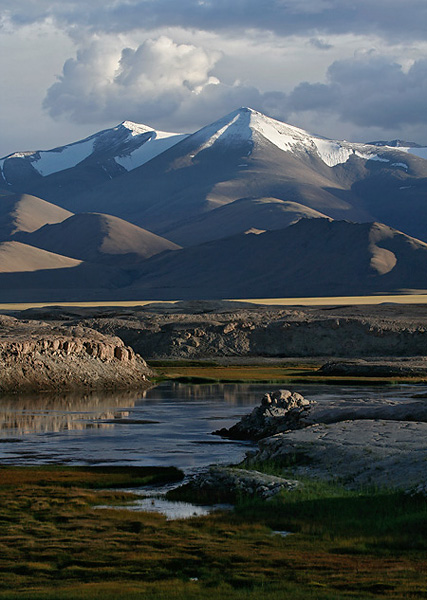
Tso Kar is not an expanse of blue waters like Tso Moriri and Pangong. It is more of a marsh in a wide valley with deep waters here and there. It is miles wide and so long that I can’t see the other end. After being used to the constantly undulating terrain in Ladakh for a month, seeing such a vast flatland comes as a surprise.
The grass around Tso Kar is tall and grows densely at places. There is plenty of bird life along the lake. We see kiangs, the Tibetan Wild Asses, getting on their feet and sprinting away at the first sight of us. Tall snowy peaks dominate the western bank while the peaks to the south are smaller and have an reddish-brown hue.
Tujhkse, a small village on the bank of the lake, appears devoid of people but for a couple who run a parachute-tent restaurant. They show us to one of the several houses with signs that read ‘home stay.’
We left early next morning, driving through Morey Plains and Tanglang La. In our earlier journey on this road when we were arriving from Manali to Leh, it was already dark when we crossed Tangland La. This time we get to see the landscapes that we had missed earlier: another wish fulfilled by the conspiring universe. The mountains here are rocky and unlike the loose soil on the slopes in most parts of Ladakh. The rocks are dark and have unusual hues varying from maroon to chocolate brown. There are queer formations all over the mountains – super sharp and jagged ridges; peaks shaped with sharp upward projections like tridents put next to each other. They are often so steep that they project like walls of rock on either side of the road.
We made the downhill journey after Tanglang la quickly and were back in Leh before noon.
Prints of all the images available. Request for prints.
Some images can be seen at a bigger size on paintedstork facebook page
As monsoon clouds move into the western ghats in the early days of June, the hills of Chikmagalur see a remarkable transformation. The vistas of grassy slopes and the dense forests of Bhadra Wilderness disapper under a blanket of thick fog. The fog never recedes for the next three months and it looks as if the skies have disappeared, never to come back again. But come September, it goes away as magically as it had arrived to reveal the beautiful blue skies and to welcome the warmth of the sun.
Chandradrona Parvata, commonly known as the hills of Bababudangiri Hills, host the highest peaks in Karnataka and is home to some of the densest rainforests in the region. I made a dashing visit to the hills this monsoon season and made an attempt to capture the foggy hillscapes. Here is a collection of images of Chandradrona’s Fog.
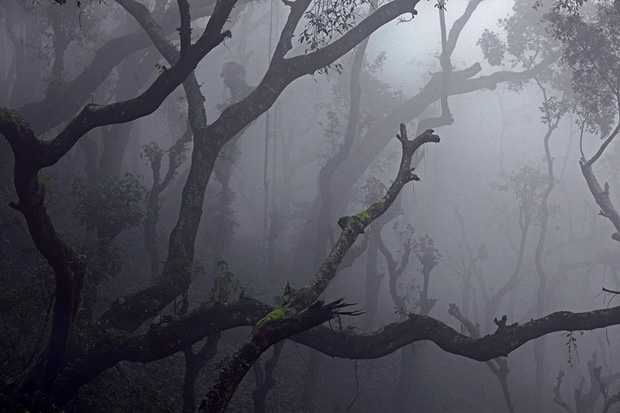
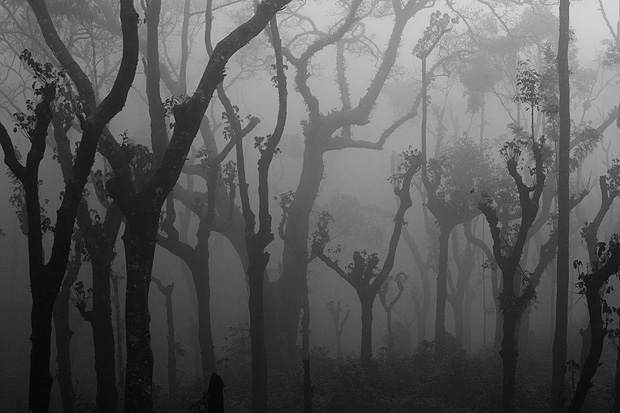
Coffee estates dominate the slopes of Bababudangiri. The district of Chikmagalur, along with neighbouring Coorg, grows bulk of the coffee produced in India. The need for a balance of sun and shade in coffee estates allows coffee growers to retain some of the trees that naturally grow in the region, but they constantly chop the branches and leaves to allow some sunshine to seep in. This creates a weird landscapes full of tall trees standing bare, often with only tender leaves sprouting from their hacked branches. Add a foggy monsoons that hides the details in the landscape and you get an eerie atmosphere in the hills.
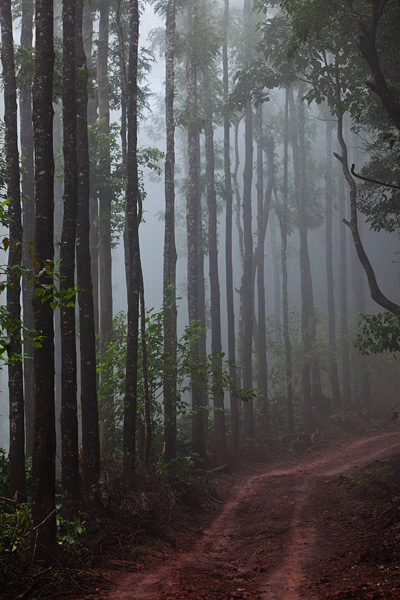
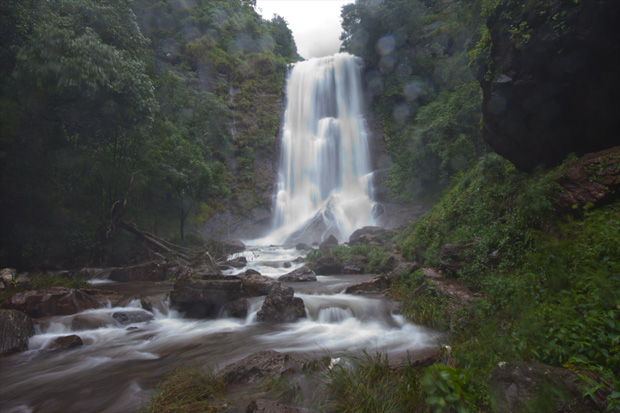
Many roads in the hills are without tarmac and sometimes you can barely call them roads. Many roads are also privately owned by the coffee estates that are spread over thousands of acres. We drove through one such road on an ancient Mahindra that lacked the luxuries of shock absorption. Sometimes we treaded over rocks when the road disappeared in stretches, each time double checking to ensure that our backs have stayed unbroken. The road lead to the roaring Hebbe Falls that was falling with full force in the peak monsoon season. I stood in the narrow valley of the stream and felt the wrath of the waterfall whose sprinkles made me completely wet in a matter of seconds. I went there determined to take a picture and decided not to step back despite being faced by a jet of droplets hurled away from the waterfall into me. Keeping the camera covered most of the time, I set it up on a tripod, composed blindly and hurriedly took a picture, exposing the camera in the open just for a few seconds. The lens surface became completely wet in those few seconds and you can see the droplets in the picture. I knew this was a task meant to fail, but I had no heart to come back without trying.
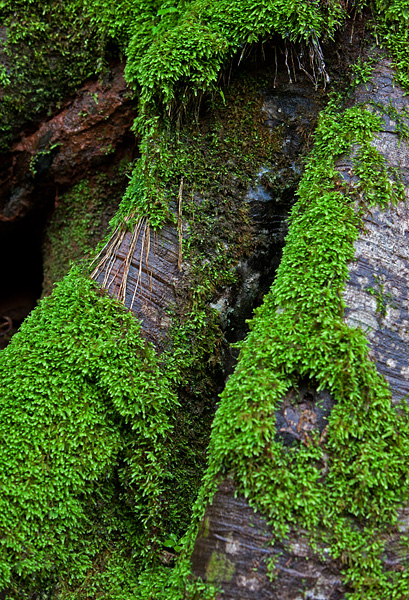
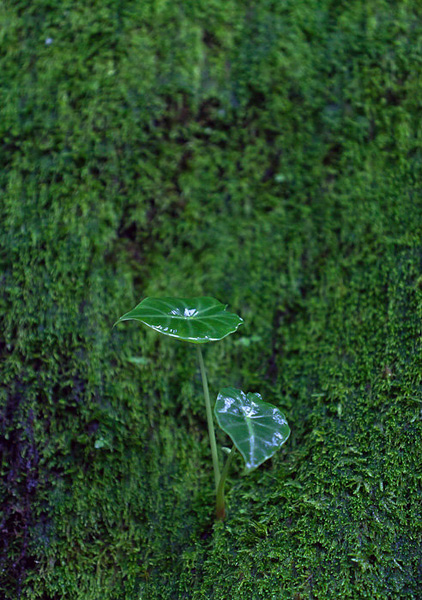
Monsoon is the season of fertility in the highlands of Chandradrona. Every exposed surface remains wet all through the three months of rain. Life in different shape, form and size grows effortlessly at the slightest opportunity; even tree trunks are never spared.
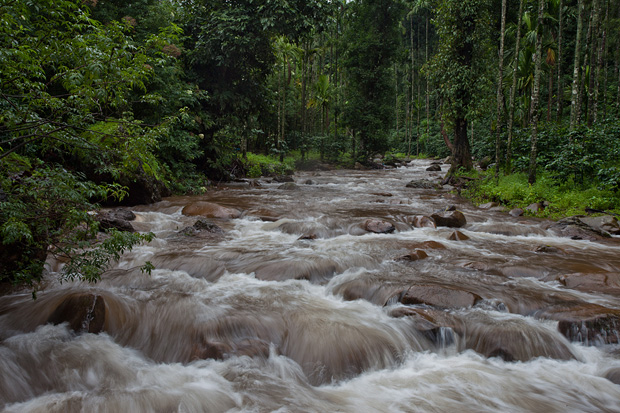
Innumerable streams crisscross the forests in these mountain, sometimes rushing down the hills in a great hurry and sometimes meandering gently through the forests. They come together in River Bhadra and feed the plains of the Indian peninsula. These streams come alive during the monsoons, charged by the continuous rains that keeps pouring throughout these three months.
Prints of all the images available. Request for prints.
India Travel Blog Newsletter is sent approximately once a month (sometimes less frequently), summarizing the previous month’s activity and giving a glimpse of the coming month on the website. Subscribe to the newsletter by keying in your email address in the box on the top of the sidebar. Here is a copy of this month’s newsletter, dispatched yesterday.
—
Hello!
It is two months since the earlier newsletter was sent out early in August. And it has been such eventful two months that I can’t help make this a long one. I hope you have the patience to read till the end. Here is a quick summary of the newsletter to begin with.
1. Five years of India Travel Blog + Facebook Page
2. Desktop Calendar for October 2010
3. My inverviews on the web
4. Photo Essays
5. Posts from Ladakh
6. Travel Photography Articles
7. Featured Guest Posts – Less known heritage sites
8. Other posts
Five Years of India Travel Blog
The first news I want to share is on the completion of five years of India Travel Blog. In these five years, the blog has seen more than a million visitors who have come to read more than 750 posts. Read my detailed post on the journey so far – Five years of India Travel Blog
India Travel Blog is now also on facebook. The facebook page doesn’t merely reflect the posts on the blog; it also features some larger pictures, collection of images and (sometimes) anything related to travel and photography. Many of the photographs uploaded of the page have detailed captions. Join our facebook pages on the journey of seeing India and photographing its beauty.
Calendar
October 2010 calendar is now online. It is an image of an array beetlenut trees standing perfect straight and parallel to each other on a foggy day. Download it and set it up as your wallpaper.
My interviews on the Web.
Technology news portal Techgoss has a very long interview of me, where I talk about my profession as a photographer and travel writer and the journey into becoming one. TravelByU, a community travel website has featured my interview on the occasion of completing five years of India Travel Blog, where they ask me about travel writing and photography.
Photo Essays.
Many of my readers have told me that they love to see a lot of pictures on the blog. I bow and comply. Since last few months, I am making the site picture heavy, loaded with many photo features and and single image posts. In the two months since last newsletter, I have posted six photo essays.
1. Freedom Park, Bangalore
2. Faces of Ladakh
3. Ladakhi Children
4. Nandi Hills
5. Busy Monks of Ladakh
6. Gaurs of Kanha
I will soon be adding a new category called photo-essays, where you will be able to find all photo features till date in one place. You can also see other photos posted on the blog here.
Posts from Ladakh
We have had two posts from the ongoing travelog series on Ladakh since the last newsletter dispatch. There are more posts from Ladakh on the unfortunate cloudburst.
1. Korzok Gustor Festival is a vibrant festival in the remote Changthang region, where locals dress up at their best and come to the monastery to meet their old buddies and see the monks perform masked dances at the monastery
2. Korzok Fu is a lush green oasis in the arid mountain regions of Ladakh, where a group of nomadic changspa people had camped when I was there. The place is so full of life – lush grass, gurgling streams and yaks grazing happily in the pasture – I fell in love instantly. But I even got caught in a sudden storm but quickly found shelter in a nomad’s tent!
3. Also see – a story on the monasteries of Ladakh, published in Terrascape Magazine
I also wrote two very long posts on the cloudburst disaster that devastated Leh and many other parts of Ladakh.
1. The Leh Cloudburst FAQ – What happened and why were the damages so high.
2. After the cloudburst – should you go to Ladakh?
Travel Photography Articles
1. Freezing a performance – pointers on capturing stage shows and cultural events
2. Photographing Children
Featured Guest Posts – Less known heritage sites
Travel Writer Lakshmi Sharath, who writes at http://backpakker.blogspot.com has been a writing a series on ‘less known heritage sites.’ She has a list of very interesting places that few of us know about.
1. Mandagapattau – Pallave Cave Temple near Chennai
2. Alamparai Fort
3. Chola Temple at Darasuram
Other Stories
1. Book Review – Geography of Bliss – A book on author Eric Weiner’s search for happiness across the world
2. Places around and Delhi – A compilation of popular weekend destinations in Delhi with links to detailed travelogues.
I hope you are enjoying the stories on India Travel Blog. I am all ear to your feedback; please share your thoughts and feedbacks in the comments section of the blog. The coming months on the blog will see a greater focus on images, though not at the expense of information and experiences that I write.
With Diwali coming up a month ahead and a series of festivals and holidays that will follow, 2010 travel season has almost begun. Have a great time and discover beautiful places! Happy Travels!
—