Title: A Journey in Ladakh
Author: Andrew Harvey
Publishers: Mariner Books
Pages: 260
‘A Journey in Ladakh’ is Andrew Harvey’s recollection of experiences from his visit to Ladakh.
Harvey has had a long standing interest in Buddhism, but had never heard of Ladakh. He first comes to know about the ancient Buddhist civilization of Ladakh in a corner of Delhi, where he is urged to make a journey to the remarkable mountain kingdom. When he listens to praises of Ladakh again somewhere in a Buddhist retreat in Sri Lanka, he makes up his mind and heads north. The book his full of his encounters with fellow travellers, local people, monks and rinpoches in the mountain country.
The book seems to wander aimlessly during the initial half and is full of random conversations and fragments of his memoirs that fail to form a good story. The author seems to be exaggerating or struggling for words when he describes his own experiences and feelings about the land and its people. The reader begins to feel that the book is no more than a journal of loosely coupled jottings of experiences of a journey in which Harvey describes about the difficulty of travelling in the bus to Leh, about his lodge owner and few talkative fellow tourists. While the book does hint about spiritual inclination of Harvey and the travellers he speaks to, the spiritual quest gains no significance until he meets a head lama.
However, a flow comes back into the book in the later half where Harvey starts getting deeper into the essence of Buddhism as he experiences and tries to understand the core values like love and compassion that form the foundation of every ritual, painting or celebration. He finds it easier than ever to connect with people in his surroundings as he is groomed by conversations with the monks. At times, he witnesses some strange local rituals and even goes through some metaphysical experiences. At the end of his journey, he is barely short of being a convert.
While his spiritual experiences and conversations with the lamas give a good direction to the book, it does feel as though the author has failed to carry his readers along with his experiences. Sometimes it appears as though the author goes through something that can’t be expressed in words, which may also make those experiences appear unreal or his narration limiting. His struggle with narration is evident in some occasions, especially when he describes the landscapes, paintings and some personal experiences in the monasteries. Many distractions in the book that come, such as conversations with his fellow travellers, makes the book slow paced. Yet, for someone interested in Tibetan Buddhism, this is an ideal book to understand the experiences of an outsider’s first brush with the religion.
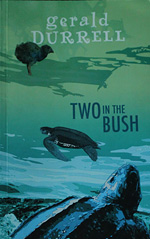
Title: Two in the Bush
Author: Gerald Durrell
Publishers: Westland Books
Pages: 188
Acclaimed naturalist Gerald Durrell travelled to New Zealand, Australia and Malaya in search some rare endemic species inhabiting the region with two purposes. First, to see and learn about conservation efforts in these countries and second, to make television films on these animals for the BBC. ‘Two in the Bush’ is a memoir of his experiences during the journey.
What Durrell sees down under are some species that have chalked their own path of evolution and are much different from wildlife in the bigger continents. Some such animals are well known – like platypus, kangaroo and koalas. But he sees a lot more than that, like the royal albatross chicks that could spit at you on approach or the dancing lyre birds that can imitate many sounds including car alarms and electric saw. Some of these have exotic sounding native names like weka, kaka and tui! He tries to imagine emotions of these animals as he observes and interacts with them, making his readers get a good feel of his encounters.
Written by anyone else, this could well have become a book for serious naturalists but Durrell ensures that his readers have a lot of fun as he humurously describes what he sees. It is not just these animals that he jests at, even the people he meets and works with along the way become his targets. His sense of keen observation and sharp humour put together makes the book readable by anyone who is even remotely interested in birds and other wildlife.
But sometimes it is hard to conceive a bird or its action that is completely unheard of, no matter how well one can describe it. It happens when one reads about the features of a bird like Takehe, call of siamang primates or the dance of lyre birds. It does seem like something amazing but is never easy to bring a shape to those birds or imagine their hilarious actions in mind. I went through this feeling in the initial pages of the book, until I decided to actualise his descriptions with images and videos from the internet. It saved the effort of visualising and lead me to some amzing videos and pictures of the life that Durrell describes, like in the footage of lyre bird below.
Besides introducing the wildlife down under in a lighter and easier manner, Durrell muses considerably about the state in which they are surviving. There are many birds and animals that number just about a hundred or two. Some birds that were thought extinct were rediscovered but their strength was so low that they had to be bread in captivity to ensure their survival and procreation. Durrell makes an appeal through the book to aid and support conservation as he describes the grim future of the biodiversity in these parts and muses on the man-animal conflict.
Sometimes the book does feel shallow and not sufficiently informative as he moves swiftly from one place to another without delving deeper into the life of his subjects and not elaborating each of these birds and animals in detail. But that’s what makes this book readable to everyone – keen naturalist as well as the casual reader.