Bhutan is a place that is in my wish list for a long time now. So when fellow travel blogger and prolific traveller Priyank started writing about Bhutan, I followed his posts. His series of posts on Bhutan are a mix of interesting tidbits, opinions, some history and knowledge besides the chronology of his journey.
As our bus descended into the valley, we saw houses with metal roofs and other signs of progress compared to Thimphu. I got into an argument with a guy who lamented the fact that natural building materials were being replaced by modern ones and that this trend is bad and that government should ban it. Well, I would personally prefer to live in a house with wooden or ‘natural’ roof. But who am I to judge others? I don’t live in Paro! If local people think that metal roof is better, cheaper, functional, etc., I trust them more than my wishful thinking of an idealist world.
He has just concluded the series with an interesting post on how he managed to hitchhike out of the country when his money was running out! Read his series on Bhutan, titled Mystic Druk Yul [link to table of contents]
My first proper day in Leh started with a rush to the ATM. In a town that has more tourists than locals, your best bet to get your money from the only functioning ATM is to get there early in the morning. At 10am, the queue was already long enough that it took me an hour of waiting, a few tense moments of machine malfunctioning and rumours that the money is running out. I had to get some money that day or go hungry till tomorrow! Thankfully things turned out for good.
Leh is not a place where you want to hurry things. And hurry, we did not. When we asked our guesthouse owner for something do that evening, he pointed us towards Shanti Stupa. Stepping out and loosing our way through the maze of roads in Sankar Village, I spotted a little girl and asked for directions.
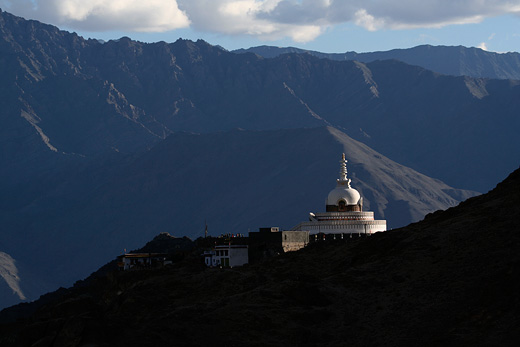
Shanti Stupa
“Julley..,” I greeted her, using the Ladakhi word for ‘hello’, and asked for directions to Shanti Stupa. Incidentally, julley can mean ‘hello’ as well as ‘good bye’.
She looked up with her bright face and smiled in return, the kind of innocent smile that makes you fall in love in that very moment. She pointed me towards North in response, added that she is heading in that direction and will show us part of the way. I asked her a few more questions as we walked together, but she did not have answers to much of them. “I am from Kargil,” she responded instead, indicating that she doesn’t know much about Leh.
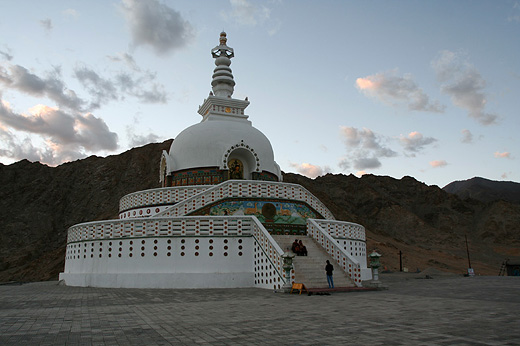
Shanti Stupa
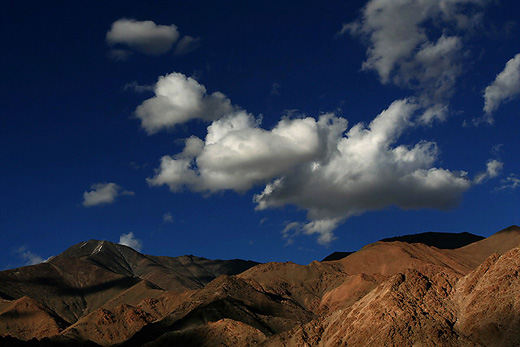
Puffy clouds over Ladakh Range of Mountains, seen from Shanti Stupa
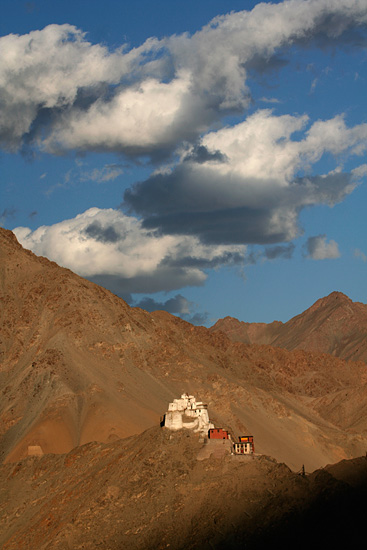
Evening light over Namgyal Tsemo Monastery, seen frmo Shanti Stupa
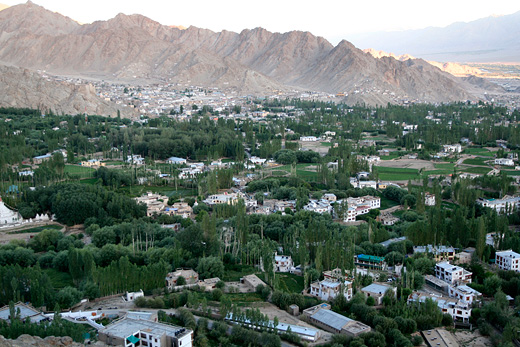
Like everything religious in Ladakh, Shanti Stupa is also located on a hill. The way up appears easy on looking up from below, but as I walked, I became conscious of the thin air in this high altitude (10,600 feet, 3500 meters) and had to cut down my pace. The vista of the mountains got better as I climbed up, bringing in the whole town into the view from the top. Shanti Stupa itself is not an admirable structure, but the panorama of the Indus Valley from its premises, with its green stretch spreading like an oasis in the middle of dry brownish mountain ranges, gives a perspective of the scale of the landscape that accommodates Leh. Puffy white clouds hovered over brown mountains at one side, while the cold snow claud mountains of Zanskar were kissed by dark rain bearers to the other side. At the opposite side of the town, the last rays of the sun gently moved past a crag hosting Namgyal Tsemo Monastery, making a distinct mark between the arriving night and departing day. At the twilight hour, peace prevailed in the atmosphere despite the crowded platform of the Stupa. Shanti Stupa is the best place to watch the sun drift over the skies above Leh.