Rohtang Pass is a place that marks many divides. To the south are the green slopes caressed by monsoons every year and to its north is a stark landscape often called the forbidden valley. Beyond Rohtang, the landscape begins to start resembling Tibetan, and so do the people. Temples give way to monasteries and Shiva makes way for Buddha. Apple orchards are replaced by potato and sweet peas. It is as if you just changed the DVD and a different movie started playing on the gigantic 16:9 screen.
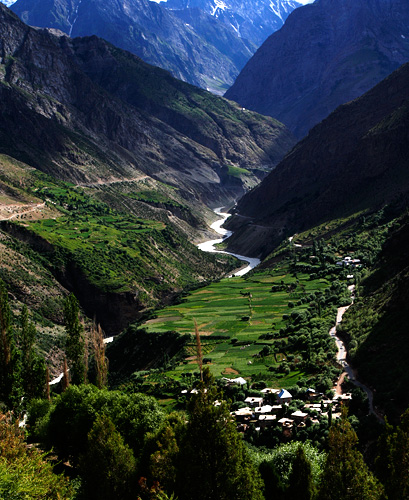
The fabulous setting of the town of Keylonw, Bhaga River and the road from Tandi
People north of Rohtang have an unusual pride about the altitude they live in. Every village along the way lays some special claims about its location. In Spiti Valley, a deviation on the Leh highway, people at Kibber Village once loved to call it as the highest permanent inhabitation in the world. When the record was broken somewhere else, they were not ready to give up. They came up with more possibilities instead: highest village with electricity, highest village with a motorable road, highest village with a post-office, and so on. A quick web search reveals all possible versions and may even give ideas to cook up new ones. Just below Kibber at the base of Spiti Valley, the petrol pump in Kaza doesn’t fall behind in making the ‘highest in the world’ claim.
Going past Keylong, probably every named place has something highest attached to it. It is only a matter of finding out highest ‘what’!? Indian Army takes bulk of the credits for creating all these highest hypes. In Pang, a tourist stopover on the way to Leh, is an army camp labeled as the “world’s highest transit camp.” Far north in Ladakh is Siachin glacier with its notorious claim for being the world’s highest battle field, where India and Pakistan have been fighting and wasting away lives and resources for a land that neither party can put to any good use. Once you have the privilege of making claims for world’s highest battlefield, the highest airfield is obviously not going to be far away. And Khardung-la, the world’s highest motorable pass doesn’t need any introductions. But Khardung-la’s days are probably numbered: everyone speaks of motorable passes in Ladakh and Tibet that raise much higher. I am sure they will find a new title for Khardung la when another pass officially becomes the highest motorable road.
That’s much digression from Rohtang Pass where we started from. It is a quick and steep descent from the pass, down to the valley of Chandra River. The small village of Khoksar next to the river is more a food court than a village. Dhabas line up the 100m or so length of the road, which is as long that the village spreads. A Himachal Pradesh Government PWD bungalow in the village may be open for visitors, but most people prefer to continue to Keylong. Despite the charm of Chandra River, Khoksar is not a pretty place and is too close to Manali for a halt.
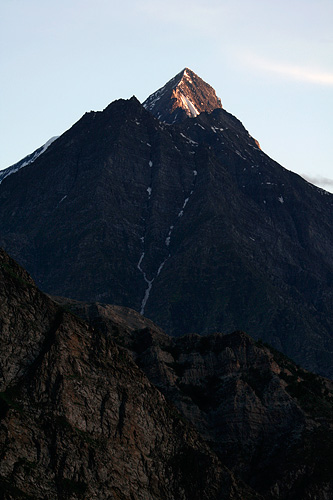
Mighty mountain peaks seen from Keylong town
The way further is parallel to Chandra River, going downstream after crossing the river at Khoksar. It is usually muddy and flows swiftly in the months of July and August – the peak season for travelling to Ladakh. Photographs taken in later months show it in a deep hues of blue, a color that eludes most people who are on their way to Ladakh. The tall peaks along the way tend to have last snow of the season, and many tall waterfalls come down from the steep hills to merge with Chandra.
Tandi, 10km before Keylong has the last petrol pump on the highway. The road here turns right and continues along the valley of Bhaga River. A sign at the confluence of Chandra and Bhaga reads [not verbatim; recreated from memory]: “Welcome to Tandi, the confluence of blue waters of Chandra and green waters of Bhaga.” Unfortunately, the colours are all mixed up with plenty of earth, and what is there to see is two muddy currents coming together into one.
Chandra and Bhaga have an interesting origin. They both begin at different faces of the mountain at the same location – Baralach la. Chandra flows east and then turns west traversing through the valley of Lahaul, while Bhaga flows south through Darcha and Keylong. They meet again in Tandi, like two long lost sisters getting to see and hug each other. More like we see siblings separated at birth rejoining in an emotional drama in a Kannada movie, with the lead actor playing two roles.
Keylong is a quick 20 minutes drive upstream Bhaga River. It is the place where most people prefer to spend the night on the way to Leh, as we found out on arrival.
After the post on Incredible India promotional video, here is one from Australia. It intrigues me how different the two are. The India campaign relies heavily on celebration and living the moment, while the Australian one is about escaping. Does it say something about how we are? I don’t know.
In today’s Thursday Travel Photography column I am going to talk about cropping. The second part of this article has weekly image reviews. If you would like to have your images reviewed to know what worked well and how it could have been improved, choose some of your best images and post them on group pool of India Travel and Photography. Don’t forget to tag them as itpcritique, so they can be chosen for review. You can also post your questions related to photography as a comment to this post, or in India Travel and Photography group discussion. I will answer them in next week’s article.
CROPPING
The camera sensor or a frame of film has a fixed dimension. However, the image you have in mind may not always fit in those dimensions very well. Consciously or unconsciously, we tend to live with the picture that we have got from the camera. Sometimes, getting rid of unwanted part of an image can enhance it by a great deal. A tasteful cropping may improve the aesthetics of the image, but in many occasions, it is simply a practical tool that doesn’t demand much intelligence or an artist’s eye. You can just eliminate parts of a flat sky on the top, a disturbance in a corner or an element that doesn’t fit well with rest of the frame.
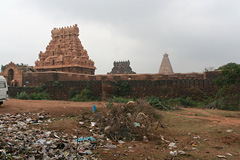
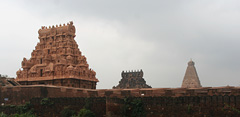
This is very straightforward when you look at the examples below. The picture of Thanjavur Temple and the cropping speaks for itself and needs no explanation.
Let’s look at it in some more detail. Why did I even include the garbage in the first place? Small elements may creep in unnoticed in a picture. But here, that is obviously not the case. I could have recomposed the shot by removing the lower part and including the sky instead. But there are two reasons for not doing so.
First, the cropped image to the right is how I conceived my picture irrespective of what the camera would capture. Be it sky or the ground, I was going to crop that excess anyway. Second, I chose to include ground instead of the sky, as it would allow me to hold the camera horizontally. Including more of the sky instead would need tilting the camera vertically, and would have resulted in a distortion, making the towers look converging. Allowing the garbage to seep into the frame and cropping it later was the easy choice.
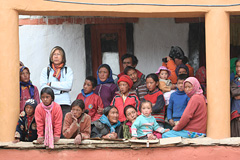
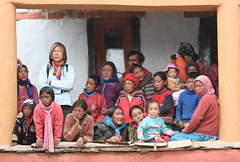
In many occasions, choice of cropping is not necessarily so obvious. In the picture below, where people are intensely watching a cham dance performance in a monastery in Ladakh, there are no obvious eyesores similar to the above image. However, getting rid of the portion beyond the right pillar helps create a neat and good looking frame, and removes a distraction in the picture. Also note that I got rid of the cable hanging on the top.
There are several such occasions when cropping can help. Here is a quick list.
1. When there are unwanted elements in the image, like the garbage in the picture of Thanjavur Temple.
2. To provide a neat uniform look to the image by removing any distraction, like in the second example above.
3. To get rid of too much of bland elements that may not add value to the image, such as a very plain sky.
4. To emphasize your subject subject and keep the viewer focused on it. For example, if you are shooting a particular building, you could crop any neighbouring buildings that sneak into the frame, if you can’t avoid them at the time of framing.
5. To remove technical errors that may crop up in the image. For example, wide angle lenses may produce images that are slightly skewed at the edges.
Cropping helps you to overcome the physical limitation created by the size of the sensor. I would advise having a cropping in mind at the time shooting, like I had with the picture of Thanjavur Temple, than try to look for a crop at a later point of time.
IMAGE REVIEWS
The image below is posted for review by flickr user mallumax
Flowers rarely fail to make good choice of subject. Same applies to this too, and focusing on just a part of the flower usually works well. The simplest way this image could have been improved was to shoot it against a clutter free background. A completely green background would have easily made the subject stand out in against background. My earlier article in the thursday-travel-photography series on backgrounds gives a better idea of how a uniform background makes a lot of difference to the image, and ways to achieve background blur.
If you would like to have your images reviewed to know what worked well and how it could have been improved, choose some of your best images, post them on group pool of India Travel and Photography and tag them as itpcritique. Only tagged images are taken for reviewing. You can also post your questions related to photography as a comment to this post or in India Travel and Photography group discussion. I will answer them in next week’s article.