India Travel Blog Newsletter is sent approximately once a month(sometimes after two months), summarizing the previous month’s activity on the website. Subscribe to the newsletter by keying in your email address on the top of the sidebar. Here is a copy of this month’s newsletter, dispatched today.
Hello,
Hope you are having a good summer of travelling. Here is 12th edition of India Travel Blog newsletter, updating on the latest posts on the blog and informing you on future programs.
May 2009 Calendar is now posted on the blog. The image is from a colourful Kathakali performance, where angry Bheema looks for his enemies in the battle! Visit here to download the picture.
The focus of last month has been photography. A new series on the blog hopes to help travellers take better pictures and come back home with beautiful memories that don’t fade. The series, called ‘Thursday Travel Photography’ is posted every Thursday as the name indicates, providing simple and easy to use tips to improve photography. It has already completed a month with five posts. You can see them all here. Below are the list of topics that were covered this month.
1. Asking permission to shoot people
2. Early mornings
3. Getting the background right
4. Looking for interesting foregrounds
5. Holding the camera stable
I would love to know your feedback on the series, and suggestion on anything that you would like to see covered in this column.
Besides the article, I also review images submitted for critique to assess how the image could have been improved, and what are the things that worked well with the composition. You can also ask questions related to photography and get your doubts clarified. If you would like to submit your images for review, join our flickr group – India Travel and Photography and post images on the group pool. Don’t forget to tag the photo as itpcritique if you would like to see it reviewed next week. You can ask your questions on photography in Group Discussions. The group is also a platform to share your travel photographs or discuss anything you wish to, related to travel and photography.
MONTH OF MAY
The coming month will focus on Ladakh, with extensive travelogue, photographs and information on this mountainous region. The articles posted will be from nearly all the important places in Ladakh, drawn from my two months of wandering in the area last year.
Keep reading and happy travels!
Thursday travel photography is now on for a month. I would love to get your feedbacks and suggestions on the feature, and know what more would you like to see in this column. Please comment. Starting next week, I will also be answering any questions or doubts related to photography that are nagging you. If you have a question to ask me, you can leave a comment on this post, and I will answer it next week’s article. Alternately, you can also post it as a new discussion thread on India Travel and Photography flickr group.
Today’s article has two sections as usual, with the second section on image reviews. If you would like to have your images reviewed to know what worked well and how it could have been improved, choose some of your best images and post them on group pool of India Travel and Photography. Don’t forget to tag them as itpcritique.
AVOIDING CAMERA SHAKE
In the days of film cameras when we mostly took 6×4 prints and were happy with it, camera shake was hardly an issue. Since the time the world has gone digital, we see large and magnified images on our computer, and any shake in the camera is easily visible in the photos. On many occasions we come back disappointed to see a what would have been a good picture gone bad due to camera shake. This article explains the primary reasons for camera shake, and explores ways to avoid it. The reasons first:
When we take a picture, the shutter in front of the camera’s sensor opens for a brief while and closes, letting light fall on the sensor. The time for which the shutter is open is often very small, and may be as low as 1/100 seconds, or even 1/1000 seconds or less on a sunny afternoon. The more light we have outside, the less time the camera sensor needs to create the image. In such a short time, even if there some vibration in our hands, it doesn’t reflect in the picture. However, when we shoot indoors or in the evening hours when there is not enough time, shutter speed can drop to 1/30 seconds or even less. Sometimes the shutter may have to stay open for a full second or longer to let in enough light to form a good image. In such cases where the exposure duration is long, it is impossible to keep our hands absolutely still. Slightest movement of hand becomes apparent in the picture when you see it in large size. The shake may not be obvious in a small print size like 6×4, but when you see the full image on the monitor, you will see the effects of unstable hands. Also, when we are pressing the shutter release button, our hand invariably moves a little, and can cause the camera to move.
To add to it, a zoom lens can magnify the vibrations just like it magnifies the objects in the frame. If you are shooting at a long focal length such asa 200mm or more, slightest vibration may appear prominently in the image.
Let’s look at a few ways to minimize, or completely eliminate camera shake.
Hold your camera in the right position. The positions 1, 2 and 3 in the picture below (camera image from Canon website) show the appropriate positions for holding the camera. Most cameras have a grip(a vertical bulge with coarse surface) on the right hand side. Hold the camera here using your right hand, with your thumb supporting the back of the camera and three fingers holding the grip. Let the index finger be free to press the shutter release button.
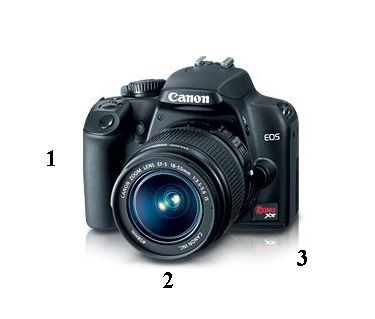
The position of the left hand depends on how big your camera is. If it has a lens as big as the one in the picture or larger, support the lens from the bottom at the middle of the length of the lens (position 2) using your left hand. Hold the lens gently using your thumb and the index finger. If your camera is small and doesn’t have such big a lens, support the camera at the bottom left corner and hold the body gently. Do not hold very tight from either of your hands. When you are pressing the shutter release button, try to keep rest of your hand stable and gently press the button using the right-hand index finger.
If you are shooting in low light, avoid using the LCD and use the viewfinder instead. Holding the camera closer to the body allows your hand to remain stable.
Use continuous mode. Use continuous mode if your camera support the feature. In continuous mode, the camera keeps taking pictures as long as the shutter release button remains depressed. Consult the camera manual to see how this can be enabled. Some low-end cameras may not support this at all. While shooting, hold the shutter release button until two pictures are taken. The second image is likely to see less shake, as your fingers would have remained depressed and not moved when taking this picture.
Advanced Settings. If you are not shooting full auto and your camera gives you considerable creative freedom, you can increase the ISO till you feel confident about getting the right shutter speeds. The downside of this is, the image can turn out grainy due to the noise introduced at higher ISO. If your camera or lens supports some image stabilization technologies, make sure it is turned on.
Use a tripod and cable/remote release. This is recommended only for serious photographers. The effort involved in lugging a tripod is simply too much unless you are very serious about photography. While in most cases it is sufficient to use tripod alone, best results are achieved if it is used along with a remote release(a very basic remote control that does the function of shutter release button) or cable release(a cable extension with a shutter release button). In case you don’t have a cable release, it helps to put the camera on timer mode and take the picture.
IMAGE REVIEWS
The image below is posted by flickr user manisholiday

This well executed shot is perfectly exposed, which is not easy in the dark interiors of the monasteries. The colours have also come out well, and the line of lamas are well places at a side of the image. The viewer’s eyes clearly lead to the sitting lamas who are the focus of the image. The image would have come out much better if the Dung Chen(the two long instruments) were completely in the frame. With the tip cutoff, the viewer fails to get a good perspective of the length of the instrument and it feels incomplete. Besides, the round long end of the Dung Chen would also add a visual appeal to the image.
If you would like to have your images reviewed to know what worked well and how it could have been improved, choose some of your best images, post it on group pool of India Travel and Photography and tag it as itpcritique.
