It was Pico Iyer who made me long to visit Lamayuru. In his enchanting travel story on Ladakh in New York Times, he describes the approach to Lamayuru and its mountains with extra vigour.
“… along a zigzagging, one-lane road that winds up and up above a sheer drop, I recalled at every heart-stopping turn why the word “gompa” means “solitary place,” until suddenly, as we rounded a corner, Lamayuru Gompa was there before us, high up on a cliff.
…I had thought myself hard to impress after traveling for decades across the Himalayas, I heard a gasp escape my jaded lips, and realized I was glimpsing a location even more unlikely than that of the Potala Palace in Lhasa, and a temple even older than that wonder of the world.”

I put Lamayuru high on the list during my first visit to Ladakh, but did not expect the journey to become an adventure. The day before I was to travel from Leh to Lamayuru, clouds had taken over the sky all over Ladakh. Heavy rains through the night had fueled angry streams that poured truck loads of mud on the roads and broke bridges that they flowed under. The next morning, an hour’s journey from Leh, we were stopped by a landslide – a slushy mass of mud under which the road had disappeared.
That, however, wasn’t something to worry about. Clearing the road was a ten-minute job for the BRO earth movers, though the powerful machines took more than an hour to arrive at the location. The real trouble awaited us only a kilometer ahead, where a roaring stream had taken away an iron bridge that came on its way. Unlike our last obstacle, this one wasn’t going to be put back in shape in ten minutes. We had to find another way out.
As we waited and the day progressed, vehicles kept piling up on either side of the road. Some villagers built a temporary walking bridge by laying poplar stems across a narrow crossing. Buses arriving on either side struck deals to exchange passengers. It took a few hours of waiting, but eventually we were on our way.
On reaching Lamayuru a few hours later, I realized that the landslide had worked to our advantage. The day before our arrival, every guesthouse in the village was running full and a few people even had to sleep on the veranda of the houses or floors of restaurants. But thanks to the closed roads, taxis weren’t plying today and the tourist crowd had stayed off. Guesthouses were going empty.
The prize for arriving at Lamayuru was a view found nowhere else in Ladakh. The mountain slopes below the village once supported a now-drained-off gigantic lake. The slopes that were once under water appeared like a big splash of yellow butter over the otherwise dark-brown mountains that rise steeply from the base of the valley. Often called ‘moonland’ by the locals, these gently undulating mass of hardened mud was supporting a glacial water body that existed millenniums ago. With the passage of time, erosion from wind and water had created curious patterns all over the slopes – some like bastions of castles rising above the steep cliffs, some like smooth sea of sand dunes and some that looked like massive cheese blocks with many holes in them.
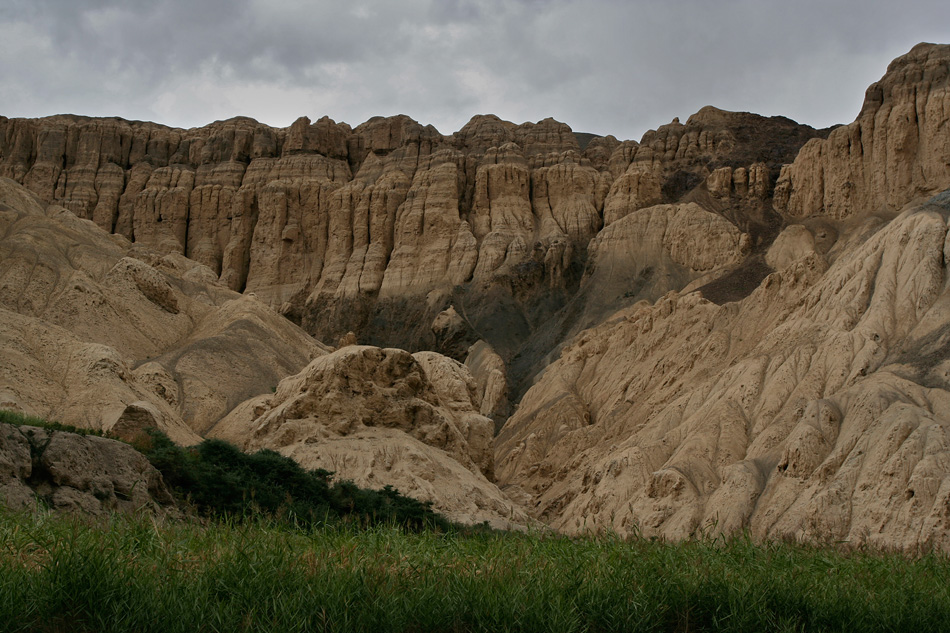
Standing high above these magical slopes was the monastery of Lamayuru built over the mud-castles created by nature. The monastery’s construction crept into the crevices under its foundation, with its doors and windows making surprise appearances to break the contiguity in the slopes holding them. A bunch of chortens stood high above the monastery, making an effort to stretch a little higher the already-high mountains that reached for the clouds.
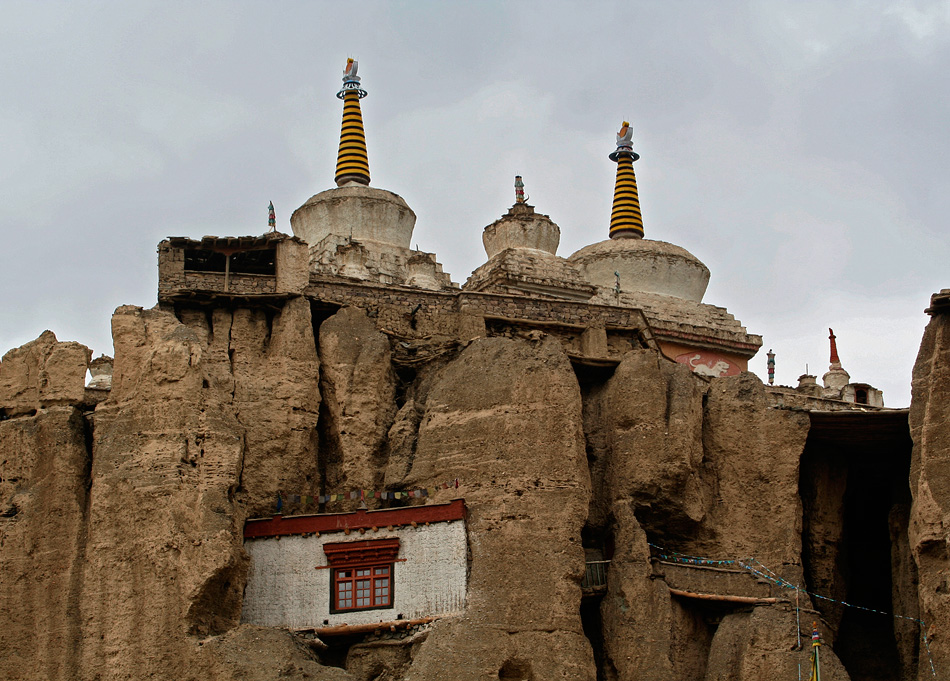
The monastery’s past is a mix of history and legends. It is one of the oldest Buddhist Monasteries in the region, built in eleventh century by monk Rinchen Zangpo who was known for his translation of Buddhist texts from Sanskrit to Tibetan. The monastery was a witness to several confrontations between the armies of Ladakh with those of Kashmir and Central Asia, with fortunes swinging in different ways through 13th century to 15th century. The monastery had to be rebuilt again after it was completely destroyed by the army of King Zorawar Singh in early 19th century. When Central Asian armies retreated from Lamayuru after facing natural calamities created by protective forces, the place was declared a sanctuary for criminals, who were deemed free of their acts after entering the boundary of the monastery.
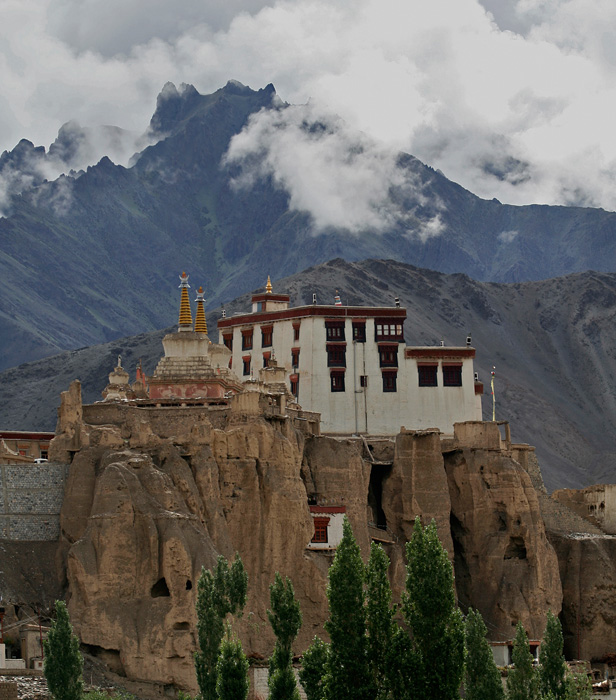
I spent my days in Lamayuru walking up and down the slopes that offered me many perspectives of the ‘moonland’. The roads, usually empty but now completely silent thanks to the broken bridge, allowed us to walk in peace without the occasional noises that broke the peace in the mountains. The clouds that had threatened our arrival at Lamayuru continued to hover over the mountains, but did not create further trouble. Two days later, when the news came that a new bridge was now ready in place of the broken one, it was time for me to return before a new wave of visitors would hit Lamayuru.
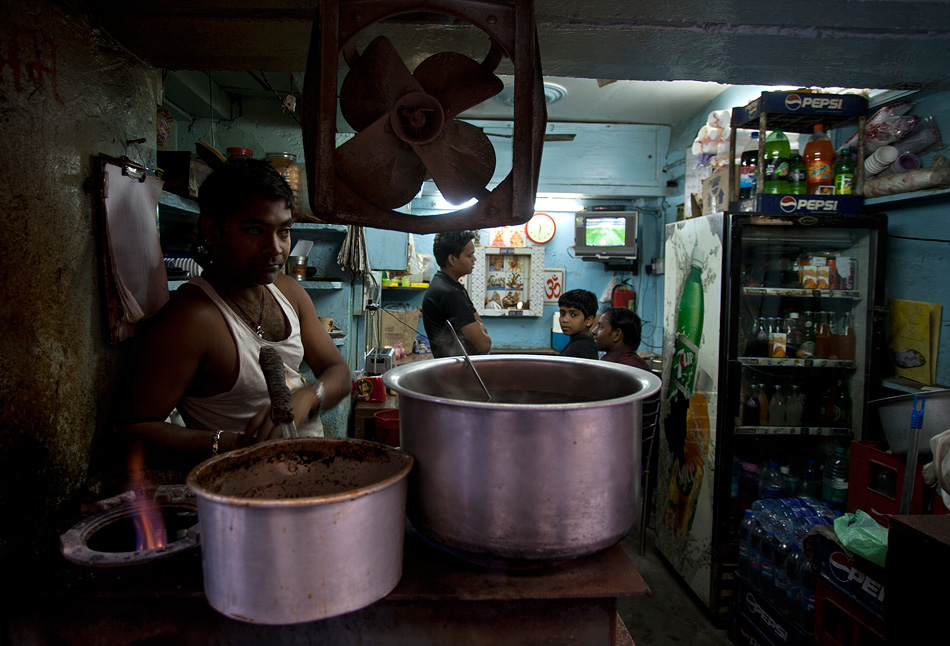
I found this eatery when we were walking through the small lanes around Chandni Chowk last week. The place had many elements of interest for the camera – the blue background, play of light, big aluminium vessels and a burning flame. The man of the shop was very willing to be photographed and was very candid with the camera, which helped me make a natural-looking image.
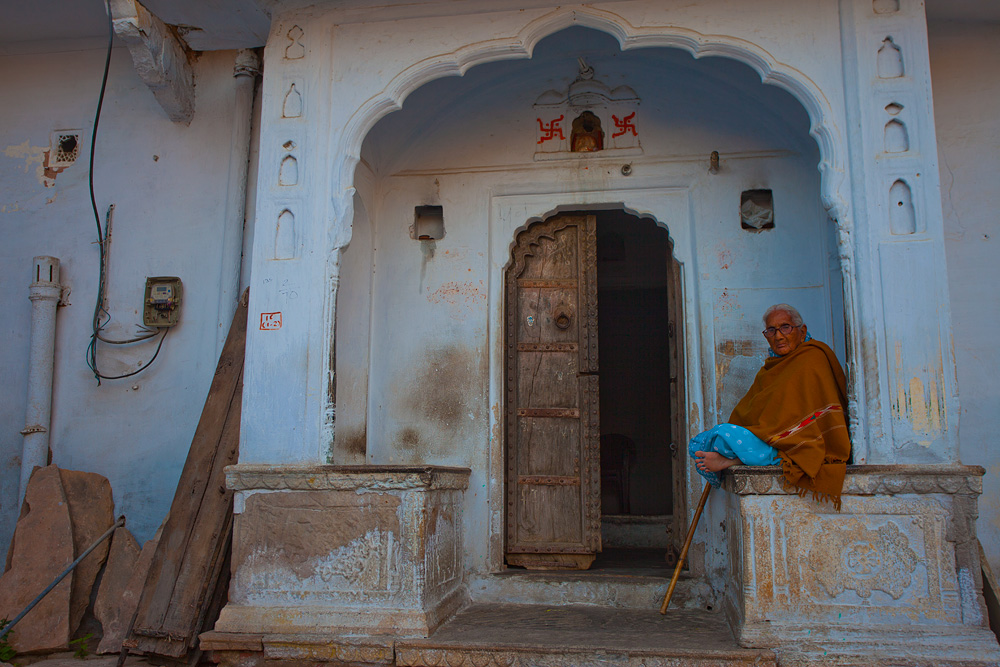 Strolling through the lanes outside the touristy quarters of Jaipur, we entered a small lane crowded with houses. As I have occasionally seen in these parts of the country, the lane expanded into a spacious quadrangle surrounded by tightly packed houses. A few cars were parked at the center. A cow–there are few places where you won’t find one–tied under a tin roof stared at us uninterestedly. An elderly lady sat on the veranda of her house, spending the evening in solitude. I first thought the house was a temple, thanks to its decorative arch and a tiny altar above the door with bright saffron swastikas on each side. The lady responded in affirmative when I requested her permission for a photograph, but did not say much else.
In the meanwhile, we had caught the attention of a bunch of elderly men who sat in a circle and whiled away the evening discussing politics. One of them started talking to us and immediately, without our realization, a connection was established between the visitors and the locals. Ice was broken and conversations flowed freely. The strangers at the quandrangle, who had now transformed into our hosts in a matter of few seconds, took turns to introduce themselves. One was a retired government official, one was a priest and another one was a musician. The eldest man in the group, who was a generation senior to everyone else, remained silent and watchful. We all were sitting on the veranda of the musician’s family, which had once served the kings of Jaipur. They were proud about their achievements and took us into their house to show the instruments they possessed (a harmonium, a flute).
And then, as it normally happens, questions were asked about our professions and our whereabouts. Of course, at the end we were asked to stay on for a cup of tea.
As a photographer who often encounters and speaks to strangers all over the country, I have seen people react to our cameras in a very predictable way. They usually come in two extremes – very friendly or very unwelcoming. The more touristy a place gets, the more camera-toting people a place sees, the more likely that the encounters are the latter kind. The farther you get, the more you move off the highway, it is more likely that you find friendlier people. And then there are always hidden places just round the corner from a well-known place where you still see hat friendly smiles not compromised.
It is perhaps a natural progression that happens to people who often find themselves pointed with a camera, more often than not unsolicited. At first, one may find it charming that they are being photographed. But as it becomes a common practice, and as the photographers attempt to capture them more in the form of an exhibit from a distance than a fellow human being, it is expectable that the people get distressed or want something in return for their contribution. But I am digressing; let me come back to our encounters in Jaipur.
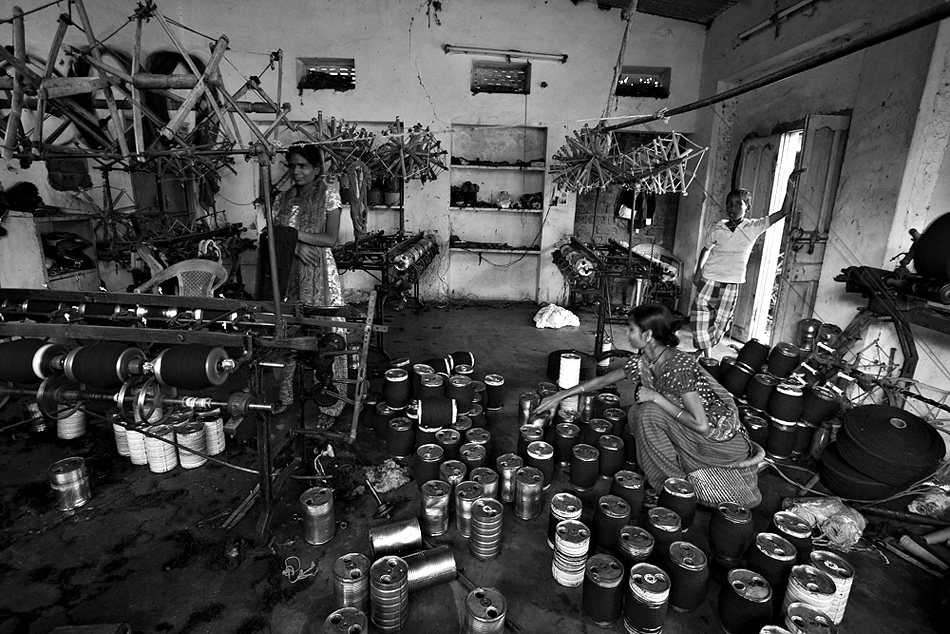
A factory producing yarns.
It was one of those corners just outside the touristy attractions of Jaipur, where we found these friendly men who were very welcoming. After exchanging contact details and a promise to email photographs (to granddaughter’s email id, which they referred to as ’email number’), we headed out in search of more of this Jaipur beyond its well-known monuments. In the next one hour, we encountered frolicking children, women carrying water from public taps and a small factory producing yarns.

Life outside Hawa Mahal, Jaipur.
Our day of gallivanting in Jaipur was made of a series of such encounters that stayed in memory. We began as everyone did, peeping through Hawa Mahal and walking into City Palace, but kept an eye on the more down-to-earth encounters. The bustling life outside Hawa Mahal has always been one of my favourites, where the pink edifice offers a grand background for rickshaw pullers, vegetable vendors, bicyclists and every other type of people in a city that still breathes its past.
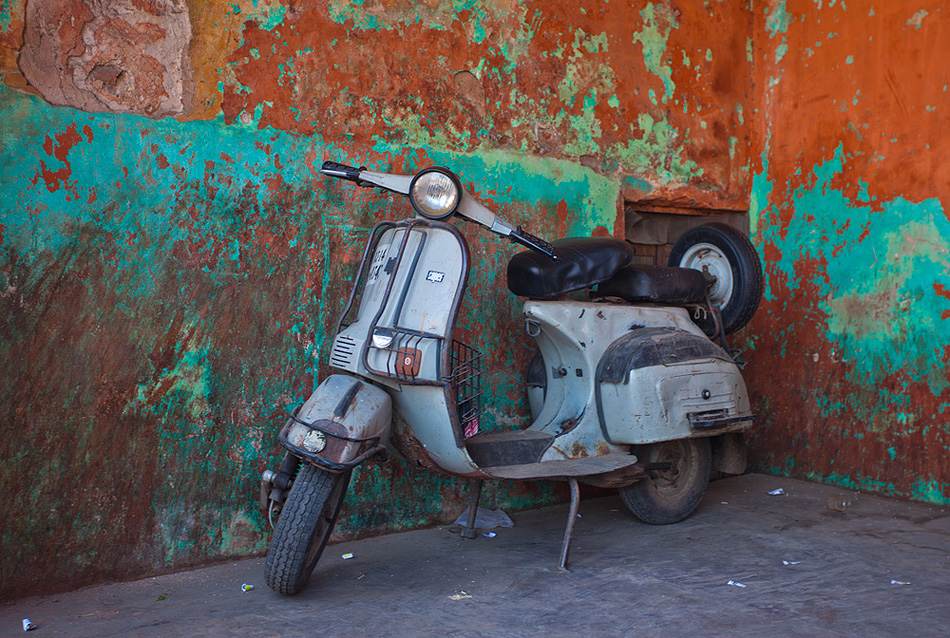

Streets and markets of Jaipur
Later in the day, we walked through the local markets that are not very far from the heritage site,s but are rarely seen by the hoards of tourists flocking the monuments. The variety and colours in the shops were overwhelming. Here too, people were welcoming and were happy to stand in front of the camera. My encounters of the day included a jeweler with a nice long beard, a hardware store owner with a smug smile, a colourful display of flowers and a scooter parked in front of an old wall with paint peeling off.
We had begun that day with the cameras on the shoulders, passing through Jaipur’s well-known sights like the Hawa Mahal and Gaitor, but keeping the eyes open to everything around them. As the day progressed, we saw ourselves spending less and less time at the monuments, dwelling more in people interactions and straying towards places less frequented. It was one such walk along the lanes outside the walls of the old city, which had taken us to those friendly group of elders at the end of the day.