Baba Rakeshji from Rishikesh
In the past few months, I have been focusing my energies on connecting with people from the places that I travel to. There is a certain charm in knowing about the lives of people, how they grew up, their occupations and in connecting the story of the people with the character of the place. They are not well-known faces; they are not the local chieftain or celebrity types. You would not turn your head and look for a second time if you pass them on the street. But every one of them have a story to tell. And everyone has a story from which we can learn, expand and come back a little more evolved. My first conscious effort in this was a brush with Rakesh Baba from Rishikesh, a man who left everything and came here in search of peace.
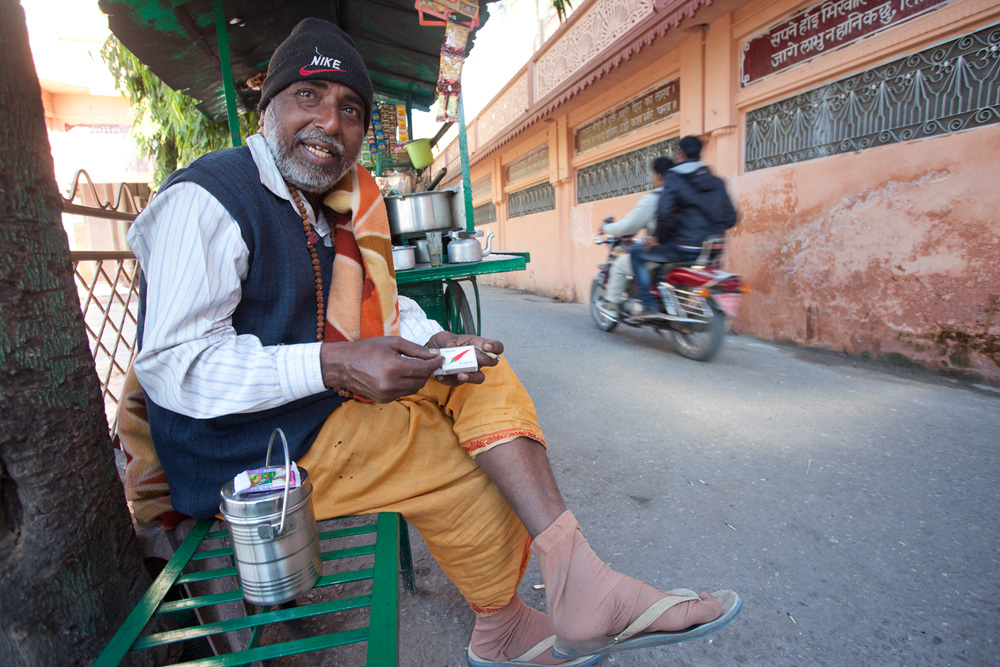
I met Rakesh Baba on a winter morning in Rishikesh. It was at one of the ghats leading to Ganga, where I saw him feeding leftover loaves of bread to a pair of dogs that happily wagged their tails behind him. We exchanged glances, and from my past experiences, I immediately knew what he would say next.
“baba ke liye chai pilado” – help baba for a cup of tea.
I had heard these words in several occasions during my earlier visits to Rishikesh. Unlike before, this time I was waiting for those words and hoping that it would become a conversation starter.
I nodded to baba in affirmative, and instead of the usual practice of handing over a coin, I offered to buy him a cup of tea. We walked together to a tea-cart on a narrow lane by the river and ordered for two cups of milky-sugary chai.
It was a pleasant and sunny morning in Rishikesh. I had arrived here the day before, after a rushed visit to Agra and Varanasi on work, hoping to spend much of my time relaxing by the river. Before I met the baba, I was sunning on the river bank with a book, indulging in a story as much as in the song of the gurgling river. It was a bright and sunny morning – the kind of day that is cherished during the winter months. A nip in the air was well-compensated by the shining sun. The day was perfectly scripted for spending by the river, a book in hand.
I was down a couple of chapters into the book when baba arrived on the scene, altering my plans. Over a cup of tea, it did not take much time for him to get talking. He spontaneously went on a monologue, telling the story of his life, unasked.
Rakesh-ji worked as a trucked driver during his life before babahood. He drove his truck along the length and breadth of the country, though he was confined to a few routes for a good part of his life. When he came to know that I was from Bangalore, he instantly named a few places in the city and talked about the big towns on the highway approaching Bangalore from north. Journeys in his truck had taken him to the mountains of the north, deserts of west, remote corners of the east and to the edge of the country in the south. His base was in Delhi, but work kept taking him across the country.
Driving trucks was a work of choice for Rakesh-ji, though he distinctly understood that it is not a coveted choice of career for most people. “My father is a retired magistrate in a Delhi court and my brother works in the police department,” he said, “I went to college, but I really wanted to become a truck driver.” His tone indicated that he wanted me to understand that he took to driving trucks not because he did not have any options.
Before he quit work and moved to Rishikesh to live the life of a baba, he had a family comprising his wife and a son. Rakesh-ji’s wife had died a few years back, while his son was married and worked in a bank. Life had probably settled to a predictable pace.
The moment of change arrived about two years ago, when his truck was rammed by a drunken driver on a highway somewhere in Gujarat. Rakesh-ji survived the accident, but the fingers of his left hand permanently lost their strength and he could no longer use them for any work. Driving trucks wasn’t possible either, so he had to quit driving and retire to his house in Delhi.
Troubles began with his retired life. Rakesh-ji’s son had picked up a drinking habit and wasn’t treating his wife and child well. Rakesh-ji was deeply upset and could not fathom the fact that his son had turned out this way. One day, he decided to leave home, without carrying any possessions whatsoever, and came to Rishikesh to live as a baba. He has been living here for nearly a year now, sleeping on a temple floor and depending on a dharmashala for food. He has a spiritual guru living in Moradabad, whom he visits whenever he wishes to. He hasn’t told his son about his whereabouts, but has kept in touch with his father and brother. He doesn’t think or worry much about his future, but hasn’t completely escaped his past as well.
There were several questions that kept coming to me throughout his narration. By this time, we had grown comfortable with each other for me to ask those questions. What happened after the accident? How did he find his way to Rishikesh? What keeps him here and what provokes him to live the life of a mendicant? Is he looking for solutions to his problems in another world? Some questions had answers, and some did not.
The accident and his son’s drinking habit were largely the reasons for change. The truck-owner paid for his hospitalization after the accident, but doctors could not revive his left hand. His days of driving trucks had to end, confining him to a retired life in Delhi. The fact that his son came home drunk everyday did not help much. Rakesh Baba deeply hated alcohol. Time and again, he would break his story to tell me that he could not imagine living with someone who had a drinking habit. “In all my years, I haven’t cultivated any habits except beedi and chai,” he told me again and again, “I never did drugs or alcohol and can not tolerate people who do.” I can’t remember how many times during our conversation did he emphasize on this dislike to alcohol. Sitting at home after the accident, it was hard on him to see his son coming home drunk. He decided to leave the house and head to Rishikesh. But like any parent, he would still spend nights thinking about his son and the family, deeply pained at times and perhaps wishing that things were different.
His time in Rishikesh was largely spent singing Bhajans with other babas, waiting for his share of food in the Dharmashala or making conversations over a beedi and chai in the lanes adjoining Ram Jhula. He was one of the lucky few who was allowed to sleep in a temple premises and did not have to spend the night on the streets. Yet, he was finding it hard to spend the winter nights with just one thin blanket and a couple of woolens that he possessed. He suffered from diabetes and was treating it with some kind of a traditional medication. He did not seem to be thinking much or get worried about his future, but largely lived his life one day at a time. His past, however, still haunted him.