Ever since I travelled to Ladakh with expedition leader Manish Lakhani, who took me on the fabulous Chadar Trek, I have been longing to return again in a winter. I have been itching to visit Pangong Lake in winter months when it freezes over.
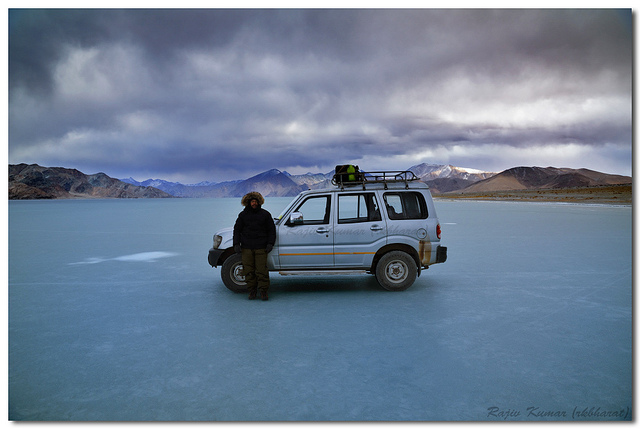
Pangong Tso in winter. Photograph by Rajiv Kumar Bharat; reproduced with permission.
This January, I am back in Ladakh, again with ever-reliable expedition leader Manish. While I am skipping his Chadar Trek (if you ever want to go on Chadar, he is the man to go with) this time, I am joining him to explore the winter season at Pangong Lake and surrounding areas. Our itinerary is fluid, except for the date of arrival and exit. Join us, if you are interested in exploring the stark landscapes of Ladakh in a time when few people dare to venture in this region.
Dates
+ Arrival in Leh: 28th January, 2013
+ Depart from Leh: 3rd February, 2013
The Itinerary
During the seven days that we are spending in Ladakh, here is the rough itinerary that we are looking at. This itinerary remains fluid. Do note that the weather and administrative difficulties play a role in executing this plan. Any changes in the itinerary would keep in mind an interest to see beautiful places in Ladakh in winter glory.
- Rest day and acclimatization on arrival – 1 day
- Pangong Lake – 1 to 2 days
- Tso Moriri – 2 days
- Monasteries and interesting places around Leh OR drive to Hanle close to the border to Tibet – 1 to 2 days
- Departure day – 1 day
Contact me if you intend to join this tour. Please do not leave a comment.
The desktop calendar wallpaper for November 2012 is Bhuthanatha Temple in Badami on a rainy day. Download 1336×768, 1280×800 or 1024×768 as your wallpaper.

This article was written for Terrascape, a travel magazine where I write a monthly column on photography.
For most travellers, it is a natural tendency to look for popular and well-known subjects when it comes to photography. So, when we travel to a beach-side holiday destination, we aim our cameras at the colourful sunset over the sea. In a town known for its rich heritage, we are likely to come back with photographs of famous monuments. The list can go on to subjects like waterfalls, mountain peaks, etc. But have you ever thought about photographing that small tea-shop next to your viewpoint? Or did you ever try exploring traditional occupations of people at a destination with your camera? Such digressions can often help you discover an unseen beauty that is not mobbed by every person with a camera.
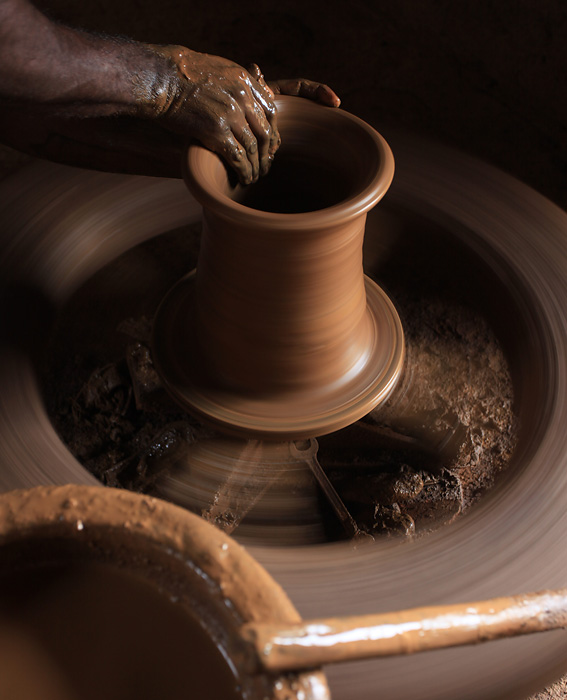
The best way to explore such less-known options is to allow yourself ample time and take a walk with your camera in a new place. It helps, if you have already done some research on the place and have some idea on what to expect. Some of the best sources of such information can be other photographers or travel journalists who may have visited the location in the past.
Personally, one major subject that fascinates me is crafts and workmanship from a region. The more complicated these are, the more appealing they are likely to be for the camera. For instance, I was spending a few days travelling around Thiruvananthapuram and photographing its locales for a story. In my first visit to the city, I went around Kovalam Beach and Padmanabhaswamy Temple– the well-known places to see. The next time, I spent some more time researching for interesting locales, and found a fishing town and a colony of traditional handloom weavers just south of town. These places not only showed me interesting faces of the city, it helped me make images that not every photographer will come back with.
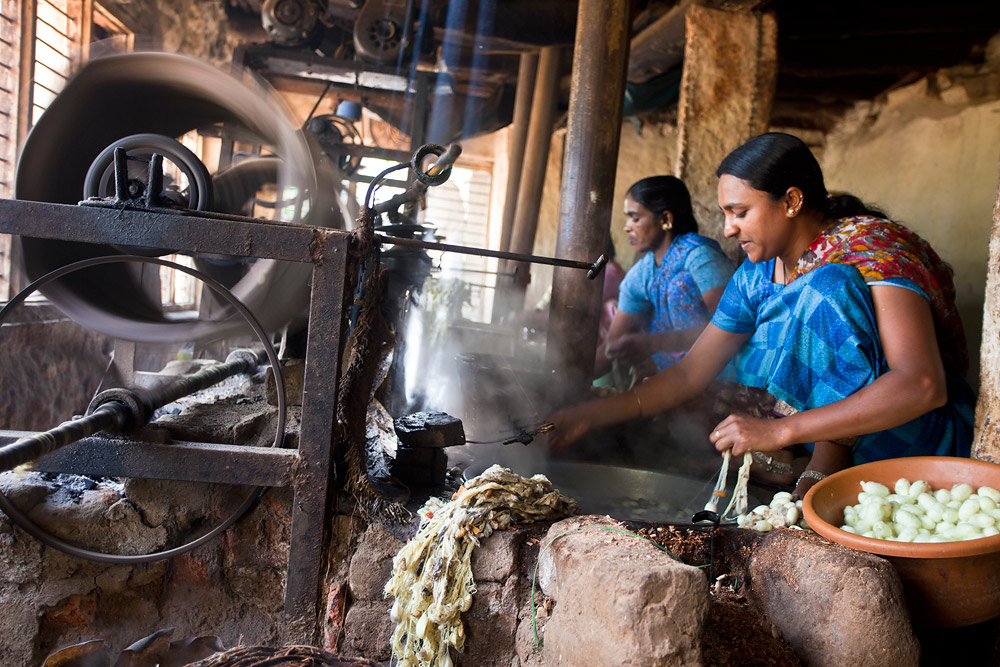
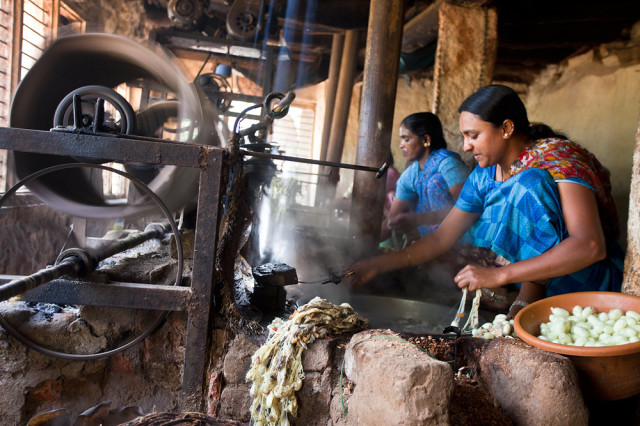
Another instance I recollect is from Nandi Hills, a picnic place near Bangalore. Most photographers go to Nandi to capture the landscape or birds in the area. But not far from this favourite picnic destination of Bangaloreans is a village that offers many unusual photography opportunities. One such place was a cottage industry, where half-a-dozen women worked extracting yarn from silkworm cocoons. It was an unusual place where rusted wheels were turned by a sooty motor, which accumulated shiny fiber of silk extracted from the cocoons.
Very often, such crafts are limited and specific to a locale that you may not find everywhere. And you will always find something interesting no matter you go. For example, you may find people making kites in the lanes behind Taj Mahal in Agra. Just outside Jaipur city is a well-established business of making hand made paper. Seek such occupations that make excellent digressions from the main scenes that attract everyone’s attention.