The Monastery at Thiksey is one of the places that I much like in Ladakh. Naturally I was excited when I got to know that I will be able to make another visit to the monastery during my trip to Ladakh last month.
The place was much different last month and looked desolate, unlike my earlier visit in summer time when it was buzzing with tourists. It is a large monastery with more than hundred resident monks, but it was so empty this time that I saw no one except a monk who showed us around. There was some change in the landscape too. The arid and brown mountains around Thiksey were dressed in fresh snow. The Indus Valley, which is one of the greenest places in Ladakh during summer months, had lost its colours to an expanse of white. Some images from visit to Thiksey last month.
Also read my two-part travelogue on Thiksey from the earlier visit.
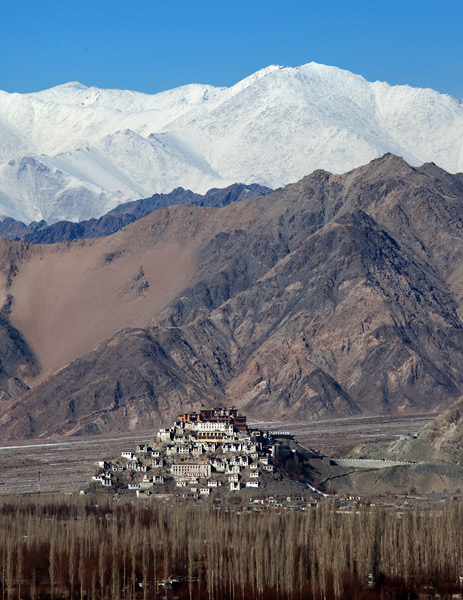
The dramatic setting of Thiksey Monastery
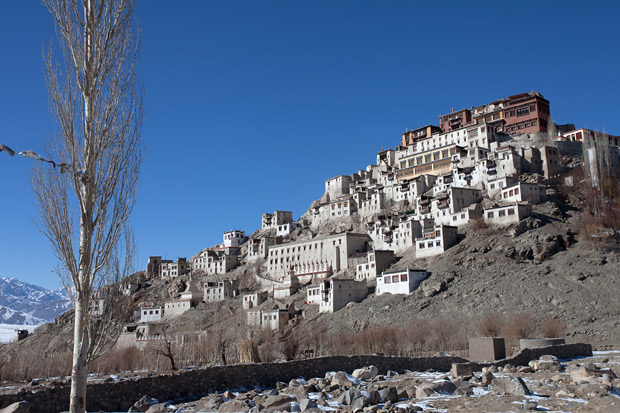
The monastery complex is often compared with Potala Palace in Lhasa
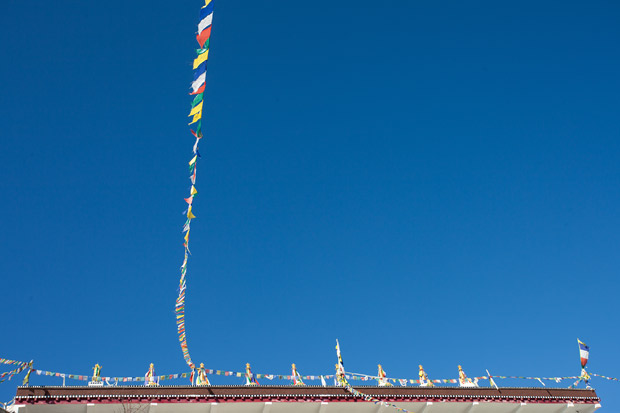
Chortens and Prayer Flags (?).
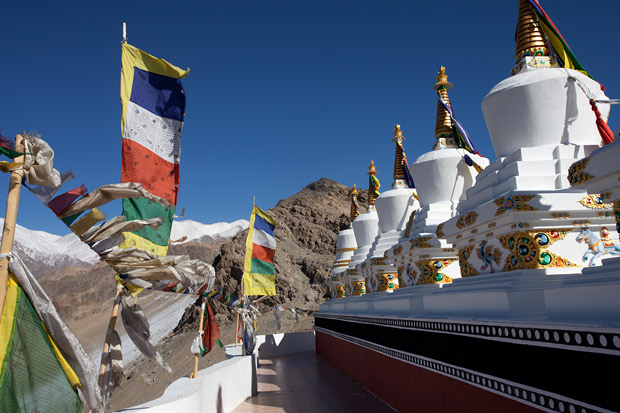
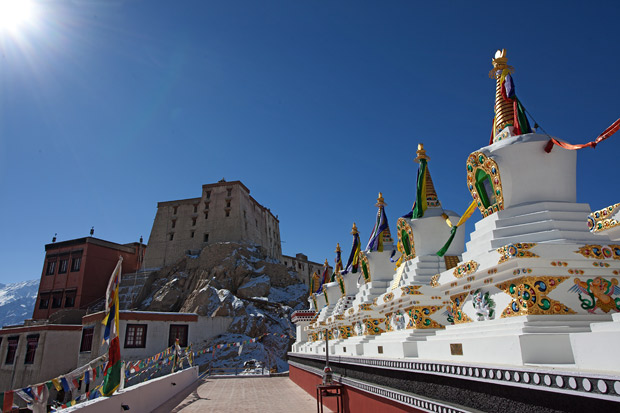
Chortens, monastery, super-blue skies and a bright sun.
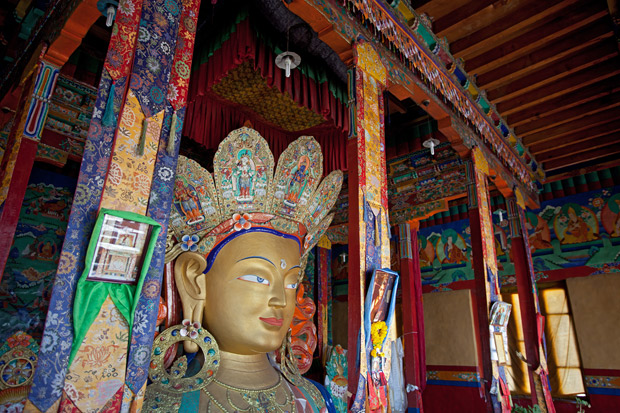
The two-storey high Maitreya Buddha statue at the monastery.
Prints of all the images available. Request for prints
When Lady Luck has her eyes set on you, she makes appearances in unlikely places and in unlikely ways.
A Snow Leopard was the last thing I was expecting during my two-week trip to the heart of Zanskar. Being winter, I was hoping to see and photograph no more than a bird or two at the villages we encounter on the way. Our guide Lobsang, who had been beating these tracks for more than ten years had never seen a Snow Leopard in this part of Ladakh. Same was true with our tour leader Manish, who had been visiting Zanskar every winter for the last five years.
It was the ninth day of our trek and we had begun the downstream journey from Zangla Village in Zanskar to Leh. Taking advantage of the roads built to traverse within the remote regions of Zanskar, we were taking a car for the first fifteen kilometers before the road ends and the walk begins.
As we were driving from Pidmo Village to Tsarak Dho, someone in the car spotted a group of Ibex on the other side of the slope, perhaps about half-a-kilometer away. The Ibex, about a dozen of them, were sprinting fast along the slope. For a moment we wondered why they were running so fast. Someone suggested that they were perhaps scared by our car. But we were too far and that was unlikely. Gazing at them from the window of the car, I silently wondered what made them sprint. That’s when I saw an odd one in the group. The last one among the runners appeared to have an unusually long tail, unlike rest of the group with short raised tails. I shouted to Lobsang with excitement and said, “something is chasing them.”
Lobsang, who has grown up in Changthang region seeing many snow leopards eat up their sheep, had a second look and decidedly said, “it is a snow leopard.” There was a sudden burst of excitement in the group. We stopped the car and got down quickly for a good look.
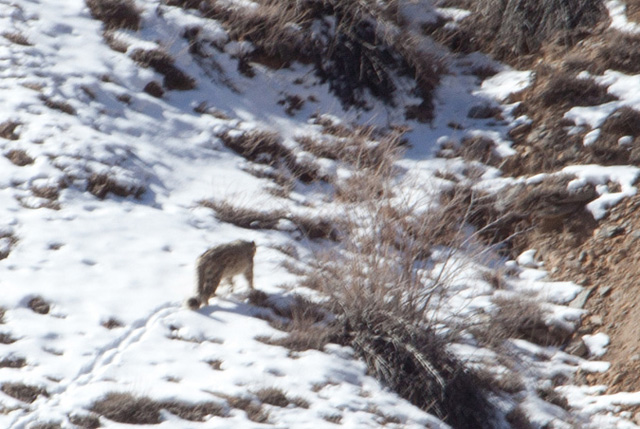
While we were getting out from the jeep, the action on the other side of the slope had come to an end as quickly as we had seen it begin. The group of ibex had managed to give a slip to the leopard and the chaser had given up. A few ibex had got separated from the group, but none were in the danger of being caught. We lost sight of the leopard for a few seconds until Lobsang traced it again, emerging slowly from a depression in the slope. It now walked slowly up the hill with a grace that only a big cat can display, despite having lost chase. Its head though, was drooped and barely seen from the distance that we were at, perhaps with a sense of resignation arising from the failed chase.
As he walked slowly uphill on a scaly patch of snow, I asked Lobsang to keep an eye on it and returned to fetch my camera from the car. The leopard allowed me a few poor-yet-recognizable shots before it went behind a bush and out of our sight.
On visiting the villages of Dha and Hanu, we realized having fallen into a tourist trap. But we did manage to get the best out of the two days spent in the area.
Dha-Hanu region became a dot in the tourist map because of its people. Brokpa or Dards, as they are called, speak a different language than Ladakhis. They have a culture different from Ladakh and are a small community of just two thousand people surviving in the western part of Ladakh. But the single fact that has become a selling point for travel agents is that they wear very different clothes. Or that’s what we were told.
Perhaps Dha-Hanu was never a part of tourist’s itinerary when Ladakh was initially opened to people outside. Let me think of the sequence of events that would have helped Dha make the mark: some anthropologists would have toiled hard to dig out details of a community that the world had forgotten. They would have spent a year or two studying their way of life and their origins to publish a scholarly paper. Some enterprising men would have picked up interesting facts from these papers, taken photographs of women in traditional clothings and sold it to tourists in Leh. Some adventurous backpackers would have followed the trail to Dha, came back to spread the word about the last of the people who belong to an interesting community. The result: an explosion of tourists who could go extra mile to see some thing interesting or some people exotic.
When we asked around for specialties of Dha-Hanu, two things stood out. The driver who took us from Tso Moriri to Leh told us that the people here speak a different language and wore a different style of clothes. This was reiterated by further research where we learnt about this race of people who did not share the traits of people of rest Ladakh. It seemed worth making a visit. Not that the clothes they wear mattered much, but it would be worthwhile seeing more corners of Ladakh and meet more people.
As we alighted the bus at Dha, all that we saw were a bunch of men wearing shirts and trousers and women wearing salwar. That was alright. Perhaps only the elderly people wear traditional clothing. Or perhaps just elderly women. May be we have to go deeper into the village to meet a few of them.
The mystery was unraveled the next morning when we were talking to Dolma, the lady of the guesthouse where we were staying. “They wear those clothes when tourists ask for it,” she told us, “tourists usually pay them to do so and take their photographs.” It was an obvious tourist trap. It is so overdone that now it is a common and accepted routine for tourists to visit Dha – Hanu, have some locals to wear their traditional clothes, take photographs and go back. Dolma asked us later if we weren’t planning to do it. We weren’t. When I casually took a picture of a lady at the village (who was in her everyday clothes) later that day, she came to me and demanded that I pay up. Uncomfortable with taking pictures of an unwilling person (and not wanting to pay), I decided to delete the image instead. But another lady we met a little later was more willing.
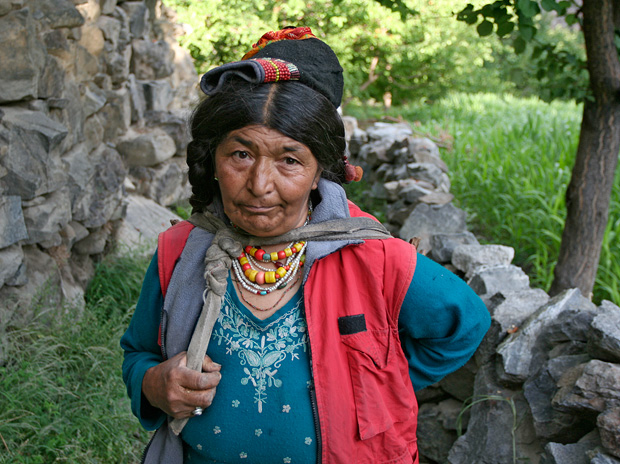
People here do look like they belong to a race different from Ladakhis. They look more Central Asian and less mongoloid. They are also more modernized than rest of Ladakh. Although they are Buddhist, they are less devoted than Ladakhis and the monastery in the village doesn’t seem to be well attended to. A French anthropologist who was at the guesthouse gave us some idea about the complex system of relationships between people in their society, which seemed very convoluted and was much different from polyandric society that Ladakh used to be.
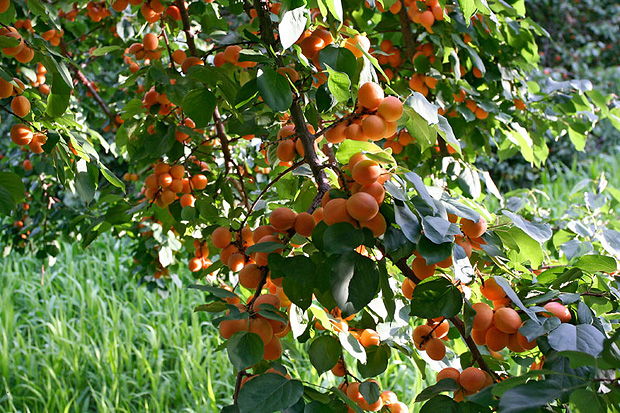
An apricot tree, fully loaded.
There is a visible difference in the attitude of people as well. The smiling faces and jubilant ‘julleys’ that you encounter everyday in Ladakh was missing in Dha-Hanu. But what they lacked in cheerfulness, they made up in their hospitality. At Baldes, a nearby village, we were invited for lunch by a kind lady whom we met on the road. As we walked back from her house later in the day, another man whom we met on the way called us in to have some snacks. A lady whom we met a little further on the road invited us for tea. I don’t remember any place, even in the hilly regions full of large hearted people, where every stranger you meet invites you home for refreshments.
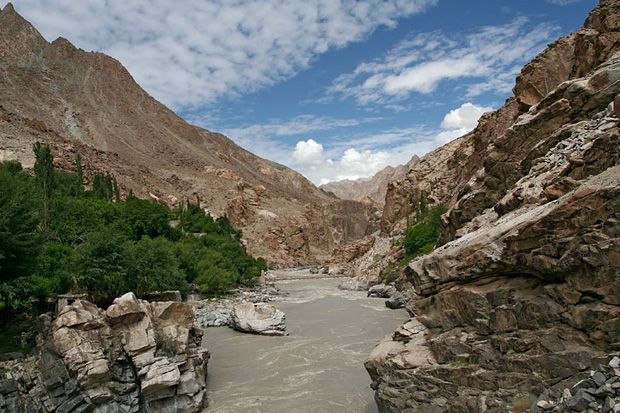
River Indus at Dha
But Dha is not just about its people. We had fallen in love with the village the moment we took the narrow path from the bus-stop to the village. The place was covered in lush greenery unseen anywhere else in Ladakh. Everywhere I see, branches of apricot trees were drooping with ripened fruits. The vegetable gardens spread all over the village were covered with cauliflowers and cabbages ready to be plucked. Even in the guesthouse where we stayed, ripe grapes were waiting to be plucked right at the courtyard. I could reach ripe apricot fruits just by stretching my hand from a window. It was so beautiful that I did not have to care what the people here wear.
The mountain slopes here are steep and are a rich hue of brown. River Indus flows swiftly next to the village in a narrow canal, sometimes so narrow that I wonder how it manages to hold all its waters in such a small space. Dha was worth a visit even when it turned out to be a tourist trap. It was two days well spent even when we did not bother to pay people to pose for us with their traditional attire.
Prints of all the images available. Request for prints.