A guide to Dzongs of Bhutan

If you are the kind who makes travel lists, there is very good chance that the list includes Bhutan. And then, even if you have read two paragraphs about the country, you would have heard about Dzongs that are one of the primary attraction for visitors in many parts of the country. Here is a short guide to understanding what dzongs are.
Introduction to Dzongs
Dzongs are dominating fortresses spread across the country. Often, they are so large and located strategically such that you can see them from miles away before you approach a town. As you travel through the country, the tall white structures of the dzongs with tapering mud walls that surround a yellow-roofed tower are something you will begin identifying with the landscape of the region.
Dzongs serve as the administrative and monastic centers for the twenty districts of Bhutan, called dzongkhags. They are usually divided into two parts, often separated by a tall central tower called utse. While one section is dedicated to administrative activities, the other part will be occupied by the monastic body.
Most dzongs are historical structures that were built two to four hundred years ago, while some were built as recently as the second half of twentieth century. Quite a few dzongs have been rebuilt since their first construction, as the generous use of wood has been a cause of many fire accidents that destroyed the original structures. The dzong at Wangdue Phodrang was destroyed by a fire as recently as 2011, and the work of rebuilding it is now in progress.
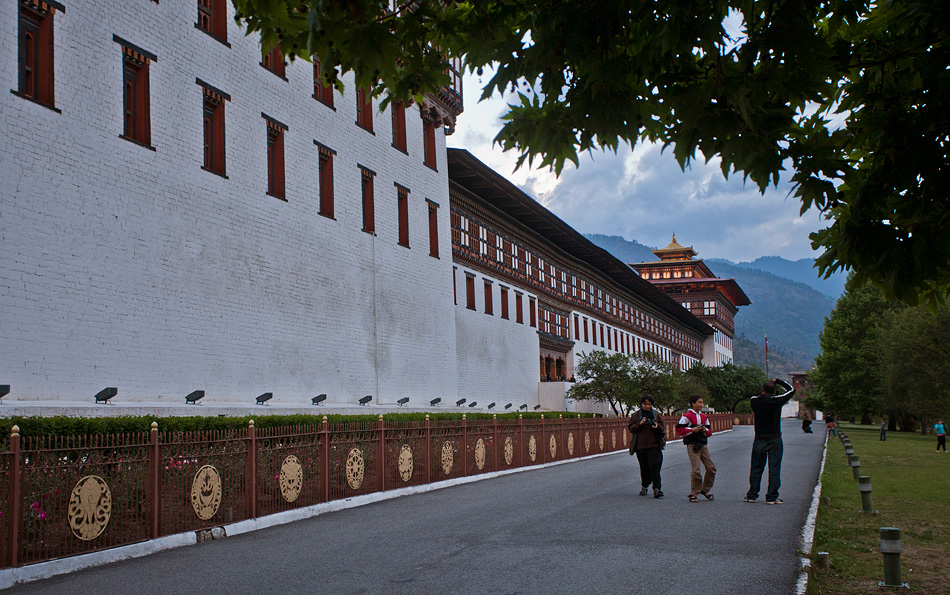
The Tashiccho Dzong in Thimphu is perhaps the largest of the dzongs in all of Bhutan, which now houses the central secretariat and the king’s offices. It is also home to the central monastic body in Bhutan. Punakha Dzong is perhaps the most beautiful among the dzongs that are easily accessible to visitors.
History
In early 17th century, Bhutan was unified under single rule by Shabdrung Ngawang Namgyal, a Tibetan monk who arrived here on a spiritual guidance. He and his followers subdued the local rulers and were instrumental in giving Bhutan its separate identity from Tibet. Several dzongs were built during the conquests and unification, which served as military bases to launch operations from. Subsequent to dominating Bhutan, dzongs became the administrative and monastic centers of the districts and continued to operate as strongholds to defend the country against later invasions from Tibet.
The practice of a dzong housing both administrative and monastic body has continued till today, although its purpose as a military base is no longer relevant. Several Dzongs we see today may have a history that dates back to 17th century, but the buildings that are found today may have been reconstructed during the course of time.
Architecture
Nearly all dzongs are built in the same manner and have a similar layout inside, although the outer structure may have different shapes depending on their location and space available. The dzong at Thimphu — perhaps the largest of the dzongs — is built at the base of Thimphu Valley and is a long rectangular structure. Rimpung Dzong in Paro is nearly square, built on the slopes overlooking the town. Punakha Dzong’s shape and size are limited by its narrow space between two rivers. The outer walls are usually built with mud – very thick walls that taper inward as they go up. The roof is usually standing on wooden planks.
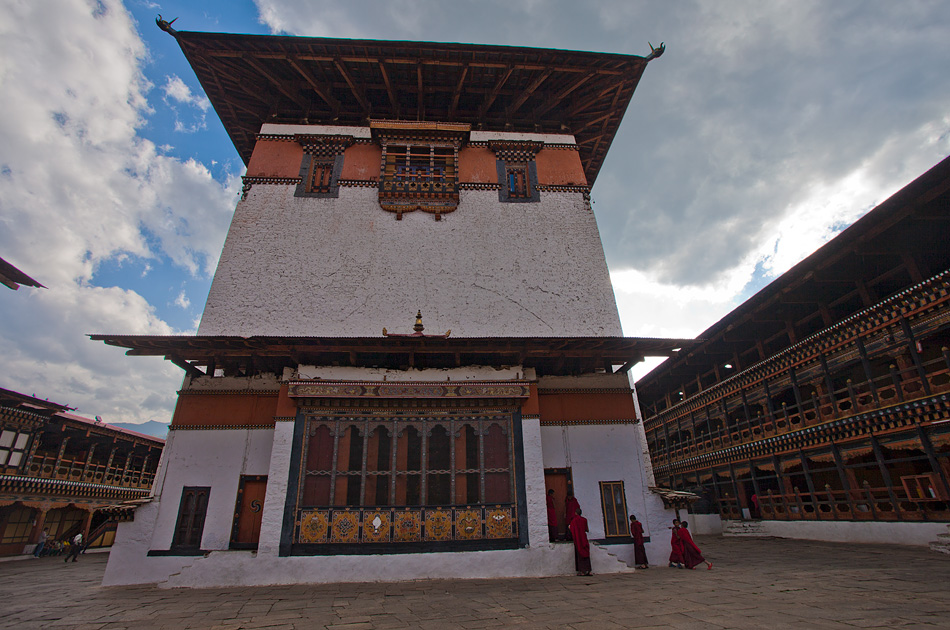
The central tower (utse) of Paro Dzong.
Inside, the dzongs have two sections — monastic and administrative — usually on different sides of the utse (central tower). The administrative side consists of offices, while the monastic section has prayer halls, temples and living area for monks. The utse, normally three to four stories in height, has a temple at the base level. On entering the dzong, you will arrive at a large courtyard with utse at the center. Monastic and administrative areas will be spread around the courtyard and adjoin the outer wall of the dzong.
For Travellers and Photographers
On your first visit to a dzong, you will never fail to admire the vastness of the courtyard, tallness of the utse and the elegance with which every other part of the dzong is designed. The utse induces a sense of grandness, while the generous use of wood around the courtyard and the temples bring in a sense of ancientness. The temples, usually a large hall with an altar on one side, are quiet places where you can sit and meditate for long hours.
Look out for young, energetic monks running around chasing each other, or sometimes engaged in chores assigned to them. It is a delight to watch the naughty, ochre-robed charmers moving around the courtyard.
Most dzongs remain open for visitors only till 6pm. Visitors from outside Bhutan are required to be accompanied by a local person. Dress formally, or you may be denied entry.
Even though they are similar in architecture, each dzong tends to have its own character, making it worth visiting more than one. Thimphu’s dzong is huge, and is approached through a long path with a beautiful garden on one side and the walls of the dzong on the other. The courtyard and utse are gigantic, making everyone appear tiny against them. It is a pleasure to watch ochre-robed monks walking next to the huge walls and prayer wheels at the monastic side of the dzong. Watch out for the fluttering pigeons, which add a lot of character to the place.
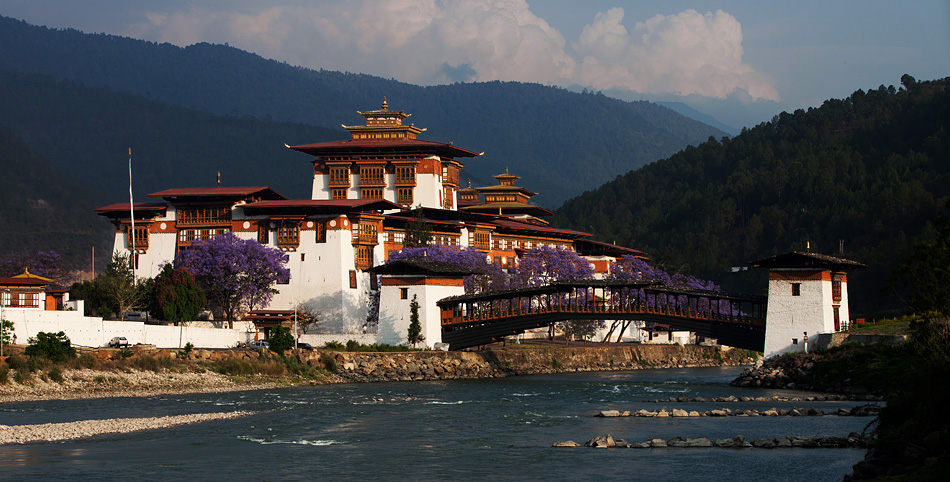
Punakha dzong scores high in the list of travellers and photographers, thanks to its brilliant location. It is located at the confluence of Mo Chu and Pa Chu Rivers, with tall hills dominating the landscape behind it. The dzong is accessed via a beautiful wooden bridge over Mo Chu. In summer months, Jacarandas bloom along the lane between Mo Chu and the dzong, adding a dash of purple to the white beauty that the dzong is. While you are here, don’t miss the floodlights adding glory to the dzong in the twilight hours.
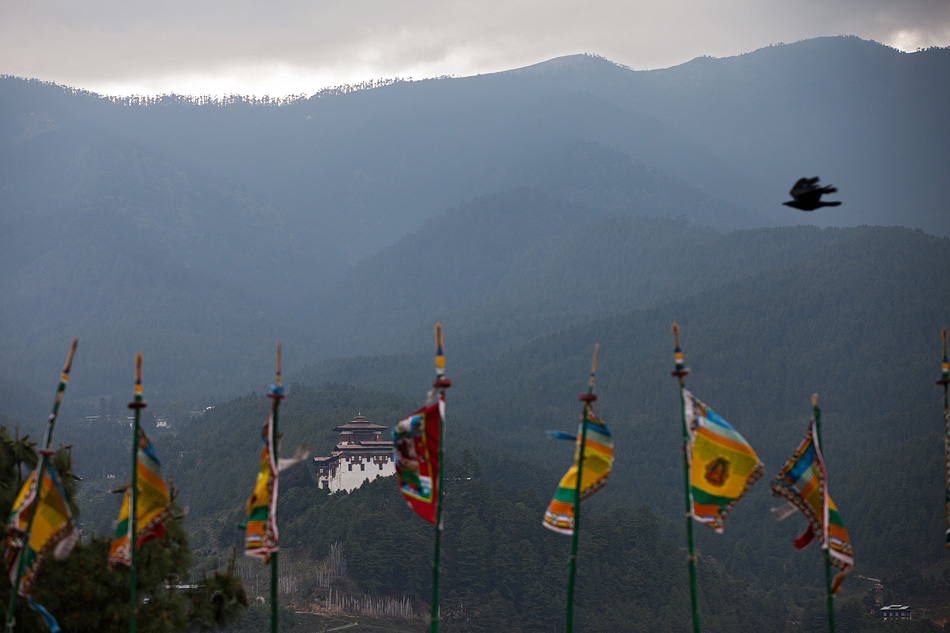
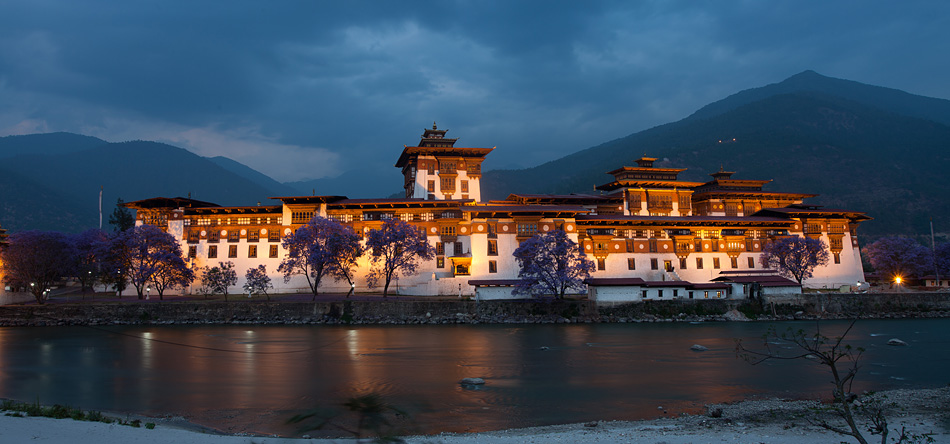

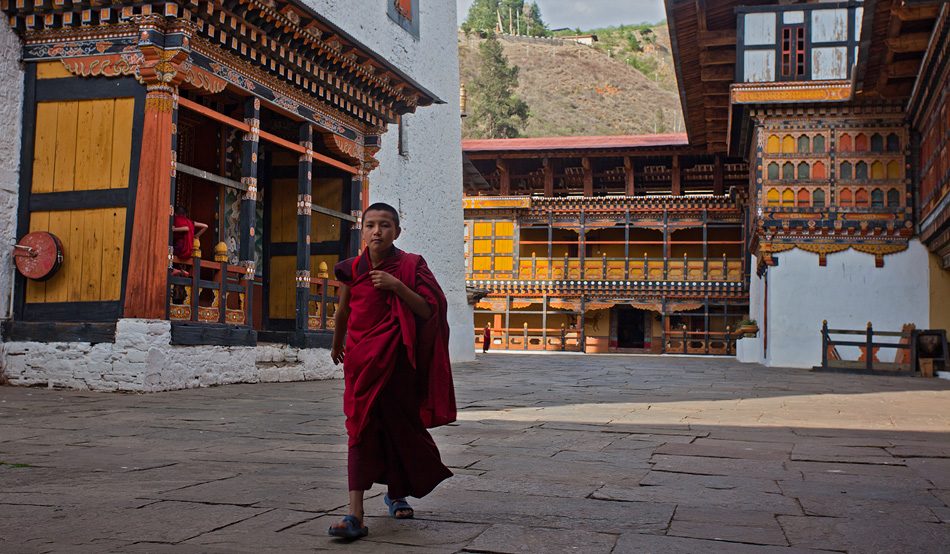
From left to right: Dzongs at Bumthang, Punakha, Thmiphu and Paro. Click to see larger images.
Paro’s Rimpung Dzong is also visited by many travellers. In here, look out for young brat-monks livening up the courtyard in the evening hours. They make great subjects for your camera as well.
Nearly all dzongs are lit by flood lights after sunset, which offers excellent photography opportunities.