For Indian Nationals travelling to Bhutan, the contrast between the two neighbours can be a big surprise. Moving from Jaigaon in West Bengal to Phuentsholing in Bhutan–towns located in contiguous stretch of land separated only by the border line–you see the dense sprawl of an Indian small town giving way to a charming little place full of green spaces. The disorder that we are so used to in India disappears on to the other side.
The differences continue to catch the attention of a first-time Indian visitor all through the journey. In Thimphu, the traffic (or whatever few cars you see on the road) moves in an orderly fashion and respects other road users. The buildings, even in the densest part of the city, are well-structured and the facades follow the traditional construction style. A sense of rush that we are so used in India is replaced by a slower and simpler pace of life.
The major towns of Bhutan, such as Paro and Thimphu, appear no bigger than a cluster of small villages. And the villages faraway are almost always set in a brilliant surrounding, flanked by fields on one side, a river flowing by and wooded mountains surrounding them in all direction.
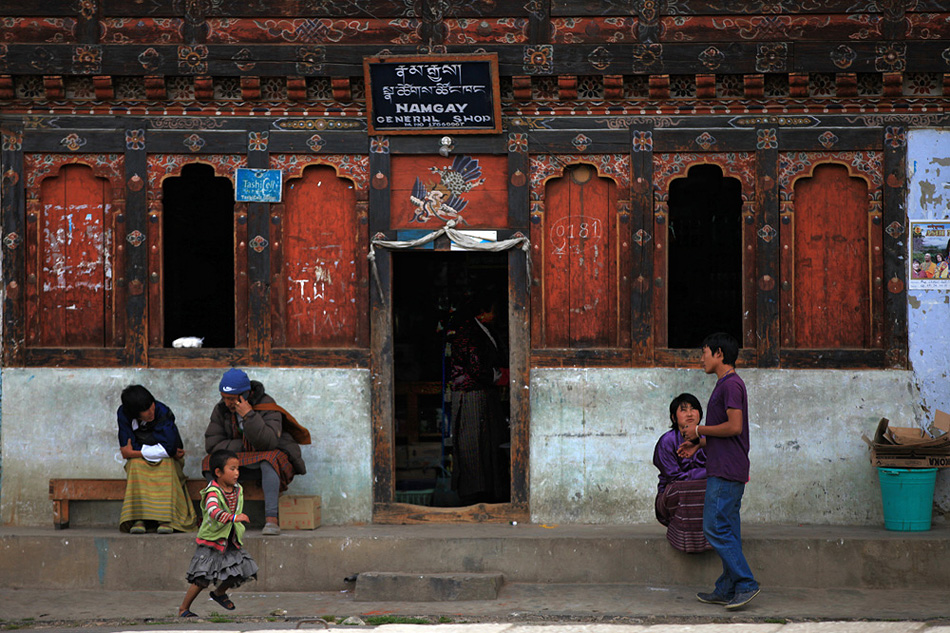
The main street of Ha Village
Ha is one such village – the kind of place where one would just want to leave everything to come and settle down. The village has sufficient supplies and good connectivity to find everything that you would need, but a pace of life that can suit the laziest person. A small line-up of shops, a bus stop and a couple of restaurants are all that the village is. Mountains rise steeply on either side. Clear waters of Ha River flow right next to the main road that connects the villages in the valley. The only noise in the village is the occasional murmur of a vehicle that passes by, perhaps no more than one in every ten minutes.
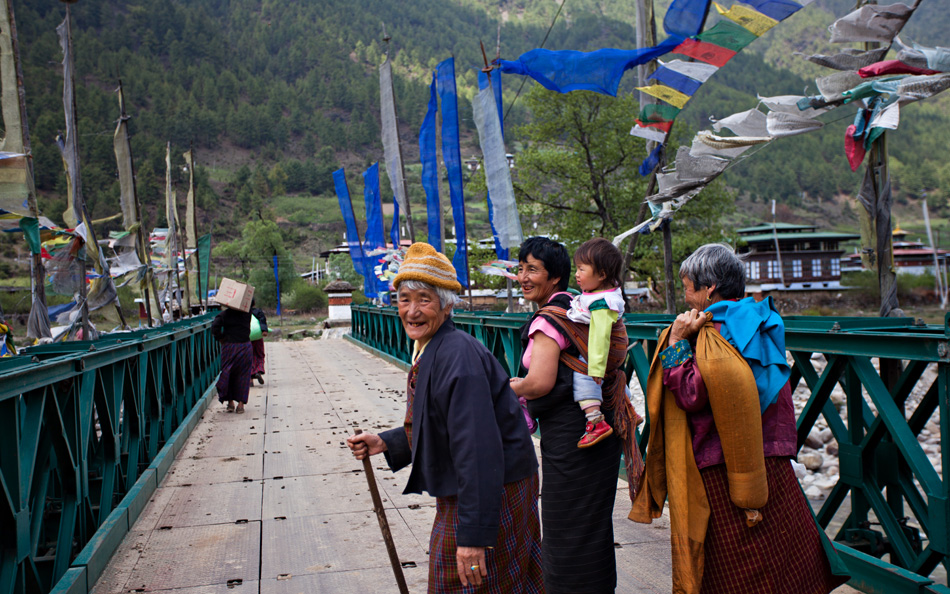
At a bridge across Ha River, next to a village in Ha Valley.
The valley of Ha is a series of villages, each usually set apart by a ten-minute driving distance. Most people live off the land and seem to have a happy and contented life. A road runs parallel to the river, steadily moving up the mountains. The villages, with prayer flags fluttering around the houses, are scattered in the wider parts of the valley, each one having no more than a score or two pack of houses. Dense pack of coniferous trees occupy every inch of space that is not in use by people, hinting that the winters are probably cold and snowy. But in summer months when I usually visit, the weather is joyfully pleasant, thanks to the altitude and the cool breeze coming from the high mountains.
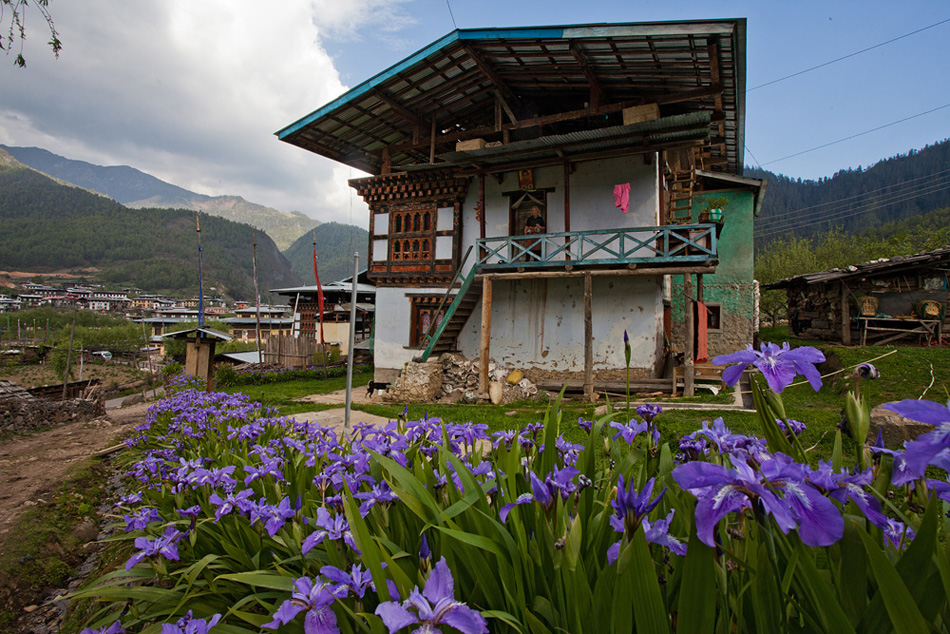
A house surrounded by bloom in Ha Valley
The valley is one of those places where you do not really feel like coming back ever. It is high up on the list of places that I have visited where I would have simply loved to settle down forever.
I usually make two visits to Hampi every year. If there is one thing that I necessarily look forward to during every visit, it is the climb to Matanga Parvata to watch sunrise over the landscapes of this ancient city.
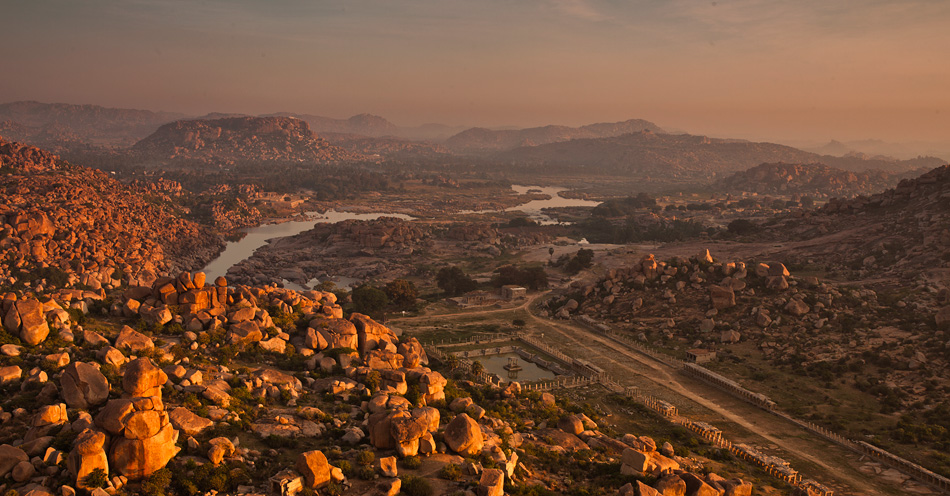
Matanga is perhaps the tallest hill in Hampi, on the right bank of Tungabhadra River. From the vantage point on the top, the sun rising over a misty landscape during the winter months highlights a wave of ridges that line up the eastern sky. As the big blob of light moves well above the hills, the golden lights sparkle on the smooth surface of the boulders littering the landscape. Tungabhadra shines in the skylight, with occasional coracles moving up and down on its calm surface.
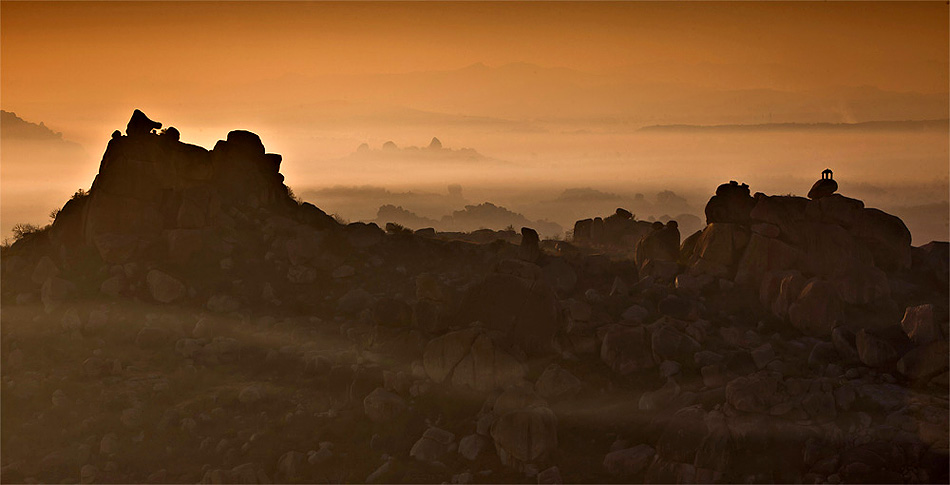
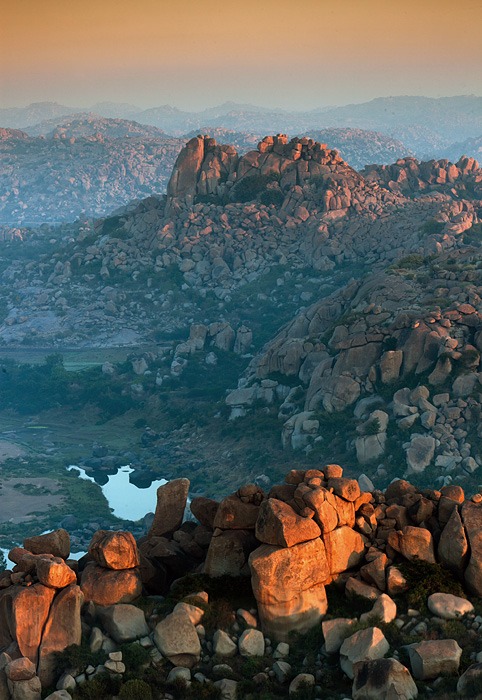
The steep fall of Matanga towards the east offers a bird’s-eye view of Achutaraya Temple right below and an uninterrupted view of the sunrise above. On the western side of the hill, the tall spire of Virupaksha Temple appears to challenge Matanga in its height. All around, remains of the erstwhile Vijayanagar Kingdom – Vijaya Vithala Temple, Krishna Temple, Lotus Mahal and several mantapas offer insights to the city’s past.
A little downstream, on the other side of the river, is Anjanadri Hill – a place of many legends. While Hampi’s hills are often credited to be the place where the kingdom of monkeys from Ramayana once existed, Anjanadri is known as the place where Hanumantha was born. The hill now houses a hoard of monkeys that usually settle around an Anjaneya Temple, as if to prove a point.
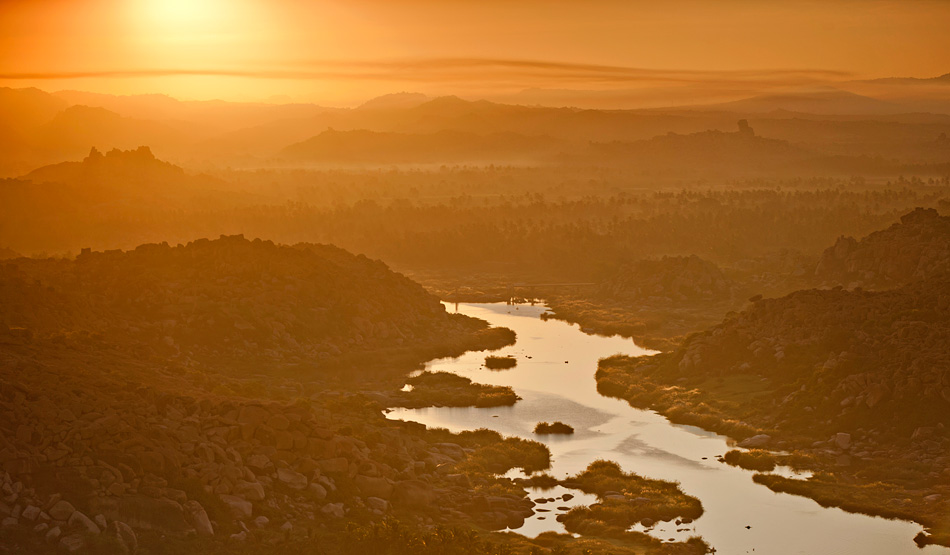
While Matanga is the highest point on the right bank, the Anjanadri probably takes the honour on the left bank. Near the base of Anjanadri, the river takes a steep turn from its northwardly flow to east, which allows a line-of-the-river view of sunrise from the hill top. In the winter months, the morning landscapes over the river appear bathed in gold – a spectacle that stays in the heart as permanently as it does in the camera.
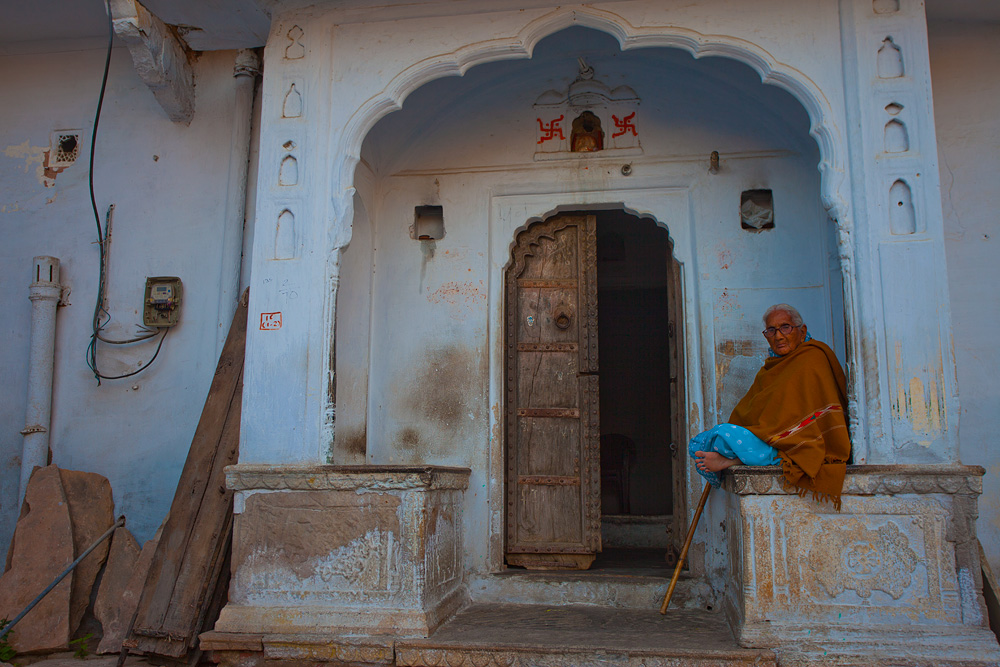 Strolling through the lanes outside the touristy quarters of Jaipur, we entered a small lane crowded with houses. As I have occasionally seen in these parts of the country, the lane expanded into a spacious quadrangle surrounded by tightly packed houses. A few cars were parked at the center. A cow–there are few places where you won’t find one–tied under a tin roof stared at us uninterestedly. An elderly lady sat on the veranda of her house, spending the evening in solitude. I first thought the house was a temple, thanks to its decorative arch and a tiny altar above the door with bright saffron swastikas on each side. The lady responded in affirmative when I requested her permission for a photograph, but did not say much else.
In the meanwhile, we had caught the attention of a bunch of elderly men who sat in a circle and whiled away the evening discussing politics. One of them started talking to us and immediately, without our realization, a connection was established between the visitors and the locals. Ice was broken and conversations flowed freely. The strangers at the quandrangle, who had now transformed into our hosts in a matter of few seconds, took turns to introduce themselves. One was a retired government official, one was a priest and another one was a musician. The eldest man in the group, who was a generation senior to everyone else, remained silent and watchful. We all were sitting on the veranda of the musician’s family, which had once served the kings of Jaipur. They were proud about their achievements and took us into their house to show the instruments they possessed (a harmonium, a flute).
And then, as it normally happens, questions were asked about our professions and our whereabouts. Of course, at the end we were asked to stay on for a cup of tea.
As a photographer who often encounters and speaks to strangers all over the country, I have seen people react to our cameras in a very predictable way. They usually come in two extremes – very friendly or very unwelcoming. The more touristy a place gets, the more camera-toting people a place sees, the more likely that the encounters are the latter kind. The farther you get, the more you move off the highway, it is more likely that you find friendlier people. And then there are always hidden places just round the corner from a well-known place where you still see hat friendly smiles not compromised.
It is perhaps a natural progression that happens to people who often find themselves pointed with a camera, more often than not unsolicited. At first, one may find it charming that they are being photographed. But as it becomes a common practice, and as the photographers attempt to capture them more in the form of an exhibit from a distance than a fellow human being, it is expectable that the people get distressed or want something in return for their contribution. But I am digressing; let me come back to our encounters in Jaipur.
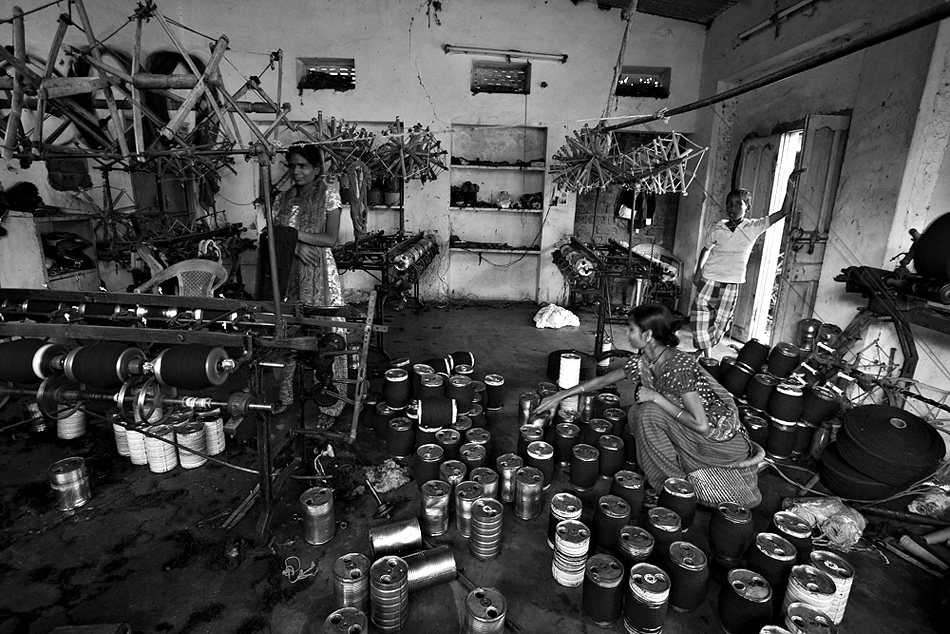
A factory producing yarns.
It was one of those corners just outside the touristy attractions of Jaipur, where we found these friendly men who were very welcoming. After exchanging contact details and a promise to email photographs (to granddaughter’s email id, which they referred to as ’email number’), we headed out in search of more of this Jaipur beyond its well-known monuments. In the next one hour, we encountered frolicking children, women carrying water from public taps and a small factory producing yarns.

Life outside Hawa Mahal, Jaipur.
Our day of gallivanting in Jaipur was made of a series of such encounters that stayed in memory. We began as everyone did, peeping through Hawa Mahal and walking into City Palace, but kept an eye on the more down-to-earth encounters. The bustling life outside Hawa Mahal has always been one of my favourites, where the pink edifice offers a grand background for rickshaw pullers, vegetable vendors, bicyclists and every other type of people in a city that still breathes its past.
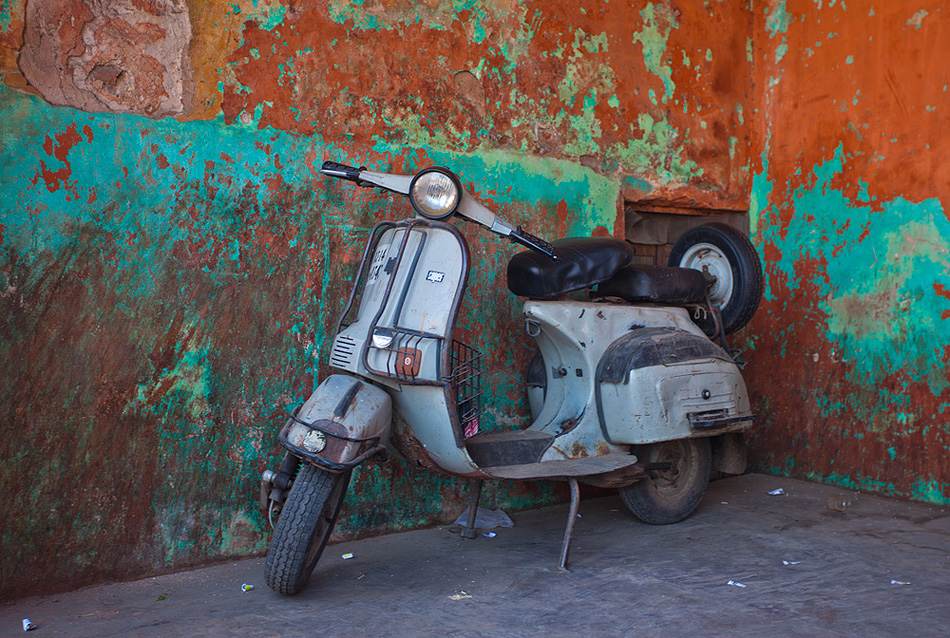

Streets and markets of Jaipur
Later in the day, we walked through the local markets that are not very far from the heritage site,s but are rarely seen by the hoards of tourists flocking the monuments. The variety and colours in the shops were overwhelming. Here too, people were welcoming and were happy to stand in front of the camera. My encounters of the day included a jeweler with a nice long beard, a hardware store owner with a smug smile, a colourful display of flowers and a scooter parked in front of an old wall with paint peeling off.
We had begun that day with the cameras on the shoulders, passing through Jaipur’s well-known sights like the Hawa Mahal and Gaitor, but keeping the eyes open to everything around them. As the day progressed, we saw ourselves spending less and less time at the monuments, dwelling more in people interactions and straying towards places less frequented. It was one such walk along the lanes outside the walls of the old city, which had taken us to those friendly group of elders at the end of the day.