Nathula Pass is a good place to see a great Asian divide. At an altitude of 14,200 feet, a flimsy barbed-wire fence separates two countries – India and the Tibetan Autonomous Region. India and China, if we get rid of all the jazzy names that the Chinese use for the territory occupied by them for nearly 60 years now. A divide deeper than geographical boundaries becomes obvious in a few minutes of walking along the barbed-wire. The Indian side of the fence is packed with tourists running up and down, taking photographs and posing with Indian jawans. A few tourists even go and stand next to Chinese soldiers guarding the fence and get their photographs taken. Enough care is taken to make sure no one puts their feet across the fence, not even accidentally. The Chinese soldiers pose with a grim face, never relaxing a bit and never offering the slightest hint of a smile. But on the Indian side of the fence, soldiers and civilians stand together, arms over each other’s shoulders, happily posing for the camera. A customary conversation and handshake follows. The jawans are happy to break the monotony of their work and the tourists are happy to carry home some good memories. There are no tourists to see on the Chinese side, perhaps because they are not permitted to come here or because the mainland is too faraway. Or may be they are just not interested.
The cultural differences are apparent even in the buildings on both sides. On each side of the border is a building that perhaps serves as some kind of an office for the border security forces. The Chinese building is all concrete and glass with no sign of life. The Indian building is decorated with patriotic paintings and photographs, and has a more cheerful design. The two nations are divided in many ways.
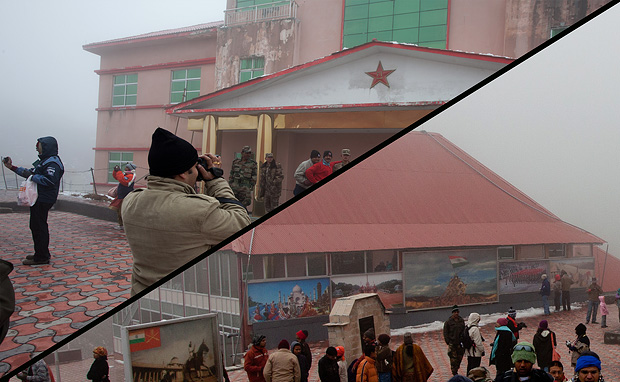
Nathula
Nathula Pass is a border-post separating Sikkim in India with Tibetan Autonomous Region in China. It served as a trade-post between India and Tibet before the Chinese occupation of the later. The government of India had sealed the border at Nathula after the Sino-Indian war in 1962 but re-opened it for trade in 2006 after talks with Chinese Government. Volume of trade through Nathula has steadily increased since then, but is still only a small fraction of the transactions between India and China.
I made a visit to Nathula with a bunch of bloggers invited to visit Club Mahindra Royal Demazong Resort in Gangtok, Sikkim. Nathula is just 50km from Gangtok, but the narrow and winding mountain roads, heavy tourist traffic and frequent landslides ensure that it takes good four hours to complete the journey. I was looking forward to taking this road, hoping to see some great views of the the valley of Gangtok from the top and experience the scale of mighty Himalayas. But for reasons I can’t pinpoint, the drive up did not excite me as much as I hoped to, though visiting the border and seeing the apparent divide between the countries was a worthwhile experience. Perhaps it could be the heavy traffic on the way, perhaps the cloudy weather that day or it could just be a jaded me. But I did enjoy seeing a dash golden and brown coloured leaves in the middle of thick greenery in the slopes and watching the streams running down at the bottom of the valley.
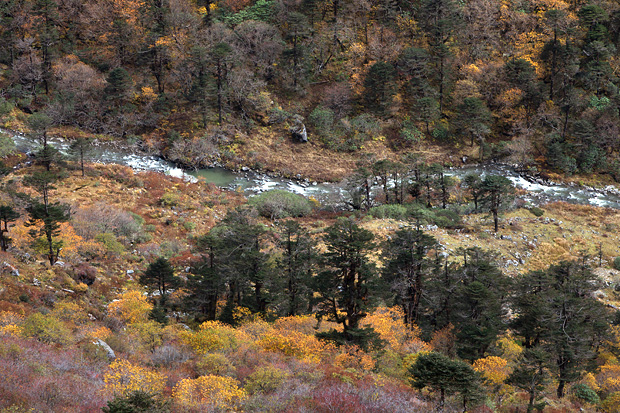
On the road to Nathula
Even Changu Lake (also called Tsomgo Lake), which I very much looked forward to see failed to excite my senses. Changu is a large greenish-coloured lake at an altitude above 12,000 feet, about 12km before Nathula. It would be preposterous call the lake ‘not beautiful,’ but the spread of shops and tourist facilities next to the lake, a road that runs right next to the waters, a bunch of telephone lines that run along the length of the lake and army bunkers located right above the lake together make the lake appear like a body of water trapped in a construction zone. However, colourful prayer flags planted along the bank and the green slopes on the other side help restore a bit of the lake’s glory. It is not just one lake that dons the mountains here: a series of small water bodies trapped in the depression start appearing on the road up from Changu. Their colours have varying hues of green and black despite being fed by the same snow melt sources.
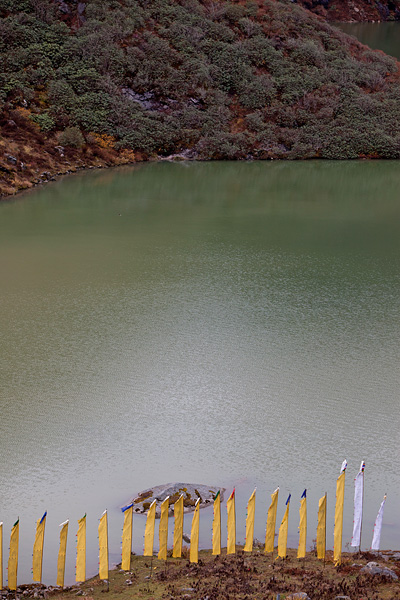
Changu Lake
Weather remained pleasant as we drove towards Nathula. The air was crisp and pleasantly cold in Changu, but the descending clouds spelled of a bad weather at higher reaches. Nathula was foggy and cold but bearable when we arrived. It had snowed the previous day and fresh dollops of snow was scattered along the slopes. The border post is a flight of steps from the road that often left the visitors breathless, but did not tire them enough to contain the excitement of having reached the frontier and pose happily for the camera. The weather deteriorated a while after we got there, thanks to accumulated fog and a gentle wind. I retreated to the Indian Army cafeteria nearby—the ever resourceful army was kind enough to run one for tourists and offer some warmth of coffee and snacks—and gulped multiple glasses of coffee to compensate for the cold weather. The smart public relations machinery of the army was not only doing a great job in keeping the tourists warm, for a small fee they were even issuing certificates to visitors on having made it to the frontier!
The Sikkim travelogue concludes in next part – Gangtok Zoo and Lingdum Monastery.
Prints of all the images available. Request for prints.
India Travel Blog Newsletter is sent approximately once a month (sometimes less frequently), summarizing the previous month’s activity and giving a glimpse of the coming month on the website. Subscribe to the newsletter by keying in your email address in the box on the top of the sidebar. Here is a copy of this month’s newsletter, dispatched today.
—
Hello!
Here is the November edition of India Travel Blog Newsletter. I hope this is coming to you at a time when you are making plenty of travel plans for the coming holiday season, or already travelling! Here is a quick summary of travel content on the India Travel Blog in the last one month.
November 2010 Calendar. The desktop calendar for November is an image of travellers gazing at the beautiful sunset from Hemakoota Hill in Hampi.
Photo Essays. We have had four photo-essays published in October, listed below. In future, photo essays will become more frequent and will contribute significantly to the content of India Travel Blog, but without any compromise in stories that I regularly post.
1. Flowers of Sikkim
2. Skiing in the Himalayas
3. Wild Dogs of Kanha National Park
4. Chandradrona’s Fog – An attempt to capture the foggy monsoon landscapes of Chikmagalur, Karnataka
With a recent change to India Travel Blog, you can now access all the photo essays ever published on the blog in last five years using one single link. There are more than forty of them at the moment. See them all the photo essays
Stories from Ladakh. There are two stories from the long series of posts on Ladakh – one on falling into a tourist trap at the villages of Dha-Hanu and another one on a quick visit to Tso Kar Lake.
Other stories
1. Mysore Palace – A short visit to Mysore Palace with images of its exteriors and description of its elegant interiors.
2. The travel photography story published in November is on photographing landscapes. Winters are a great time to shoot beautiful landscapes. Read this post before you head out with a camera.
3. Not packing light. I always hear advices about the virtues of packing light. I have never managed to be one of those people who travel with very little baggage. I end up carrying a lot of stuff wherever I go. Here is my case about not packing light during my journeys.
In November, you will be seeing more photo essays on the blog and stories from Sikkim and Ladakh. Look out for some avian images from Bharatpur and landscapes from Corbett National Park. Happy travels!
On visiting the villages of Dha and Hanu, we realized having fallen into a tourist trap. But we did manage to get the best out of the two days spent in the area.
Dha-Hanu region became a dot in the tourist map because of its people. Brokpa or Dards, as they are called, speak a different language than Ladakhis. They have a culture different from Ladakh and are a small community of just two thousand people surviving in the western part of Ladakh. But the single fact that has become a selling point for travel agents is that they wear very different clothes. Or that’s what we were told.
Perhaps Dha-Hanu was never a part of tourist’s itinerary when Ladakh was initially opened to people outside. Let me think of the sequence of events that would have helped Dha make the mark: some anthropologists would have toiled hard to dig out details of a community that the world had forgotten. They would have spent a year or two studying their way of life and their origins to publish a scholarly paper. Some enterprising men would have picked up interesting facts from these papers, taken photographs of women in traditional clothings and sold it to tourists in Leh. Some adventurous backpackers would have followed the trail to Dha, came back to spread the word about the last of the people who belong to an interesting community. The result: an explosion of tourists who could go extra mile to see some thing interesting or some people exotic.
When we asked around for specialties of Dha-Hanu, two things stood out. The driver who took us from Tso Moriri to Leh told us that the people here speak a different language and wore a different style of clothes. This was reiterated by further research where we learnt about this race of people who did not share the traits of people of rest Ladakh. It seemed worth making a visit. Not that the clothes they wear mattered much, but it would be worthwhile seeing more corners of Ladakh and meet more people.
As we alighted the bus at Dha, all that we saw were a bunch of men wearing shirts and trousers and women wearing salwar. That was alright. Perhaps only the elderly people wear traditional clothing. Or perhaps just elderly women. May be we have to go deeper into the village to meet a few of them.
The mystery was unraveled the next morning when we were talking to Dolma, the lady of the guesthouse where we were staying. “They wear those clothes when tourists ask for it,” she told us, “tourists usually pay them to do so and take their photographs.” It was an obvious tourist trap. It is so overdone that now it is a common and accepted routine for tourists to visit Dha – Hanu, have some locals to wear their traditional clothes, take photographs and go back. Dolma asked us later if we weren’t planning to do it. We weren’t. When I casually took a picture of a lady at the village (who was in her everyday clothes) later that day, she came to me and demanded that I pay up. Uncomfortable with taking pictures of an unwilling person (and not wanting to pay), I decided to delete the image instead. But another lady we met a little later was more willing.
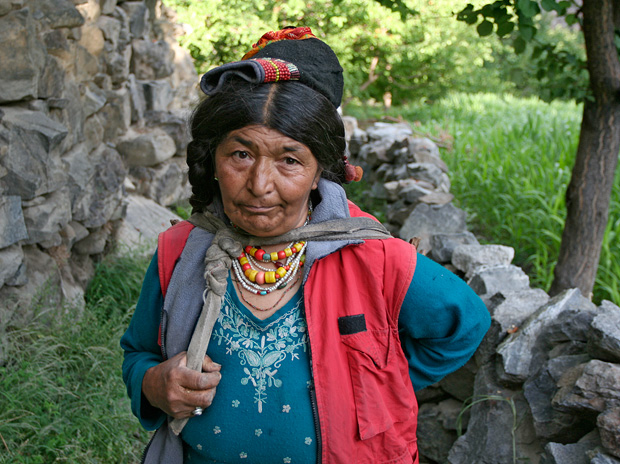
People here do look like they belong to a race different from Ladakhis. They look more Central Asian and less mongoloid. They are also more modernized than rest of Ladakh. Although they are Buddhist, they are less devoted than Ladakhis and the monastery in the village doesn’t seem to be well attended to. A French anthropologist who was at the guesthouse gave us some idea about the complex system of relationships between people in their society, which seemed very convoluted and was much different from polyandric society that Ladakh used to be.
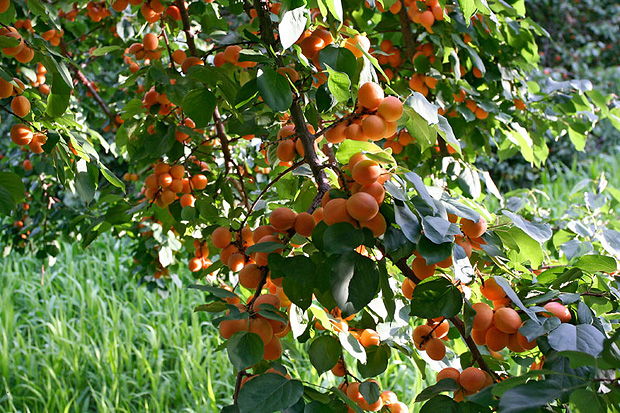
An apricot tree, fully loaded.
There is a visible difference in the attitude of people as well. The smiling faces and jubilant ‘julleys’ that you encounter everyday in Ladakh was missing in Dha-Hanu. But what they lacked in cheerfulness, they made up in their hospitality. At Baldes, a nearby village, we were invited for lunch by a kind lady whom we met on the road. As we walked back from her house later in the day, another man whom we met on the way called us in to have some snacks. A lady whom we met a little further on the road invited us for tea. I don’t remember any place, even in the hilly regions full of large hearted people, where every stranger you meet invites you home for refreshments.
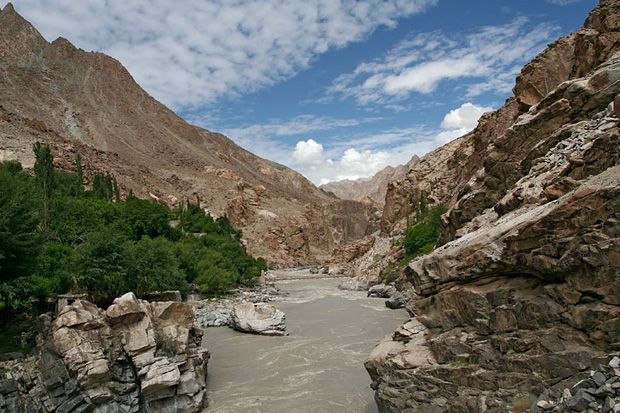
River Indus at Dha
But Dha is not just about its people. We had fallen in love with the village the moment we took the narrow path from the bus-stop to the village. The place was covered in lush greenery unseen anywhere else in Ladakh. Everywhere I see, branches of apricot trees were drooping with ripened fruits. The vegetable gardens spread all over the village were covered with cauliflowers and cabbages ready to be plucked. Even in the guesthouse where we stayed, ripe grapes were waiting to be plucked right at the courtyard. I could reach ripe apricot fruits just by stretching my hand from a window. It was so beautiful that I did not have to care what the people here wear.
The mountain slopes here are steep and are a rich hue of brown. River Indus flows swiftly next to the village in a narrow canal, sometimes so narrow that I wonder how it manages to hold all its waters in such a small space. Dha was worth a visit even when it turned out to be a tourist trap. It was two days well spent even when we did not bother to pay people to pose for us with their traditional attire.
Prints of all the images available. Request for prints.