This article appeared in April issue of Terrascape, a travel magazine where I write a column on photography
They say a picture is worth a thousand words. When you put together a sequence of pictures, they effectively tell a story far more quickly and easily than what words can do. More often than not, we focus on the objects and expressions in front of us and not think about getting behind the scene. You may have bought good-looking pots from a potter’s shop several times, but have you ever thought of finding out how they make these pots? After you take pictures of beautiful pots at display, it would be worthwhile visiting their backyard and make images of a pile of mud slowly taking a definite shape. When you come back and put together a few good images from each part of the process—from kneading the clay to giving it a final shape—they can tell a story so effectively that you have need very few words to go with the images.
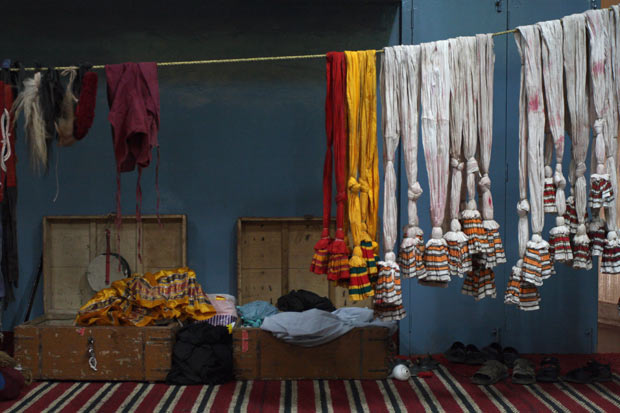
The costumes for a Kathakali show, unpacked for the night’s performance
Choose subjects that interest you. It is not easy to create a story on every topic. Choose a subject with which you can associate and enjoy spending time to understand and learn. Creating a photo sequence requires studying the subject and knowing it well to ensure that every aspect of the story is covered. So it is easier to work on a topic that naturally interests you.
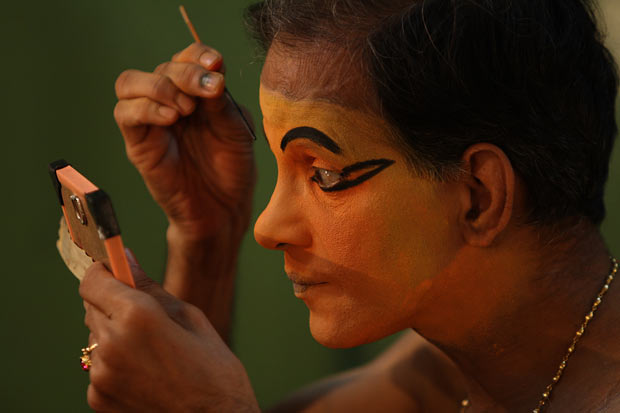
In the initial stages of getting ready, the artist applies make up on his own
Spend time with your subject. Start your work by leaving the camera at home! Take time to understand every aspect of the story you are about to capture. It helps to create a story in your mind before you are ready to shoot and tell your picture-story to everyone.
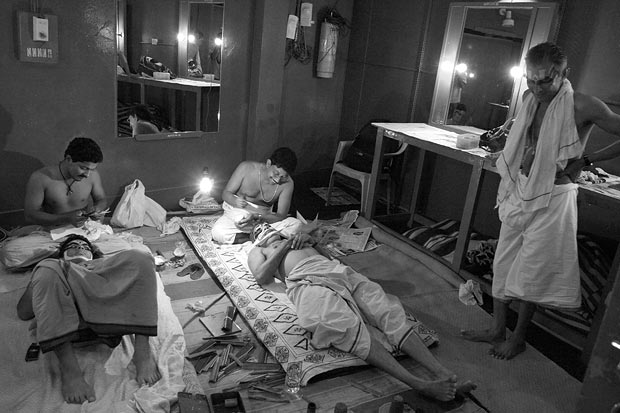
They are helped by make up artists in the next stage
Be trigger happy. Even with careful planning and study, it is never easy to conceive every image that will become a part of the final story. Keep clicking and never miss an opportunity to shoot every moment. Professional photographers often take hundreds of photographs to make a story in just half a dozen images.
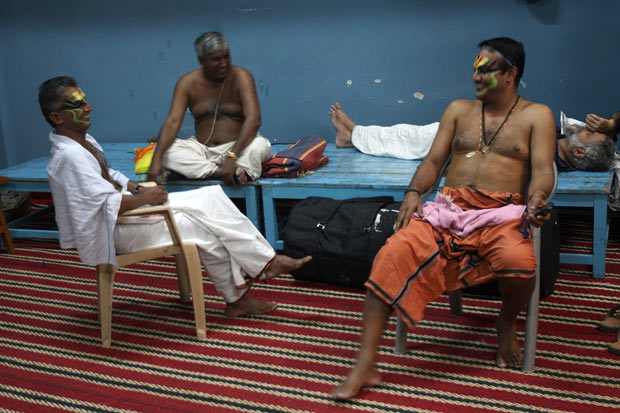
While some are being helped with their make-up, others relax as they await their turn
Not everything is a story. A sequence of related images may not always make a story. Putting together five good images of an animal, a monument or any such entity will not make a chronological sequence that speaks of itself. A surprisingly simple guideline helps here: a story is something that has a definite beginning and an end and a series of events in the middle that help achieve the end. Also see if the events have visually compelling aspects (like a potter turning the wheel) suitable for making a photo story.
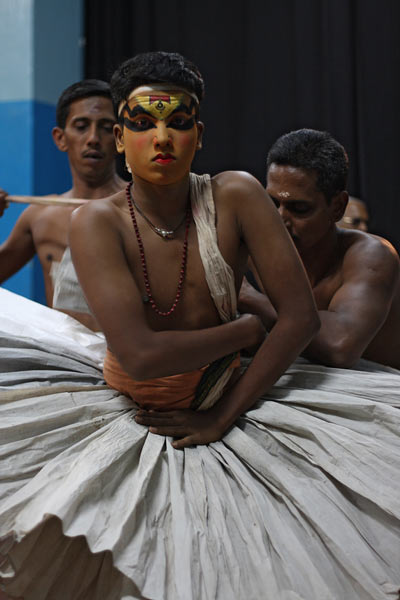
The costume
IMAGES
This image sequence was shot during a Kathakali performance. The images not just show the action on stage, but also depict all the work that happens behind the stage. The actors spend more than half a day to put on their make up and costumes, giving the photographer ample time to document the events before the show.
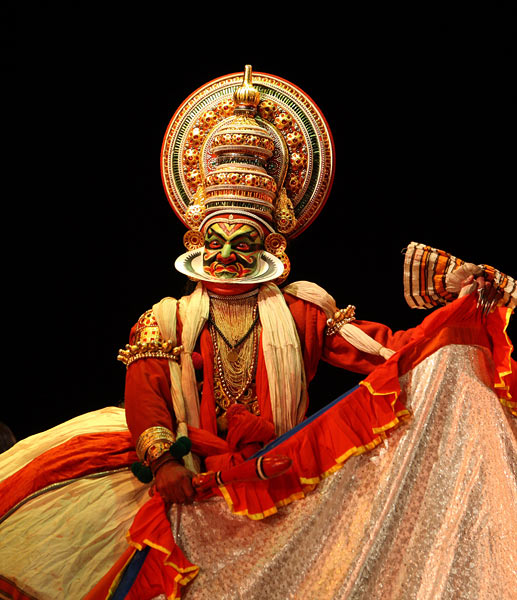
On stage.
Even when the heavy bike troubled me a great deal, I manage to keep my eyes open to the sights around me as we drove past Chang La.
Leaving Karu Village after a breakfast of Alu Parathas, we rode past the village of Shakti before the climb to Chang La began. If there is a village anywhere in Ladakh, there has to be monastery perched high on a crag somewhere nearby. Sure enough, there was Chemrey Monastery visible far away on the mountain slopes.
We climbed steadily keeping a deep valley and Shakthi Village to the left and the mountains to the right. Tall jagged snow-peaks of Zanskar Ranges showed up beyond the Indus Valley when I stopped at an army check-post before Chang La and looked back at the valley we had left behind.
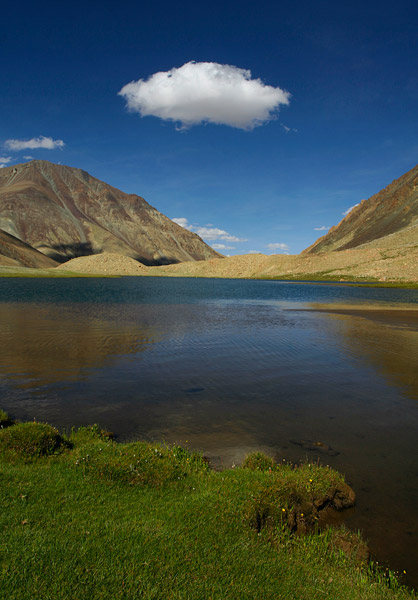
At 17,360 feet, Chang La was cold but the shining sun and absence of wind kept us in comfortable. Nevertheless, the thin mountain air and the struggles with the bike had tired me out and I was looking forward to the descent and better roads ahead. The landscape changed considerably after the pass. The valleys were wider and the slopes were gentle. There was a burst of green grass on the earth, which was a remarkable change from the arid slopes on the other side. There was more life too. Himalayan Marmots ran around playfully in the grass and wrestled with each other as we rode past them. Wild rabbits disappeared into their holes when they saw us. Where the slope was gentle, the grass was so thick and green that it completely hid the brown colour of the soil.
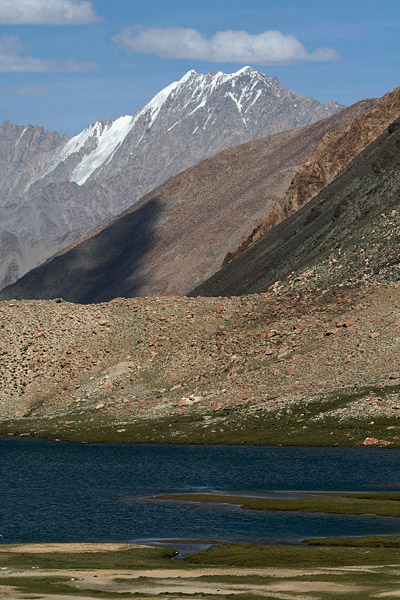
All this was great, but the greatest moment on the road came when we stumbled upon an open area with a deep blue waterbody in the middle of it. A stream that flowed from down from Chang La spread open on a grassy expanse and its blue waters reflected the mountains surrounding it. Tiny yellow and white flowers spread densely in small patches amidst the green grass. Occasional clouds that passed above the mountains reflected in the lake, creating distraction in the blue plane. The water was so clear that we could see the pebbles at the bottom as clearly as if there wasn’t any water. In the arid landscape of Ladakh, this was the first time I was seeing a natural lake so attractive that its serenity made the journey feel complete much before the destination was reached.
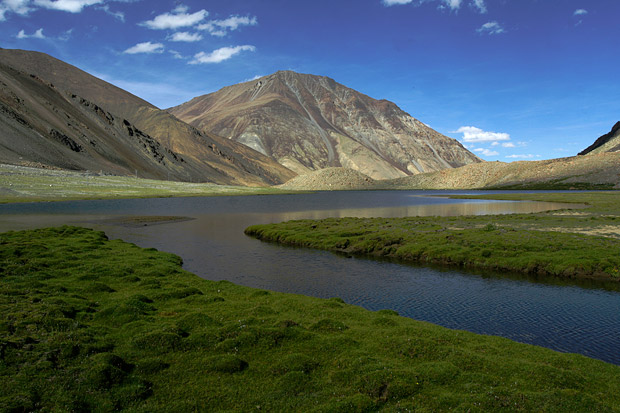
Nevertheless, the destination—Pangong Tso—still had to be reached and we were to find out soon that it involved a lot of struggle!
I rented a motor bike that weighed three times my weight and rode from Leh to Pangong Lake. Riding with a payload more than 150 kilos (me, a pillion rider and about 40 kilos of luggage) on a super heavy bike and heading to a no man’s land at an altitude of 14,000 feet was like inviting a disaster. Disaster did not come, but the hardships along the way almost forced us to abandon the journey.
The plans were grand. We were to leave Leh for Pangong Tso, spend a few days at the lake and continue further to Tso Moriri before returning to Leh. A week long trip meant carrying plenty of luggage. With us was a large 80 liter backpack, two smaller shoulder bags, a heavy tripod, two sleeping bags dangling at the back of the bike and twenty liters of fuel supplement. I would not be surprised if an onlooker thought we were shifting house. After all, Pangong is a great place to call home, especially during summer months.
Although I wasn’t very kicked up on doing these long rides on a bike, economics and logistics favoured renting one. Hiring a cab was going to be prohibitively expensive. While we did have enough time to take a bus or to look for a shared jeep, it would have been a crime to speed away through the mountains without stopping along the way to see all the beautiful sights as and when we wished. Choosing a bike seemed practical even if the ride was going to be an effort.
The beginning of the journey was smooth and easy. We made an early start and rode on the smooth highway that ran parallel to Indus until the small village of Karu. The smaller road to Pangong deviated here from the highway, but the surface nevertheless remained smooth and the ride was trouble free. Taking the bike appeared to be a good idea.
The first signs of trouble started showing up during the long climb to Chalng La, the mighty pass at 17,360 feet that we had to cross before descending towards Pangong. The Bullet Thunderbird now seemed unhappy with its load and was reluctant to respond to the accelerator at difficult ascents. It refused to go further in a few occasions when the ascent was very steep, forcing the pillion rider to walk for a few minutes till we found an easier section of the road. This however was a small problem and did not threaten us from completing the journey. But once we reached closer to Chang La, the tarmac on the road disappeared and we were left to wade streams that cut across the road, ride through mud, rocks and wet soil. It wasn’t exactly an easy ride, but was nevertheless completed by struggling to balance the heavyweight bike on rocky and slippery surfaces, sometimes supporting it by dipping my feet into the frigid waters. It must have taken us a good thirty minutes to cross the pass to be welcomed by another stretch of smooth tarmac. We were cruising again along an easy stretch, descending comfortably on a metalled road.
The big trouble however came an hour later when we least expected it. Bigger troubles were to come next day, just a few kilometers before reaching Pangong.