People of Ladakh seem to regard tourists as a different species altogether. It is not hard to understand why.
For a community that had remained isolated for centuries, opening up Ladakh to rest of the world suddenly exposed them to many things that they never knew before. A lot of Ladakhis perhaps found it hard to understand why people came in large numbers from different corners of the world just to go from place to place, doing little else but see places and take a few pictures. The tourists also did not fit their earlier mindset towards life in which summers were meant to work hard, make a living and stock up for the harsh winters.
My first realization of this this gap came when I was chatting with Tsering Thondup, a nomad shepherd from Changthang region. One day, looking for escape from a sudden storm, we sought shelter in Tsering’s large tent built from Yak Wool. As we warmed ourselves with a cup of hot yak’s milk and struck a conversation, he casually asked if we had been travelling. When I nodded, he innocently asked what is it that we gained from all the travels – ‘ghumne se aap ko kya milta hai‘?
When he asked so, he had unknowingly managed to reach somewhere deeper and questioned all the philosophies and reverences that I had built into the idea of travel. It almost made me ask myself about the virtues of travelling, about the idea of opening our minds by seeing new places and soaking in new cultures. That moment, I was not sure if I could really call travelling a process of self evolution that I had always conceived to be. I was not sure if it was worthwhile roaming the world seeking new things instead of being rooted somewhere and work for the good of oneself and everyone else. I wasn’t even sure if travelling merely for pleasures of the new place really brought a lasting pleasure or gave a temporary high that pushed you to your lows at the end of the journey. It reminded me what a wise man once said to me, ‘how much of goodness can you take? How much ice cream can you eat? How many movies can you watch? How much of a beautiful landscape can you see? You will eventually get tired. Your senses will get tired. You will have enough of all that. Look inward instead!’
This curiosity of Ladakhis towards travel however was diminishing over time. In the last thirty years when Ladakh opened up to tourists, whether people understood the idea of travel or not, they surely used it to their advantage. As they realized the earning potential from tourism, enterprising Ladakhis quickly jumped in to facilitate the visitors. In his book ‘A Journey in Ladakh,’ Andrew Harvey quotes an elderly lady from Leh who says, ‘When I was young every family would send a child to be a Buddhist monk. Now every family wants their child to be a tourist guide.’
Yet, Ladakhis still see tourists as a different species. The reasons are plenty. The tourist is unlike a Ladakhi in many ways. He is someone always in a hurry. He keeps running from place to place. He smiles less and may even get angry once in a while. He doesn’t do much work besides chasing traditionally dressed Ladakhi women for a photograph. Most importantly, he never uses public transport but zips from place to place in a chartered vehicle.
The last one—about the public transport—seems to be embedded deeply in the mind of every Ladakhi. It became evident to us on the day we arrived in Padum, the biggest town in the heart of Zanskar after a journey of two long days. Having arrived on a day when most hotels seemed to be full, we walked from guesthouse to guesthouse looking for accommodation. A guesthouse owner with a few rooms vacant said that he was waiting for a party of tourists who had booked for that day. When we pointed out that it is already an hour since the only bus to Padum has made it to the town, he casually responded: ‘they are tourists. They won’t be coming by bus.’
We went through a similar experience when we were stuck in the small village of Ulley Tokpo due to a landslide that blocked the main road. We were the only tourists among a large group of locals who were trying to walk to the other side and find another bus to continue the journey. Someone helpfully suggested that we could perhaps book a taxi once we walk across the landslide, never realizing that we were planning to take a bus.
Not to blame them, the tourists to Ladakh find it near impossible to fit their schedule into public transport. Buses to some places are so infrequent that you will have to wait for more than a week to catch the next bus. Taxis are priced so steep that many tourists find no choice but to run from place to place to keep their costs low. Most people who visit Ladakh are ready to leave even before they get a good idea of local ways of living. The interaction of tourists with locals is usually limited to their driver or guide, often keeping each side an enigma to the other.
There are largely three kind of people you get to see in Leh. The Ladakhi Buddhists are the one you encounter most often – they are the native inhabitants and manage most of the tourist infrastructure in the region. The next set of people you see very often are the tourists. They probably outnumber locals in summer and vanish during the cold winter season. The third biggest population is of Kashmiris who come from Srinagar and surrounding areas in Kashmir Valley. They mostly work as labourers doing all the hard job that locals would prefer to outsource. You often see them pushing carts with large drums of water to hotels and restaurants in the water-starved Leh. Their population appears small going by the number of people you see on the streets, but they perhaps stay behind the scene and do all the tough jobs. The only time you see them in large numbers is during the morning prayers at the mosque in the main market.
I had a short conversation with one such Kashmiri when I was walking towards Leh’s new bus stand. It is a long walk on a winding road from main market to bus stand. When I saw a small lane that appeared to be a short-cut, I stopped to check with someone if the alley takes me to bus-stand.
“Yes,” he told me, “I am headed that way too. Come, let’s walk together.”
This man had a tall build with a reddish face, sunken cheeks and a long curvy nose—features typical of Kashmiri men. For a moment I wondered if it is a Kashmiri way to invite people to walk together. A few days ago when I was looking for directions to Shanti Stupa, a little girl who happened to be from Kargil had asked me to walk with her.
We walked together to the bus-stand that was just five minutes away at the other end of the alley.
Our conversation started with the usual question – ‘where are you from?’ I answered him and asked him the same question.
‘From Kupwara district,’ he replied, ‘are you travelling?’
I nodded in affirmative.
‘Have you been to Srinagar too?’
I silently shook my head in response. I had entered Ladakh through Manali – Leh highway and had never visited Srinagar before.
‘What is there in Leh that you want to come here?’ he continued talking now a bit excitedly, ‘Go to Srinagar, it is green and beautiful. There is nothing to see here – the mountains are arid and there isn’t even enough air to breathe. It is tiring to walk up and down these roads. We end up breathless. You must see Srinagar.’
He was spending the summer in Leh and did not seem to like it here. It is also perhaps natural that he loved the place he can associate better with.
In fact, on our way to Leh, we were contemplating taking the Srinagar – Leh highway and spend some time in Kashmir Valley to visit Gulmarg and Dal Lake. The militancy from across the border had come down in the recent years and it seemed safe to visit Srinagar. But in the days of calm and absence of external threat, the residents had made the valley unapproachable just when we were planning our journey. Violence had broken out in Kashmir a few days before our departure over ownership of 40 hectares of land in Amarnath, cutting off supplies and blocking the roads to the valley. It was no longer possible to go via Srinagar. I had no heart to tell him all this, and silently acknowledged him as we parted.
We had kept our hopes of visiting Srinagar alive, as we could still return from Ladakh via Srinagar. But violence lasted so long that Srinagar was unapproachable even after two months of our stay in Ladakh. As we read through newspapers during the days before our departure, the valley was still boiling over the issue and Srinagar had remained unapproachable. It pains me even today that I could not make it to Srinagar despite having come so close to it. Dal Lake and Gulmarg are two places I have been wanting to visit for many years and had hoped to make it there during the Ladakh trip.
I do not know who is right or who is wrong in the Amarnath land controversy, but nothing really justifies the violence that erupted after the land transfer. A lot of people in Kashmir depend on tourists for their livelihood. The people of Kashmir would be much better off understanding that violence does no good to themselves as well as the visitors, but maintaining peace is beneficial for everyone in the longer run. Perhaps this man who did not like to work in Leh could have found a better job in the tourism industry closer to home, had things been peaceful in Srinagar.
I have written all good things about people of Ladakh in my earlier posts in this series. Ladakhis are usually very warm and cheerful people and always carry an infectious smile (Read: Ladakh – Good Samaritans and Ladakh – Cheerful People). But in my two months of wandering in the mountain country, not every experience was good.
While in Ladakh, we had made an attempt to travel by public transport as much as possible. But there were a few exceptions, like the time we hired a bike to get to Pangong Lake to ensure that we could stop and go as we wished, or when we took a cab to get us to Tso Moriri Lake in time for a festival. The cab dropped us at Korzok Village on the bank of the lake and returned to Leh. Knowing that the date of arrival of next bus is still many days away (read about public transport in Ladakh, where I talk about buses to some places being available at an interval of every 10 days), we scouted for options to get back to Leh.
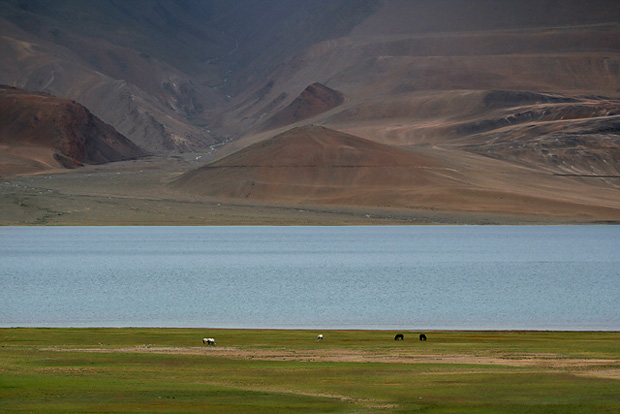
Tso Moriri Lake
Our initial plan was to look for seats to share in a returning cab or even a small truck. Since this was festival time, the inflow of tourists was higher than normal and there was a good chance to find taxis returning to Leh with some seats empty. After looking around at all the hangouts in the village, we found a group of four Israelis willing to take us back with them to Leh. These people had taken a cab from Leh to Tso Moriri and were planning to get back to town next morning, stopping for a night at Tso Kar. It suited us well. We had not planned a visit to Tso Kar earlier, but it would be good to get a glimpse of the lake, even if it is for just one evening. Although it was not necessary, we informed their driver Tashi that we would be joining the group on the next part of the journey. In a semi-inebriated condition that evening, Tashi smiled and nodded cheerfully.
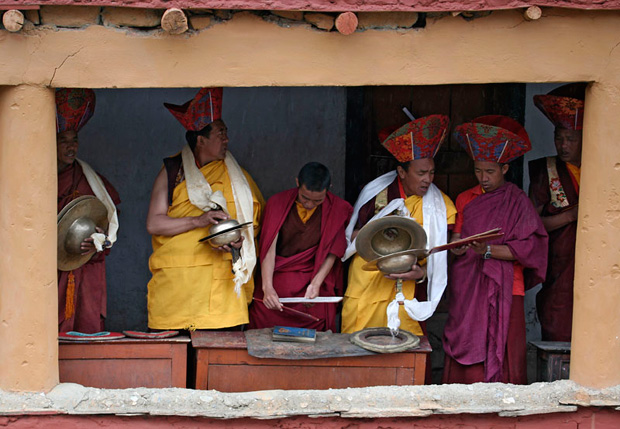
Celebrations – Korzok Gustor Festival on the banks on Tso Moriri
The next morning, we packed our bags and waited to hear from the group of Israelis when they are ready. At about 11am, one of them walked into our guest house to deliver a bad news – ‘Tashi is refusing to take you two in the cab!’ For a moment we were worried. Because we had managed to get transport yesterday, we did not bother to look further. It meant getting stranded in Korzok for at least a day, or more if there is no transport available even on the next day.
What ensued was a long argument between Tashi and us. His case was that the cab, a Tata Sumo, would not be able to pull a load of additional people in the mountain roads. It did not seem to make sense. Drivers take 10 passengers along the Manali – Leh highway in Tata Sumos every day, while here it would be just six people including us today. And if he did not want to take us, he should have refused yesterday evening when we volunteered to inform him about us joining the group. After a short exchange of words with Tashi that actually left us struggling to breathe in Tso Moriri’s this air, Tashi suddenly obliged but refused to talk to us any more.
Later in the evening when we reached Tso Kar, Tashi reminded of us struggling to accelerate in a steep slope on the way where he had to ask all of us to get out and walk a short distance. Tashi had attempted to go off road and take a steep short cut, but the cab had refused to go further. He recalled the incident in support of his argument in the morning. Now in a better mood, he also said he was very upset because we had raised our voices in Tso Moriri.
That morning, we had tried to keep a calm and worked hard to keep our voices low even when we expressed unhappiness with Tashi and argued that he can’t refuse to take us. But having walked briskly to his cab and blabbering a few sentences breathless, talking further was a struggle and we might have sounded discourteous as we spoke with difficulty, almost chokingly. I explained it to Tashi and apologized if we had sounded rude. In a region where people are so friendly that anyone getting angry is almost unimaginable, we might have sounded as if we had crossed some limits.
We finally made amends with Tashi, who opened up a bit after this conversation in Tso Kar. But it still remains a puzzle why he agreed to take us in the first place and refused later. Perhaps it was the effect of whiskey, which kept him in a generous mood when we spoke to him first!
About two weeks after we left Tso Moriri, we were to have some more uncomfortable experiences (link to a really long post on a trek in Zanskar, part of which are some unhappy experiences) while trekking in the heart of Zanskar.