When I tried to make a list of things that I wished to do two years ago, working with an NGO was one of them. Having no clear ideas of what to do and whom to approach, I looked up on the internet as usual. I came across a few NGOs listed on the web, and spoke to two-three of them. Of all of them, what quickly came as my choice for association was Youth For Seva(YFS).
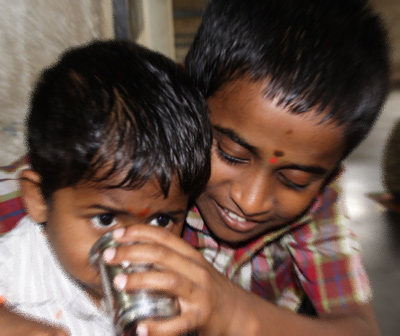
YFS had a different model of working and did not work on any projects on their own. It was an organization trying to leverage the power of web to connect volunteers and NGOs by facilitating volunteer registration through their website. Once a volunteer registers, someone from YFS would get in touch and understand his or her interests, and accordingly redirect the registrant to one of the associated NGOs.
When I first spoke to them, they had just started with two people doing all the work. Venkatesh Murthy, the founder, had rich experience in working with NGOs and independent social work. Murthy, along with Akhilesh, one of the early members of YFS, roped in NGOs, counseled every registered volunteer personally and routed them based on interests. But within a year, Youth For Seva was growing too fast and they had to have people working full time. Murthy himself decided to quit his work in the IT industry and decided to work full time with YFS for a few years.
In the course of their growth in the two years, they innovated many ways to ensure scalability. The operations were divided into zones within Bangalore, and each zone had a moderator who took care of the activities in the area. They got college students to spend time working during vacations and help with operations. They also roped in a few people to work full time at YFS.
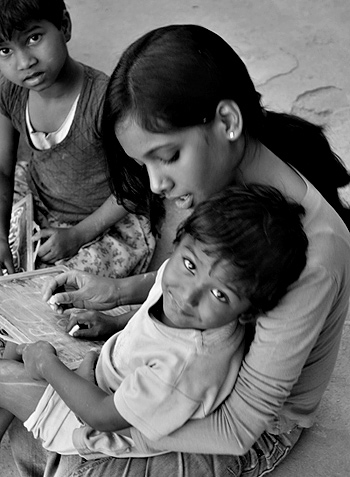
Over last two years, more than a thousand users registered with Youth For Seva, occasionally making it hard to place them with NGOs. A large number of net-savvy people from the IT industry who wanted to make a difference to the society, but did not know how to, found YFS as a good platform to begin with. Trying to place the growing number of volunteers, YFS decided to take up projects on their own.
Today, YFS works with 3,000 volunteers and 30 NGOs. Besides working with other NGOs YFS also conceives and executes projects on their own. Volunteers are working with 30 government schools independently. The current project they are working on involves sponsoring the education of 1500 underprivileged children who have been already been identified through aptitude tests. The sponsorship costs Rs.500/- per month or a lump sum amount of Rs.6,000/- for the year. Read Sponsor A Child microsite for details. Donors can donate online through bank transfer, send a cheque, or contact coordinators for more details.
If you would like to volunteer with Youth For Seva, register with your details on their website.
“Although I had thought myself hard to impress after traveling for decades across the Himalayas, I heard a gasp escape my jaded lips, and realized I was glimpsing a location even more unlikely than that of the Potala Palace in Lhasa, and a temple even older than that wonder of the world. ” – Pico Iyer on Lamayuru, Ladakh.
Going to Ladakh was a long standing dream. Friends would come back from their two-weeks in Ladakh, some on a biking trip and some taking it more leisurely, but everyone returning with loads of praises on the mountain region. The photographs spoke of the landscapes even when people did not say much. Every time I read someone’s stories or saw some pictures of Ladakh as I gallivanted in the cyberspace, the longing would re-appear and linger on. I wished to see the rare landscapes where one can drive for hundreds of kilometers without seeing any habitation. I would sit for hours making plans for the coming summer, letting Ladakh take over my mind.
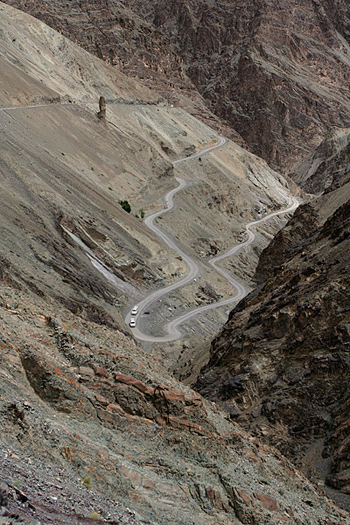
The roads of Ladakh
Ladakh had no parallels. In there was a lake that stretched more than 100km across two countries at an altitude of more 14,000 feet. It had mountain ranges standing higher than 18,000 feet, where one can simply drive through. There was more than 400 kilometers of arid landscape where not a single soul lived. Surviving there was an ancient Buddhist civilization that was like a little Tibet. It was the shangrila of travellers and an enigma for everyone. Everything I heard about it added to my yearnings.
I made the first serious attempt to travel into Ladakh two years ago. Hauling myself to Manali, the gateway to Ladakh, I could barely wait for the next two days I would be there to make plans and arrange logistics on the long journey to Leh. But Mangal Singh, my contact in Manali and the man whom we trusted to take us through these Trans-Himalayan landscapes had other plans for us. After listening carefully to our plans, knowing about the time we could spare (less than 10 days) and understanding our interests, he laid out a plan that we could not say no to. He suggested that we go to Spiti Valley, which we accepted after listening to his argument. Lahaul and Spiti was an overwhelming experience, but it prolonged my wait to get to Ladakh.
The next year, I came back with plenty of time in hand. I had quit my day-job and was armed with unlimited time. I was going to take it easy, giving Ladakh as much time it needs to explore fully from one end to other. I was back again in Manali. This time the journey would go step by step, stopping anywhere we wished to on the way and taking time just to get across the mountains to Leh.
I did manage to spend the planned two months wandering the mountains of Ladakh, seeing every corner of the region by every possible means. We took a marathon jeep ride lasting more than 12 hours sitting shoulder to shoulder with ten more people. We traveled in buses whose drivers were trained to take the steep and curvy roads with great ease. We took a taxi when nothing else was an option, and rode on bike over the high passes and across the streams. The journey took me through thousand year old monasteries, gigantic brackish lakes, ancient civilizations that persisted through the changing times, high passes and arid landscapes.
The long journey however, started with a long wait at the grimy bus station in Manali, reminiscent of the Indian plains.
To be continued.