Spangmik is as remote that a village can get but still remains accessible by road. It is almost like being at the edge of the world. A small army check-post bars civilians from going any further towards the border of Tibet. The mountains faraway cause an intrigue generated by lack on information on this sensitive region, making me wonder how the terrain at the other end of the lake would be.
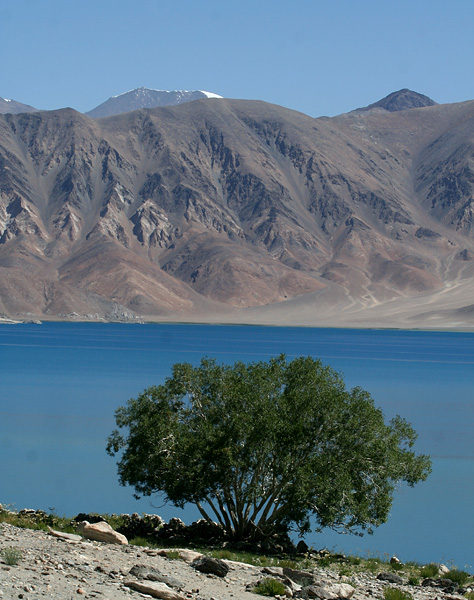
Pangong Lake
The village is located on a narrow stretch of land between the mountains and the lake, with just seven families that make a living by rearing pashmina goats and growing barley during the short summer season. These days, some families rent out a room or two for tourists while a few others work with hotels coming up in the area. Summer is a busy season where a lot of things have to be done together – tending the fields, looking after tourists, taking the goats out for grazing and collecting all necessary resources for a long winter.
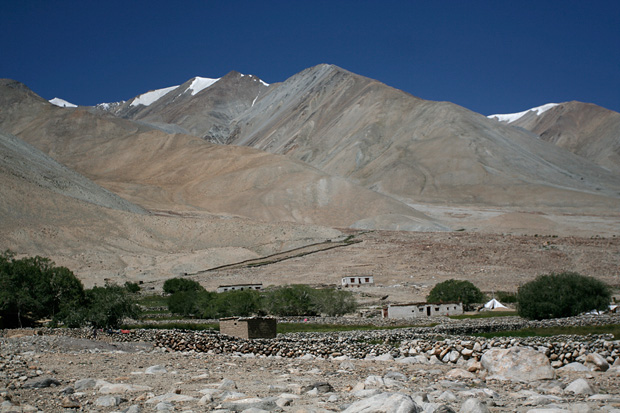
Spangmik Village and the mountain peaks.
Kunchok, the caretaker at our guesthouse gave me some insights to life at Spangmik through the year. He tells me that they grow barley in summer, but not much crop can be extracted from the earth here. Every family owns a few dozen pashmina goats that generate most of their income. “Traders come from all over North India to buy wool of pashmia goats,” he says, “we recently had someone coming from UP.” The wool is sent to Kashmir and Himachal where it is woven into fine cashmere shawls, to be sold all over the world.
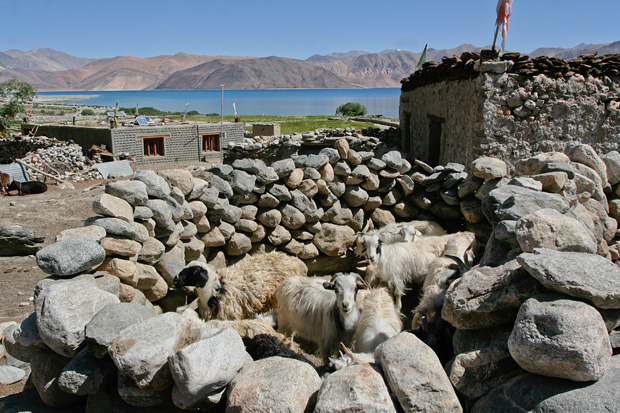
The Pashmimna Goats, Spangmik Village and Paangong Lake.
Most of the activity in Spangmik happens in summer, while winters are months to be spent doing very little work. It is a time when the weather is harsh, the land is snowbound and the lake is frozen. “There isn’t much to do during the cold days,” Kumchok tells me, “we will spend most of our days staying indoors.” But still, they are not the days spent completely idling. The sheep have to be taken care of and the meals have to be cooked, which is a lot of work in itself when you don’t have too many resources at hand. But compared to the busy summers when there is simply too much to do, they have a lot of free time in the cold days.
Unlike many parts of Ladakh that get cut off during the winter months, Spangmik remains connected with Leh by road through the year. “The road through Chang La remains open,” says Kunchok, “we are very close to the border. So, Indian Army ensures that this place is always accessible.” The sensitive border needs to be monitored continuously despite the difficult conditions in winter. “Not many people come here during winter,” Kunchok continues, “but a few tourists do turn up once in a while. The lake will be frozen solid and people even drive their cars on it.”
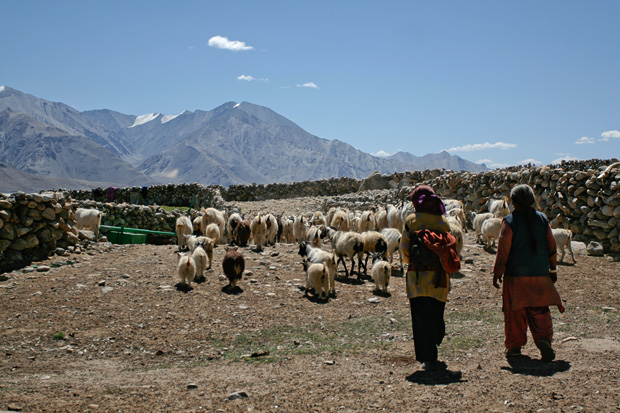
Herding the Pashmina Goats
One of the mornings when I was at Spangmik, I went for a walk in the village to take a look at the goats. They stay confined to small enclosures during the nights and are herded out to the pastures for grazing in the day. They rush out when the gates are opened in the morning, eager to get out and feed through the day. It is a bit of chaos as they run around looking for whatever little grass nearby, but an order is restored very quickly and they march in unison towards the mountains, driven by their herders. I felt an urge to go with them and spend the day in the pastures, but I have only three days in Pangong that I prefer to spend ambling near the lake.
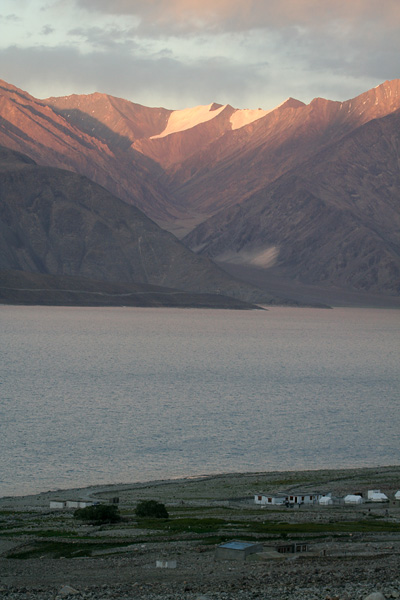
Spangmik Village and Pangong Lake during sunset.
Although I did not make it into the hills with the goat herders, one evening I climbed up one of the lake-facing slopes to the dwelling of a lama who lived alone in a small hut. Unlike many places in Ladakh, Spangmik doesn’t boast of a monastery of its own. The population here is too small to establish and sustain a monastery, but the lama takes care of spiritual needs of the villagers. It is an hour long climb on a gentle slope along a pebble-ridden path crisscrossed by many streams. Once at the top, I was hoping to get a panoramic view of the lake, but the hills closer to the lake limit our views on either side. Yet, it is a different perspective seeing the lake from high up and getting a feel of the scale of the landscape around us.
The remoteness of Spangmik is all the more evident when seen from my high vantage point. The few houses are scattered like dots in a landscape dominated by the long blue stretch of the lake and the barren mountain slopes. It looks like a place out of dreams that is too unreal and too beautiful to be true.
Our three days in Spangmik seemed too short a time to get a good feel of the place. The peace of Spangmik takes a few days to set in and become a part of our system. The peace of the village can slowly let the complicated problems of a larger world go away and have a calm influence over mind and body. But the lure of new things, new places and a desire to be everywhere is hard to resist. A monastic festival at another lake-side village was a temptation that could not be resisted. We left Spangmik, this time not taking the trouble of treading across Pagal Nala, but simply loading the bike on a Gypsy and getting it across the troublesome channel.
After a long and difficult bike ride from Leh to Pangong, we settled comfortably at Spangmik Village and spent the next few days gazing at the lake and admiring the landscape.
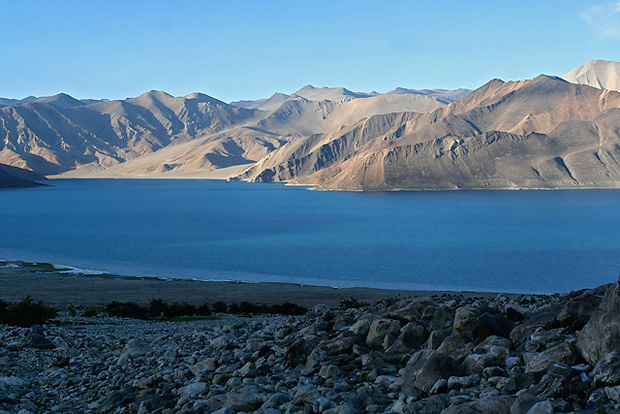
Spangmik is a small village with a handful of families spread across a narrow stretch of earth between the lake and adjoining mountains. The blue expanse of the lake, stretching for more than 100km and spread across two countries, clearly dominates the local landscape. An army truck driver who conversed with me on the day of our arrival pointed at the distant mountains to the east and said, ‘do you see those faraway peaks? They are in China.’
Perhaps very few places on earth can boast of a landscape of such immense beauty. Who would imagine seeing a 135km long deep blue stretch of water trapped in the middle of a stark mountain landscape at an altitude of 14,000 feet? Despite having seen it in pictures, having read a great deal about the landscape of the region and fully knowing what to expect, its expanse and beauty still took me by awe and surprise. I wonder how the first explorers who came to here without a map would have felt on seeing this giant blue strip of water that appears unannounced suddenly after climbing over a ridge.
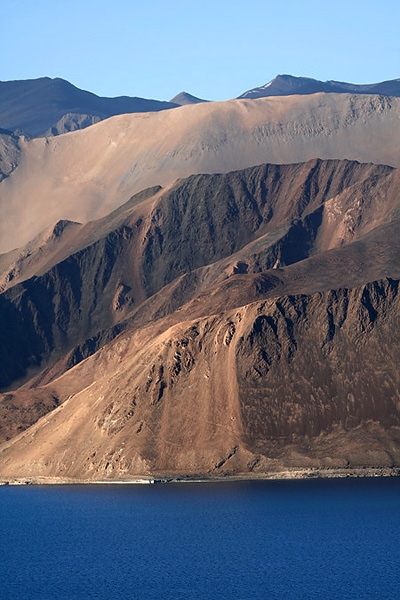
Pangong is a brackish water lake located in Changthang Plateau bordering Tibet. Wiki says that the lake once ‘had an outlet to Shyok River, a tributary of Indus River, but it was closed off due to natural damming.’ A striking feature of Changthang region is the presence of several such brackish water lakes, including Tso Kar and Tso Moriri besides a few smaller ones. Nomadic herders called changspa inhabit the grass-laden flat lands of Changthang and make a living by rearing Yaks and Pashmeena Goats. Spangmik Village is a permanent changspa settlement next to Pangong, where the inhabitants are now beginning to find additional income from tourist inflow.
Spangmik is one of those places where you don’t feel a need for something to keep you occupied; the lake and the mountains make sure you are kept happy and contented in the middle of them. Here is my journal entry from the days I spent at the lake.
“..the lake spreads so long that I can’t see the other end. The place is beautiful enough that we decide to stretch our stay by a day more than we had initially planned. We could stay longer, but we intend to attend a festival a few days later that requires us to leave.
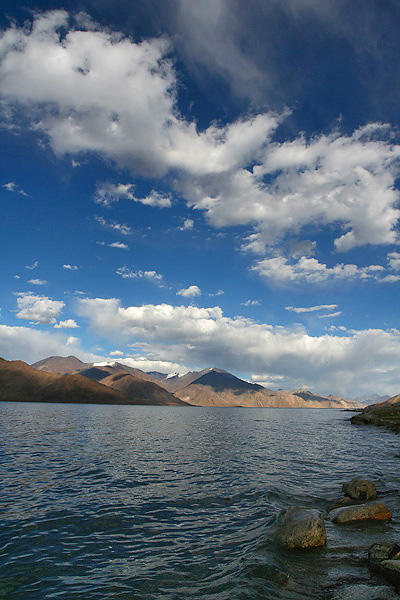
The lake keeps changing its shade as the day progresses. It has deepest hues of blue when the sun is high, with a turquoise shade near the bank and deeper hues in the middle of the lake. It looses colour later in the day and turns dull as the sun moves towards the horizon. At times when there is no wind, the clear surface of the lake reflects the brown mountains surrounding it. The water near the shore occasionally turns murky when there are strong waves, but clears up in no time. Sitting and gazing at the expanse of the lake and watching small waves hitting the shore, I look for small flat pebbles and bounce them off the lake surface, counting the number of jumps it makes on the water before sinking.
Snow has melted on most of the peaks to the other side of the lake except for small patches where the peaks slope gently. The mountains are in various shades of brown, their colours doubled by the play of light and shade created by small patches clouds blocking the sun. Waterways on the slopes formed by melting snow have made striations along the depressions in the slopes.
It is a sunny day, but the cool breeze from the lake makes me wish I had some warm clothes on. I look for some life in the lake, but there is none to be seen. After hours of staring at the lake, I see a school of tiny fish arrive from the depths of the lake. They are thin, hardly an inch long and barely visible. A small army of them kept arriving and swam near the shore in a nonchalant manner, but disappeared quickly when they saw me move. Up in the sky, I kept seeing brown headed gulls flying from one end of the lake to other, occasionally landing gracefully on the water. They would fly far into the mountains towards Tibet, caring little about borders, hostilities and access restrictions that we humans have imposed on each other. The other commonly seen inhabitants of the lake are bar-headed geese, but just a small family is all that I could see while I am here.
I dip my fingers into the water, hoping it is not frigid and doesn’t numb my fingers. It is not. The water freezes over during the winters and, as locals say, one can drive on the frozen lake surface during peak winters. But there is no sign of that cold now. I put a few drops of water on my tongue to check how salty the waters are. It is barely salty, but has a taste that indicates the hardness of the water. Knowing that the water is not cold gives me some ideas: how about going swimming? I do see a few people swim in the lake later, but the thoughts of getting serious sunburns keeps me out of it.
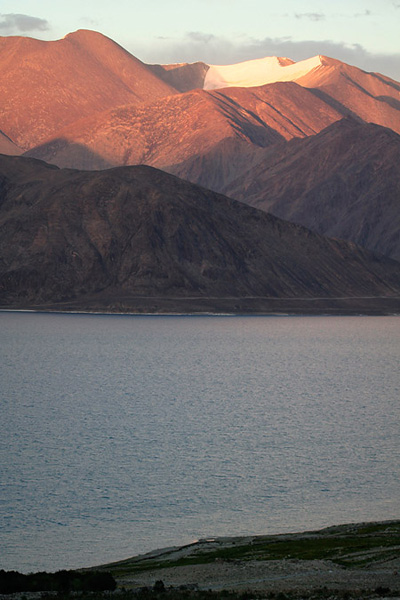
The sky and the clouds play the same game at Pangong every single day. Mornings begin with a clear blue sky with not even a small white dot to see anywhere from horizon to horizon. A rim of orange appears in the eastern ridges and rest of the landscape breaks into a dull dawn. The lake is dull grey, but slowly acquires its blue as the sun comes up. Clouds begin forming slowly and settle comfortably on the peaks to the east. They gather more moisture with progress in day and form an orange crown over the peaks during sunset. But for reasons I can’t comprehend, the sky to the west of the lake remains a clear blue but for a few small patches of puffy clouds. As the sun makes his way past the mountains to the west in the evening, the clouds begin to disintegrate and fall apart, making way for another clear morning next day…”
Next post: Journal entry on Spangmik Village.
The bike troubles were not meant to end soon. During the struggles in getting the bike up and running, the rare breaks had somehow stopped working. It was getting dark and there wasn’t much time left for us to inspect and fix the problem. We treaded in a slow pace using front-wheel breaks and made it to Thangse just before dark.
The break problem turned out to be easy to fix and took no more than a minute. But we had a bigger issue to address next morning.
We were warned earlier by jeep drivers about a stream-crossing few kilometres before Pangong Lake. The bridge across the stream had collapsed long ago, thanks to the ferocious currents. The stream would look like a pretty brook running down the mountain in the early hours, but as the day progressed and sunrays melted more ice on the slopes, water would rise to chest levels, making it impossible to cross. Its unpredictability had earned it the name ‘Pagal Nala’ – mad stream.
It seemed like a simple task to leave early from Thangse and make the 40-kilometer journey before the water level rose. But crossing a big stream usually came with its share of troubles. The path could be strewn by boulders, slippery rocks and shifting sands that could make things difficult. We had no idea how hard it would be, but there wasn’t an alternative but to try it out.
The road from Thangse turned out to be unusually green and beautiful. Excellent roads helped me forget the pains of riding and focus on the scenery instead. The narrow valley was filled lush grass, supported by a stream that ran in the opposite direction. The near-flat terrain occasionally became marshy with small streams criss-crossing the road. We saw cows and horses grazing peacefully on the way, their owners nowhere in sight. Himalayan marmots played in the grass with child-like enthusiasm. They would look cautiously from their hole before getting out to wrestle playfully with each other. I am told that the marmots have become tame enough to accept food from tourists in these parts, but none came up to us with a begging bowl. We were in a hurry as well, anxious to get across Pagal Nala before the water level started rising.
Water was less than a foot high when we got to the stream, but it didn’t look like an easy crossing. With the unpredictable nature of the nala, BRO made no attempt whatsoever even to make a temporary road across the stream. If they had ever done so, the mad stream has done sufficient hard work to ensure that there was no sign of it left.
A few vehicles were already parked near the nala before we got there. Some had given up and asked the tourists to walk across, while a few others were contemplating on crossing. The stream bed was a fifty-meter wide boulder strewn expanse with no definite clearing anywhere to let vehicles to pass. Two-wheel drive vehicles like Qualis and Innova made no attempts to get past, while a few Gypsys laboured hard over the stones.
I could not make up my mind on what to do next. A smaller bike would have had no trouble wading across the nala. You could simply push it across and even lift it over the stones if needed, but something like a Thunderbird came with its disadvantages. As we waited at the edge of the stream wondering at the next step, unsolicited advices came on our way. ‘You will never make it,’ said someone, while another said ‘it should not be a problem.’ An army officer in civilian clothes looked at us and said that we were attempting something suicidal. It did not look like an easy job in any case, but we decided to take the plunge.
We trod slowly and made it to half-way mark with some difficulty. It seemed like we will make it in no time, but quickly got stuck at the main channel, stopped by big stones that blocked our way. The bike too, decided that it is a good time to stop co-operating with us. Each time I started and revved the engine, it would struggle for ten seconds and go off again. For sometime, we were stuck on the main channel and risked the possibility of water entering through the silencer that was just an inch above the flow. Add to all this, the chill of the water was affecting my feet immersed in it as I tried to balance and support the heavy bike.
This repeated for a few minutes when the army officer took pity on us and came back to help. He ‘ordered’ us to dismantle all our luggage and instructed a jawan standing nearby to assist us. The jawan, with his perfectly polished leather shoes stood on a rock wanting to help, but couldn’t afford to get his shoes wet. As the engine failed to stay alive despite repeated attempts, he asked me to switch it off and wait for a few minutes. ‘The engine is heating up and going off,’ he told me, ‘wait till it cools a bit.’ This seemed to work and we were now guaranteed of the bike’s horse power. We managed to get across the main channel, but there were still many boulders to cross before we reached the other end. By this time, we must have spent good thirty minutes struggling in the middle. A few onlookers now came to help, pushing the bike bit by bit and getting it closer to the other side. A hefty jeep driver took over the bike from me and made the final effort to take it across. A big ordeal was over, but it was still not the end of all the troubles.
The struggles with pagal nala had left me tired and drained all my energies. Another smaller bridge a little ahead had recently given away and we were forced to tread slowly and carefully on an alternate track full of sand and gravel. Somewhere at the end of this dirt track, when we just got back to smooth tarmac road again, we had our first sighting of Pangong Lake.
The lake appeared as a small blue strip barely visible in the middle of the mountains. Its colours were of a superb deep hue that I had never seen anywhere else before. We had finally set sights on our destination. The effort, the struggle with starting the bike yesterday and efforts of getting across pagal nala were worth every single drop of sweat. It was moment of joy worth working for.
We struggled further for another half hour, riding through gravel, small streams and poor roads to reach Spangmik Village on the bank of the lake. The next three days were to be spent gazing at the lake and the mountains beyond, doing little else but admire the landscape.