Ladakh – Bike Ride from Leh to Pangong Tso – III
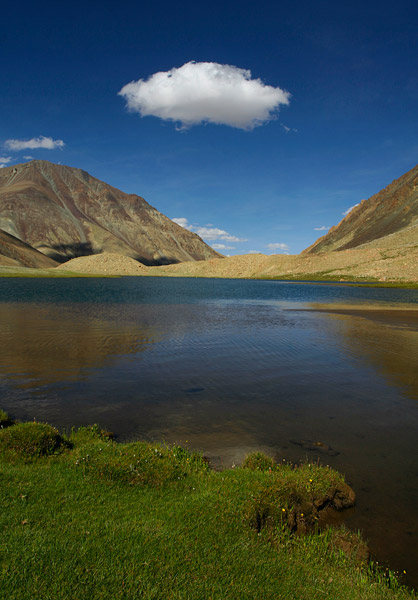
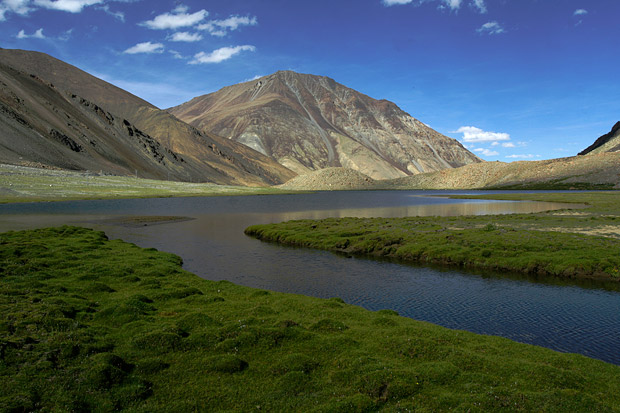
We rode past the unnamed lake, descending steadily since we left Chang La. I turned off the bike’s engine and cruised gently downhill for nearly ten kilometers. When the road became nearly flat again and the bike lost its speed, I engaged the gears, trying to bring the engine into life. In response, instead of blasting Thunderbird’s trademark knocking sound, the bike coughed, sputtered and slowly came to a halt. We were in trouble!
By this time we had come nearly two hours away from Shakti, the last village on the other side of Chang La. The next village—Thangse—was thankfully not so far, but a good 30km away and too far to seek help. We were stranded in the middle of the mountains with a 200km monster of a bike that refused to do its job. It was already beyond 3pm and we did not have much time to find help before it got dark.
I made repeated attempts to kick-start the bike in the vain hope that it may show some mercy on us. If you have handled a Bullet, you know the kind of effort needed to coax one of those unwilling bike to life even in normal terrain. Out here in the mountains of Ladakh where the air is thin and slightest effort leaves you panting for breath, I had to give up in no time. An attempt to push-start did not work either. My first instinct was to look at the spark plug, but we did not have tools needed to take it out for inspection. Back in Leh when I hired the bike, I had asked the vendor to give me a tool kit. He had laughed in response and said, ‘what would you be able to do there if the bike breaks down? Just flag a truck and get it shipped back to Leh.’ He was more or less right: my knowledge of bikes was only slightly better than my knowledge of a space ship’s engine.
I resigned from all actions and let fate decide the next course of action. The only thing I could think of doing was to stay optimistic. Perhaps someone nice would come on the way and help us out, a truck might take us to Thangse where someone from the army might be able to look at it, or at best a jeep driver passing by would inspect the bike and bring it back to life.
Thankfully, it did not take long for help to arrive. It was hardly five minutes before a truck arrived from the opposite direction. The driver stopped to ask what the problem was, and pulled over to take a look at the bike. In the next hour or so, I was to see how helpful the people in these parts can be. The driver and a bunch of labourers in the truck struggled to get the bike working, as if it is their own problem.
Everyone took their turn inspecting the bike and trying to kick-start the engine, but nothing much happened. It roared once a while and got me excited, but would not last more than a few seconds before it went silent again.
I had presumed that they would try for a few minutes before giving up and offering us to load the bike into the truck and take it back to Shakti Village or Leh. But the stayed on, trying to help us with the bike for more than an hour. In the meanwhile, we discussed our choices, which included staying at a parachute tent a little ahead for the night or to get back to Shakti on the truck.
We could not really come to a consensus on staying at the parachute tent. Waking up next morning, we would be in no better position than today and may have no choice but to take a truck back next morning. It would be a pointless effort. Going back with the truck was an easy thing to do, but having come three-fourth the way to Pangong, that would cause a terrible disappointment.
I have a disease that sometimes surfaces when I am in faraway places, especially in the mountains. When I am closer to the destination where an excitement awaits me, few things can force me to stop and head back. The thoughts of disappointment that I would suffer later keep me going and do all that I can to reach the destination. A few years ago, when I was on a 6-day trek to Goecha La pass in Sikkim, I was in a similar situation where I had difficulty in walking the last few kilometers to the pass. It was my first Himalayan trip and the cold was troubling me. I felt mildly feverish the night before and had decided not to walk the last stretch. But next morning, I found myself unable to hold back and decided to walk slowly to the destination. I must have taken thrice the normally required time, but had finally made it to the pass.
A similar emotion conquered me on the way to Pangong. I would not have been able to take the disappointment of not visiting the lake. So we kept toying with our options though it would have been prudent to load the bike in the truck and head back. As the workers continued their effort to start the bike, we struck a conversation with the truck driver. Like most people who come to Ladakh from outside for work, he too did not seem to like the place much. ‘What is there to see in Ladakh? Why do you come here?’ he asked us repeatedly. He continued, helpfully suggesting us of a better place to visit. ‘Go to Chumathang,’ he said, ‘you will see hot water coming out of the ground there!’ Srinagar was another place he thought was worth a visit. ‘It is green and beautiful,’ he said, ‘the mountains are all bare in Ladakh.’
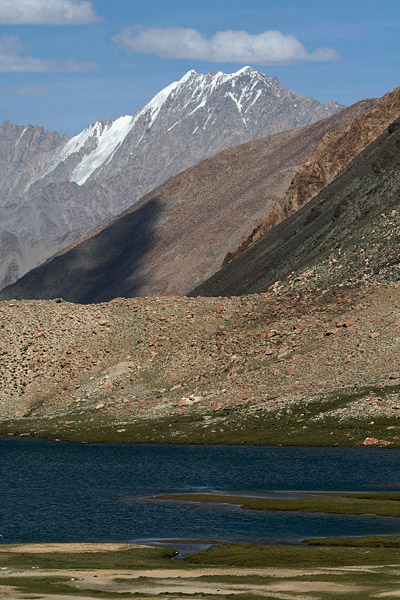
As the bike did not seem to come alive even after an hour, I drifted away from the problem and into the scenery around. A stream ran parallel to the road, carrying clear waters from the snow-melt. Lush grass and an eruption of purple flowers spread on a thin line at the edge of the water. It was a narrow valley with stark slopes on either side, with just one tall snowy peak glowing in the evening light. I was instantly in love with the place and wished I could spend the night right there.
In the meanwhile, a decision was finally made to put the bike on the back of the truck and head back to Shakti Village. It looked like there was no other choice left. Several hands joined together as we tried to lift the bike up. But the Thunderbird is no small bike and it is not easy for even half-a-dozen people to lift it by 5 feet. The task at hand was not easy and we had to give up and look for smarter ways to get the bike into the truck.
We made another attempt at starting the bike again, without much success. But even at a time when they tried all that they can and there was nothing much to be done, the truckers stuck with us and pondered on possible options instead of moving on and leaving us to handle the problem ourselves.
A bunch of bikers arrived as we were pondering on what to do. As luck would have it, one of those guys happened to be a mechanic. He spent a few minutes with the bike and quickly unearthed a loose-contact in the wires connecting the spark plug. The next moment, as if by magic, the thundering sound of Thunderbird filled the valley like music to my ears!
We continued our journey towards Thangse along with other bikers. But as it turned out, our troubles with the bike was far from over!